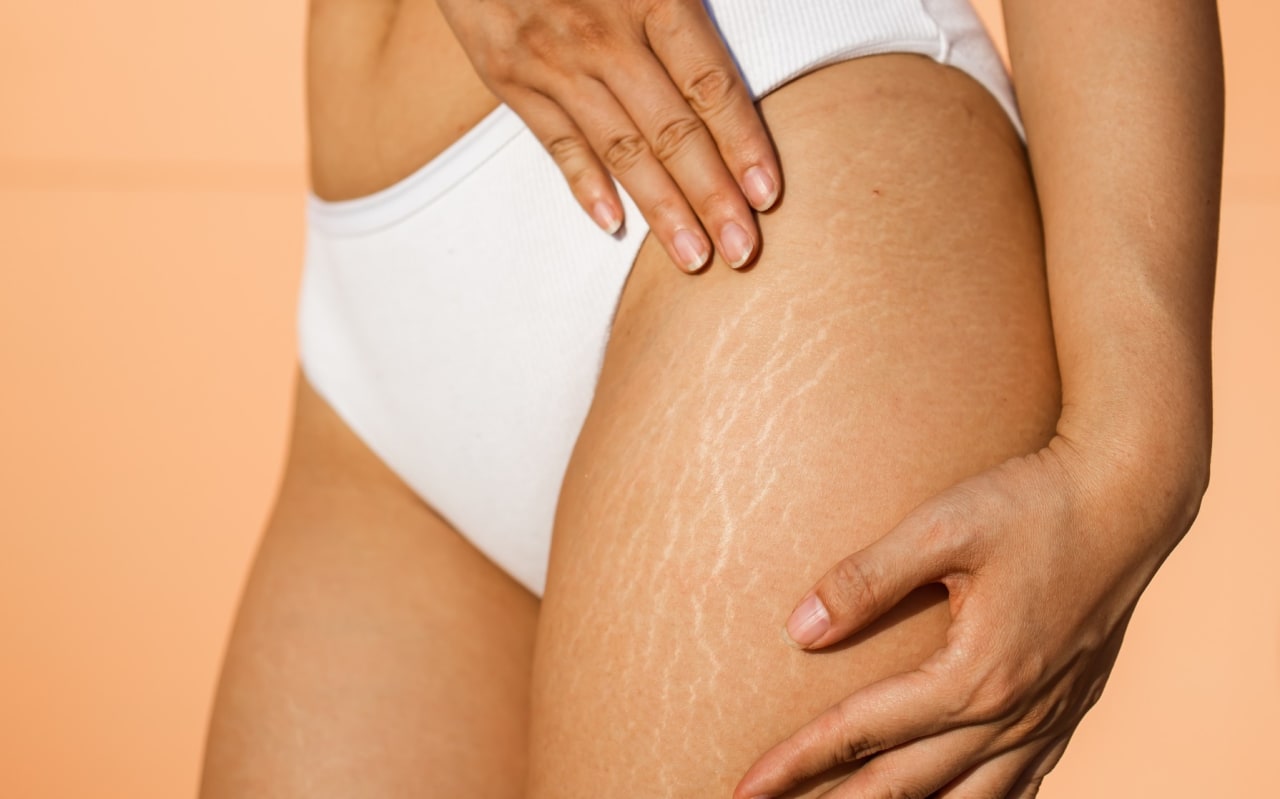
Stretch marks, or striae distensae in scientific jargon, appear as parallel, irregular striae on the skin, varying in length and a few millimetres in width, resembling small "welts". Initially reddish-purple and inflammatory, they gradually take on a pearly colour slightly lighter than the skin. They appear on areas of the body likely to become distended (abdomen, breasts, thighs, buttocks, hips, upper arms, etc. ), when the skin is subjected to significant and rapid stretching . The elastic fibres in the dermis break down and the skin "cracks".
This can happen during pregnancy or adolescence. Stretch marks can also appear in the event of rapid weight gain, or as a result of certain sports involving a rapid increase in muscle mass (bodybuilding, etc.).
In addition, high levels of cortisol in the body encourage the appearance of stretch marks because it reduces the production of collagen, which maintains the skin's elasticity. High-level athletes or people taking corticosteroid medication may be particularly prone to stretch marks. The appearance of stretch marks outside the periods of pregnancy, puberty or rapid weight change should be reported to a doctor, as it may be a sign of a condition known as Cushing's syndrome.
Apart from these particular cases, stretch marks are a common condition with no consequences other than their often unsightly appearance.