

Guide to essential oils

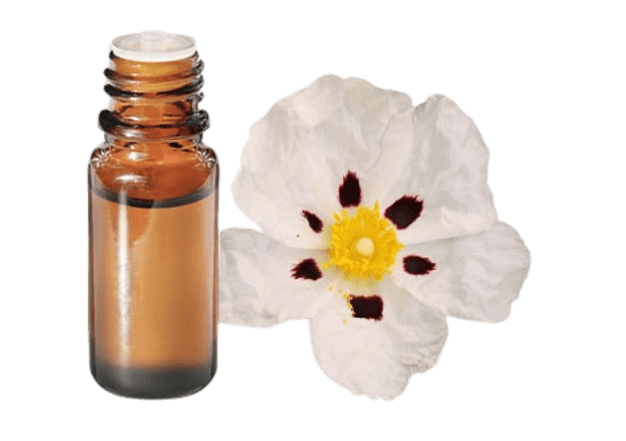
Essential oil of Gum Rockrose

Known for its powerful astringent and regenerating properties, this oil is ideal for combating the signs of ageing. It is also recommended in aromatherapy to regulate the body's natural defences.

How to use

  • Skin application and massage

    Skin application and massage

    Suitable

  • Cosmetic active ingredient

    Cosmetic active ingredient

    Suitable

  • Food grade

    Food grade

    Possible but not recommended

  • Diffusion

    Diffusion

  • Aromatherapy bath

    Aromatherapy bath

Features

Properties and uses

Precautions

Find out more

Features

Production process

Complete steam distillation

Part of the plant used

Leaves, twigs and branches

Botanical name

Cistus ladaniferus

Warning

The properties, information and methods of use below are quotes from reference books or websites on aromatherapy, hydrolatherapy and phytotherapy. This general information is provided for informative purposes only and in no way constitutes medical guidance. Under no circumstances can this information be used as a substitute for a medical diagnosis, consultation or follow-up, nor can it incur our liability. We recommend that you consult the guide to essential oils before using them, so that you are aware of any precautions that need to be taken. If in doubt, consult a doctor before using essential oils.

Properties and uses

Gum rockrose essential oil is traditionally used for: scarring, couperose, rosacea, abrasions, sores, cuts, bedsores, immunity and nosebleeds.

Health

Wellness

Beauty

Find out more

Known as a haemostatic, Gum Rockrose essential oil is traditionally used in aromatherapy to stop minor bleeding, treat small cuts and promote healing. It is also renowned for its beneficial effects in certain autoimmune or viral diseases.

Properties

In health, Gum Rockrose essential oil is recognised for the following properties:

  • Antiviral, anti-infectious, antibacterial

  • Haemostatic, stopping minor bleeding

  • Immunomodulating, it is known in aromatherapy for regulating the immune system.

Uses

Gum Rockrose essential oil is traditionally used to improve the following:

  • Bleeding, nosebleeds

  • Haemorrhoids

  • Small wounds, cuts, difficult healing, blisters

It is traditionally used to improve the following conditions:

  • Autoimmune and viral diseases

  • Chickenpox, measles

  • Reduced immune defences

Synergies

Purifying action: essential oils of Niaouli, Tea tree

In practice

As an adjunct to treatment for viral and immune pathologies (in conjunction with medical monitoring): Mix into your oily preparation. Massage along the spine.

To help stop minor bleeding: Mix into your topical preparation

Precautions

  • Avoid during the first 3 months of pregnancy, while breast-feeding and for children under the age of 3.

  • Do not use Gum Rockrose essential oil on a large wound.

  • Not recommended if you are taking anticoagulant medication (possible interaction).

  • For internal use by therapists only.

  • Keep out of reach of children.

  • Certain natural compounds contained in this essential oil may present a risk of allergy for certain sensitive individuals when the essential oil is incorporated into a cosmetic composition (according to the 7th Amendment of the European Directive on cosmetic products (2003/15/EC)): limonene and, to a lesser extent, linalool.

  • As a general rule, always test-apply your mixture in the crease of the elbow at least 48 hours before use.

  • For use as a cosmetic ingredient, please refer to the specific precautions.

  • Dangerous. Follow the precautions for use.

  • Danger. Flammable liquid and vapours. May cause skin allergy. May be fatal if swallowed and enters the respiratory tract (if accidentally swallowed, do not induce vomiting). Causes severe eye irritation. Very toxic to aquatic organisms, causing long-term adverse effects (in the event of massive spillage of the product into a watercourse).

Find out more

Gum Rockrose is a shrub mainly native to Spain and the Mediterranean region. Its Latin name (Cistus ladanifer) comes from the Greek "kistè", meaning "capsule" , because of the shape of its fruit. The special feature of this plant is that it is covered with a film of highly fragrant resin called "labdanum", which prevents the plant from drying out. This labdanum was used by the Egyptians for its fragrance and its many virtues. Rockrose is in fact one of the rare plants to have the amber scent so dear to perfumers.

Equivalents

Essential Oils

1 ml = approximately 35 drops (with our Aroma-Zone dropper caps)

Carrier oils

1 pump (Aroma-Zone aluminium pump) = approx. 0.15 ml

Mass / Volume conversion (for a liquid)

Mass (g) = Density x Volume (ml) at 20°C

Further information

1 full teaspoon = between 3 and 4.5 ml

1 full tablespoon = between 7.5 and 10 ml


However, these spoon ratios depend on a number of factors (e.g. viscosity of the liquid, temperature, depth and size of the spoon, rheological behaviour of the liquid), and we strongly advise you to use precise measuring equipment, such as graduated test tubes, graduated pipettes, and precision scales.

Aromatherapy recipes from the bibliography

EO = Essential Oil VO = Carrier Oil or Macerated Oil

Nosebleed (A. Maillard)

Health & wellbeingVarious

  • Gum Rockrose essential oil, cistus ladaniferus 1 drop

Use: place on a piece of gauze and insert into the bleeding nostril. Avoid using cotton wool, which can leave fibres in the nose.

Extract from the book "Le Grand Guide de l'Aromathérapie et des Soins Beauté Naturels", by Aude Maillard and Aroma-Zone, published by J'ai Lu, 2016 Aroma-Zone Note: Do not use when pregnant or while breastfeeding, or on children under 6 years of age.

Rosacea (D. Baudoux)

Health & wellbeingSkin problems

  • Provençal cypress essential oil 2 drops

  • Helichrysum italicum essential oil (Immortelle) - 1 drop

  • Cistus ladanifera essential oil - 2 drops

  • Egyptian Rose essential oil - 4 drops

  • Calophyll Inophyl oil - 4 drops

Use : 3 drops of the mixture applied topically morning and evening until a noticeable improvement is seen.

Stretch mark prevention - Pregnancy and breastfeeding excluded (D. Baudoux)

Health & wellbeingSkin problems

  • Commiphora molmol (Myrrh) essential oil: 1 ml

  • Pelargonium asperum cv Egypt (Rose Geranium): 1 ml

  • Essential oil of Cistus ladaniferus CT pinene (gum rockrose with pinene): 1 ml

  • Essential oil of Helichrysum italicum (Immortelle): 1 ml

  • Essential oil of Melaleuca cajeputii (Cajeput): 1 ml

  • Essential oil of Citrus reticulata (Mandarin): 2 ml

  • Argania spinosa oil (Argan): 5 ml

  • Rosa rubiginosa carrier oil (Chilean rose hip): 15 ml

  • Corylus avellana oil (Hazelnut): 50ml

Use: 1 application morning and evening on at-risk areas.

Aroma-Zone Note: Mandarin essential oil is photosensitising, so do not expose yourself to the sun after applying this blend.

Difficult skin healing, sluggish wounds (Aroma News - NARD)

Health & wellbeingSkin problems

  • Helichrysum italicum essential oil: 0.5 ml

  • Cistus ladaniferus CT pinene (gum rockrose) essential oil: 0.5 ml

  • Lavandula spica (spike lavender) essential oil: 0.5 ml

  • Commiphora molmol (myrrh) essential oil: 0.3 ml

  • Aniba rosaeodora (rosewood) essential oil: 0.2 ml

  • Argan carrier oil: 5 ml

  • Evening primrose carrier oil: 5 ml

  • Wheatgerm carrier oil: add up to 15 ml extra as required for product optimisation

Use: 3 topical applications per day

Nosebleeds (epistaxis), haemorrhage in adults (D. Baudoux)

Health & wellbeingVarious

  • Cistus ladanifera essential oil 3 drops

  • Rose Geranium essential oil 3 drops

Directions for use : compress the haemorrhage with a cloth soaked in 6 drops of the mixture. For nosebleeds, place 2 drops of the mixture on a cotton wick and then insert it into the nostril.

Pressure sores (under medical supervision) (C. Clergeaud)

Health & wellbeingSkin problems

  • 200 ml sweet almond carrier oil

  • 50 drops bay laurel essential oil

  • 50 drops true lavender essential oil

  • 80 drops thymol thyme essential oil

  • 80 drops gum rockrose essential oil

Couperose, erythrosis (D. Baudoux)

Health & wellbeingSkin problems

  • Cistus ladaniferus (gum rockrose) essential oil: 1 ml

  • Pelargonium asperum cv Egypt (Egyptian rose geranium) essential oil: 2 ml

  • Helichrysum italicum essential oil (curry plant): 1 ml

  • Daucus carota (carrot) essential oil: 1 ml

  • Vitamin E: 0.5 ml

  • Calophyllum inophylum (tamanu) essential oil: 10 ml

  • Triticum vulgare essential oil (wheat germ): top up to 100 ml

Use: 1 to 2 topical applications per day.

Gingivitis and bleeding gums (A. Maillard)

Health & wellbeingMouth care

Local use: Aroma Gingivitis advice

In a 10 ml tinted glass bottle with dropper

  • Gum Rockrose essential oil, cistus ladaniferus 5 ml

  • Tea tree oil, Melaleuca alternifolia 5 ml

Use: 1 to 2 drops to be massaged into the gums 3 times a day after brushing.

Don't hesitate to add 1 drop of this synergy to your toothpaste to make brushing easier. If these temporary problems persist, periodontal disease and its complications may be just around the corner. So follow the advice found at Periodontosis-dental decay below.

Extract from the book "Le Grand Guide de l'Aromathérapie et des Soins Beauté Naturels", by Aude Maillard and Aroma-Zone, published by J'ai Lu, 2016

Stretch mark balm with rosehip - Only for use outside pregnancy and breastfeeding (S. Macheteau)

Health & wellbeingSkin problems

  • 90 g organic shea butter

  • 10 ml argan carrier oil

  • 10 ml macadamia carrier oil

  • 10 ml Chilean rosehip seed carrier oil

  • 1 tsp aloe vera gel

  • 10 drops gum rockrose essential oil

  • 10 drops neroli essential oil

  • 7 drops of natural vitamin E

Directions: Crush the butter and carrier oils with a pestle to obtain a smooth, creamy paste. Add the rest of the ingredients, mix well and pour the balm into its jar.

Important notes (Aroma-Zone): it's not easy to make a stable emulsion (cream, lotion) using only a wax. Waxes have a low emulsifying power, so we recommend adding an emulsifier. In addition, we recommend adding a preservative to ensure that this blend is preserved.

Use: Every evening for 1 month, massage a large dab of this creamy balm into the affected areas. Do not use during pregnancy due to the presence of essential oils.

Redness from acne (D. Baudoux)

Health & wellbeingSkin problems

  • Daucus carota essential oil (carrot): 0.5 ml

  • Helichrysum italicum essential oil: 0.2 ml

  • Pistacia lentiscus essential oil (mastic tree): 0.2 ml

  • Tanacetum annuum essential oil (blue tansy): 0.1 ml

  • Cistus ladaniferus CT pinene essential oil (gum rockrose): 0.2 ml

  • Calendula officinalis OV (marigold): 3 ml

  • Transcutol: add up to 15 ml extra for blend consistency

Use: 1 application morning and evening until clear improvement.

Aroma-Zone comment: Transcutol is a pharmaceutical blend that is not widely used and allows fats such as essential oils to penetrate the skin easily. It can easily be replaced by a dry carrier oil such as hazelnut, kukui or macadamia oil.

Cracked Skin (C. Clergeaud)

Health & wellbeingSkin problems

  • Rose hip oil 50 ml

  • Cistus ladanifera essential oil 25 drops

  • True Lavender essential oil 25 drops

Use : A few drops of the mixture applied locally.

Blister (D. Baudoux)

Health & wellbeingSkin problems

  • Cistus ladanifer (gum rockrose) essential oil: 2 ml

  • Rosewood essential oil: 2 ml

  • Egyptian rose geranium essential oil: 2 ml

  • St John's wort carrier oil: add up to 30 ml extra as required for product optimisation

Use: 1 topical application 3 times a day for 5 days Aroma-Zone note: St John's wort macerated oil has a risk of photosensitisation. Do not expose yourself to the sun after applying this mixture.

Cracked Skin (D. Baudoux)

Health & wellbeingSkin problems

  • Cistus essential oil: 1 drop

  • True Lavender essential oil: 1 drop

  • Wheat Germ Oil: 3 drops

Use : 3 applications a day.

Haemorrhoids (D. Baudoux)

Health & wellbeingCirculatory disorders

  • Cistus ladanifera essential oil: 1 drop

  • Mediterranean cypress essential oil: 1 drop

  • Fragrant geranium essential oil: 1 drop

  • St John's wort essential oil: 20 drops

Use: Applied topically.

Stretch marks on the breasts - curative treatment - Pregnancy and breastfeeding excluded (D. Baudoux)

Health & wellbeingSkin problems

  • Helichrysum italicum essential oil: 2 ml

  • Cistus ladinferus CT pinene (gum rockrose) essential oil: 2 ml

  • Myrtus communis CT cinerose (cineole myrtle) essential oil: 3 ml

  • Pelargonium x asperum CV Egyptian geranium (rose geranium) essential oil: 3 ml

  • Aniba rosaeodora (rosewood) essential oil: 3 ml

  • Argania spinosa (argan) carrier oil 10 ml

  • Rosa rubiginosa (sweet briar) carrier oil: add up to 30 ml extra as required for product optimisation

Use: 1 local application morning and evening by "pinching" the stretch mark (align edge to edge).

Pressure sores and other bed sores (under medical supervision) (Aroma News - NARD)

Health & wellbeingSkin problems

  • Helichrysum italicum essential oil: 3 ml

  • Cupressus sempervirens (cypress) essential oil: 2 ml

  • Cistus ladaniferus CT pinene (gum rockrose) essential oil: 3 ml

  • Pistacia lentiscus (mastic tree) essential oil: 3 ml

  • Laurus nobilis (bay laurel) essential oil: 3 ml

  • Commiphora molmol (myrrh) essential oil: 5 ml

  • Tanacetum annuum (blue tansy) essential oil: 2 ml

  • Lavandula spica (spike lavender) essential oil: 10 ml

  • Argan carrier oil: 50 ml

  • Evening primrose carrier oil: 50 ml

  • Thyme or chestnut honey: 100 g

  • Green clay: 570 g

  • Wheatgerm carrier oil: between 180 and 250 ml to obtain a paste of the ideal consistency

Use: 1 topical application morning and evening, cover with an occlusive dressing

Before each new application, cleanse to remove any remnants of the previous application. Keep the mixture in a cool place (fridge door)

.

Pressure sore lotion (under medical supervision) (C. Lacroix)

Health & wellbeingSkin problems

  • 20 drops Italian Helichrysum essential oil

  • 30 drops bay laurel essential oil

  • 30 drops True Lavender essential oil

  • 30 drops Peruvian Balsam essential oil

  • 20 drops Atlas Cedar essential oil

  • 30 drops Patchouli essential oil

  • 20 drops Cistus ladanifera essential oil

  • 5 ml Sesame oil

  • 10 ml Rosehip oil

  • 5 ml carrot macerate

  • 50ml Jojoba oil

Procedure: Mix all the ingredients in a bottle, then add Jojoba Oil.

Use: Apply to the edge of the wound, about 1cm outside the necrotic tissue and cover with a non-adhesive dressing. Repeat 3 times a day.

"Calm innards" lotion (haemorrhoids and anal fissures) (C. Lacroix)

Health & wellbeingCirculatory disorders

  • 20 drops Cistus ladanifera essential oil

  • 20 drops patchouli essential oil

  • 20 drops mastic tree essential oil

  • 10 drops Mediterranean cypress essential oil

  • 20 drops true lavender essential oil

  • 2 ml St John's wort macerated oil

  • 5 ml tamanu carrier oil

  • 15 ml wheatgerm carrier oil

Directions: Mix the essential oils and oils, then add the wheatgerm carrier oil.

Use: Pour a few drops on your index finger and apply to the affected area 3 times a day and after each bowel movement, until you feel a sensation of well-being.

Bibliography

1

'Aromatherapy - Healing with essential oils'

Dominique Baudoux - Editons Amyris

2

"L'Aromathérapie exactement"

P. Franchomme and Dr D. Pénoël

3

'Les cahiers pratiques de l'aromathérapie française - Dermatologie'

Dominique Baudoux - Editions Amyris

4

Aroma News n° 24 Cistus ladaniferus ct pinene

N.A.R.D.

5

'Les cahiers pratiques de l'aromathérapie française - Pédiatrie'

Dominique Baudoux - Editions Amyris

6

L'aromathérapie énergétique by Lydia Bosson

Dominique Baudoux - Editions Amyris