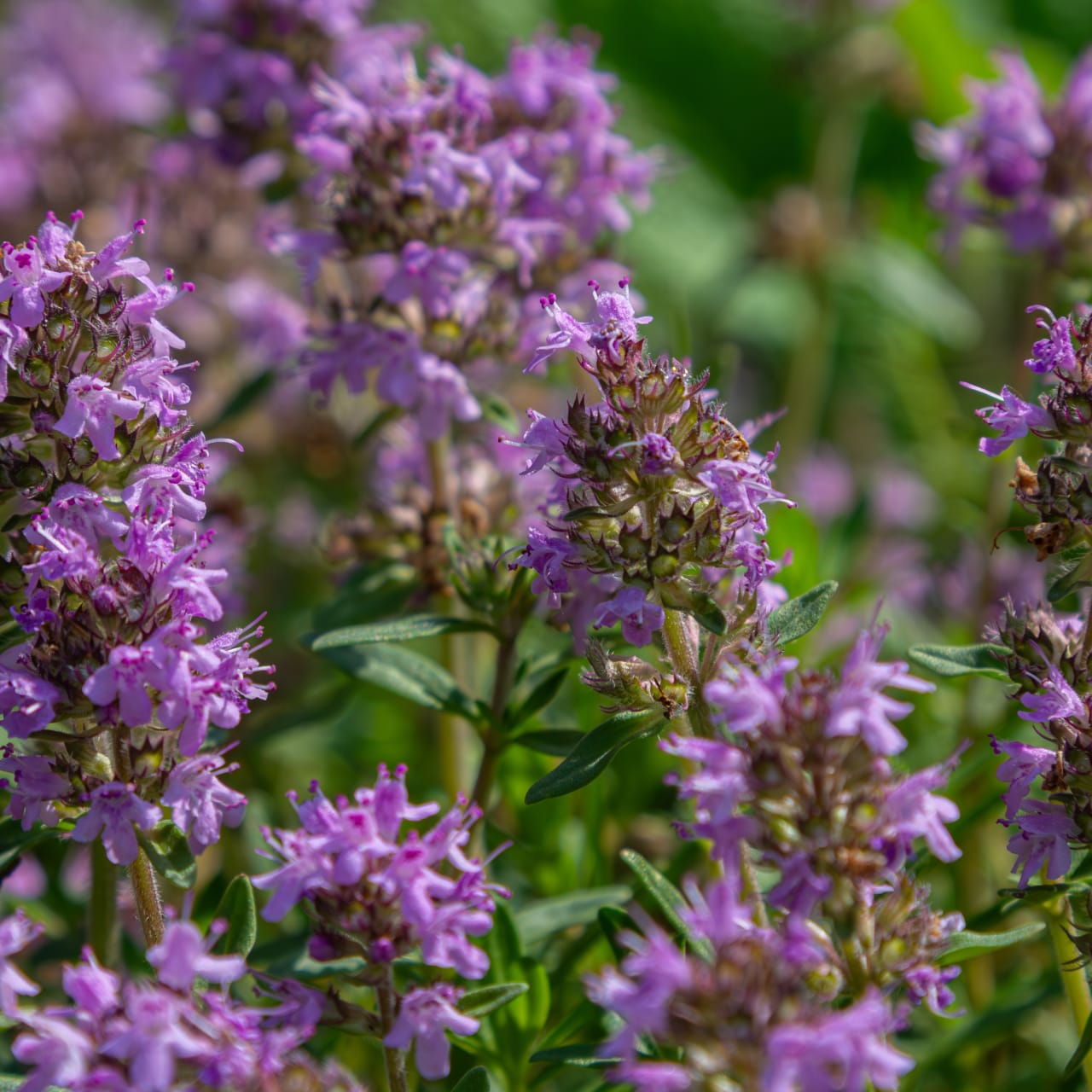



Thymus citriodorus: Lemon Thyme or Lemongrass Thyme
Lemon thyme, also known as lemon-scented thyme and lemongrass thyme, is a common aromatic plant belonging to the large Lamiaceae family, known in particular for its aromatic and medicinal herbs such as Rosemary or Mint. Lemon thyme is known by the Latin names Thymus citriodorus or Thymus ×citriodorus. It is native to the Mediterranean basin, although it has become naturalised across temperate Europe. It is thought to have arisen from a natural hybridisation between Common Thyme, Thymus vulgaris and False Pennyroyal, Thymus pulegioides.
Lemon thyme is a compact, evergreen, perennial subshrub, generally reaching 15 to 30 cm tall and about as wide. It is therefore stockier and has a more spreading habit than common thyme. Its leaves are also wider than those of its cousin. Small in size, they are oval to lanceolate and often edged with yellow or white, depending on the variety. Leaf colour also varies by cultivar. When crushed, the leaves give off a characteristic lemony scent. For this reason, lemon thyme is mainly used in cooking.
Lemon thyme contains the same compounds as common thyme, so it shares the same digestive and anti-infective properties. However, lemon thyme is milder because of geraniol, an aromatic antiseptic compound. Geranial and neral are also present in significant quantities; they create this intense lemony note and provide antispasmodic properties, which are very useful for treating coughs. Unlike its cousins, lemon thyme contains far fewer phenols – an interesting biochemical group, as they are very powerful antiseptics, but whose use is more delicate due to their contraindications. Consequently, lemon thyme is a good alternative for more regular use and for children.