The genus Mentha, belonging to the vast Lamiaceae family – which also includes lavender and sage, comprises a multitude of species, the best known of which is undoubtedly Mentha piperita, or peppermint, a hybrid between water mint (Mentha aquatica) and spearmint (Mentha spicata). Mint has been domesticated for millennia, although its exact origin is difficult to trace, as it has naturalised across Eurasia, North America, Africa, and even Australia. It has long been mentioned, notably in Greek mythology, where the nymph Mínthê was transformed into mint by Persephone, who was jealous of the attention she received from Hades. Unable to bring her back to life, Hades is said to have bestowed upon her her characteristic fragrance. Traces of mint have also been found in Egyptian tombs dating back more than 3,000 years, bearing witness to its use across civilisations.
Mint species hybridise easily with one another, which explains their great diversity: nearly 3,000 varieties have been recorded from 600 different species. There are numerous scents and varieties, ranging from the Mentha suaveolens with its apple-like scent, to Mentha x piperita f. citrata ‘Chocolate’, which gives off a scent of minty chocolate, and including Mentha rotundifolia ‘Bowles’, pineapple mint, and even Mentha x piperita f. citrata 'Basil', with the scent of basil. Some varieties are more common, such as bergamot mint or black mint, which are available from nurseries. Some mints are specific to certain culinary uses, such as Spearmint (Mentha spicata), widely used in Mediterranean cuisine for mint tea and tabbouleh, or in Asian cuisine, particularly in spring rolls. As well as its culinary uses, mint is also prized in perfumery for its fresh, green notes, particularly curly mint and peppermint. Peppermint is the most widely cultivated mint in the world, mainly because of its high menthol content, a refreshing compound found in products ranging from chewing gum to essential oils and personal care products.
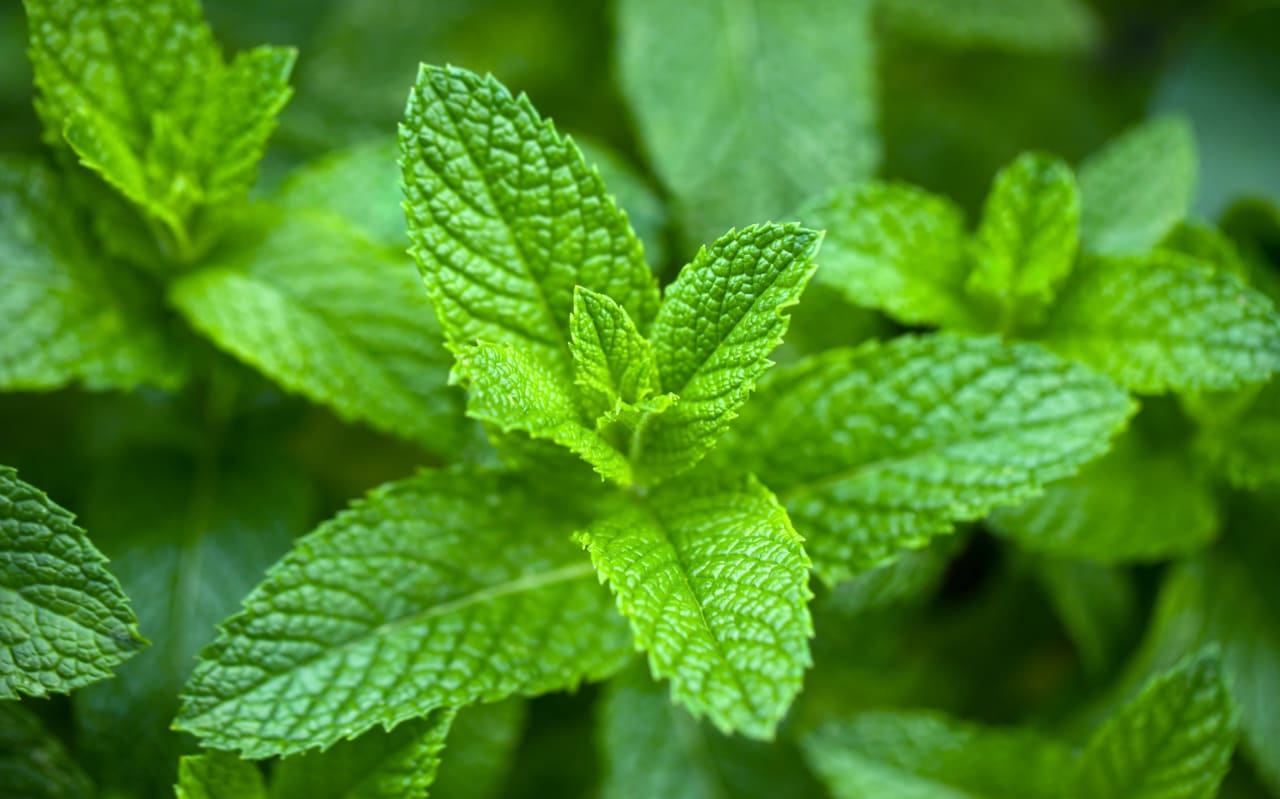
All mints share common characteristics: they are perennial herbaceous plants, some with an upright habit such as sweet mint, others creeping, such as Corsican mint. Although often cultivated, they also grow wild, forming small colonies along ditches and streams. Despite their many varieties, mints share several similarities: square stems, opposite green leaves, and spreading roots that can take over an entire garden. Popular with bees, they typically flower during the warmer months, producing small purple, pink or white flowers arranged in spikes or whorled clusters. Mint prefers cool, moist, well-drained soil and thrives in full sun, though it tolerates partial shade, or even full shade for certain varieties such as Corsican mint.