
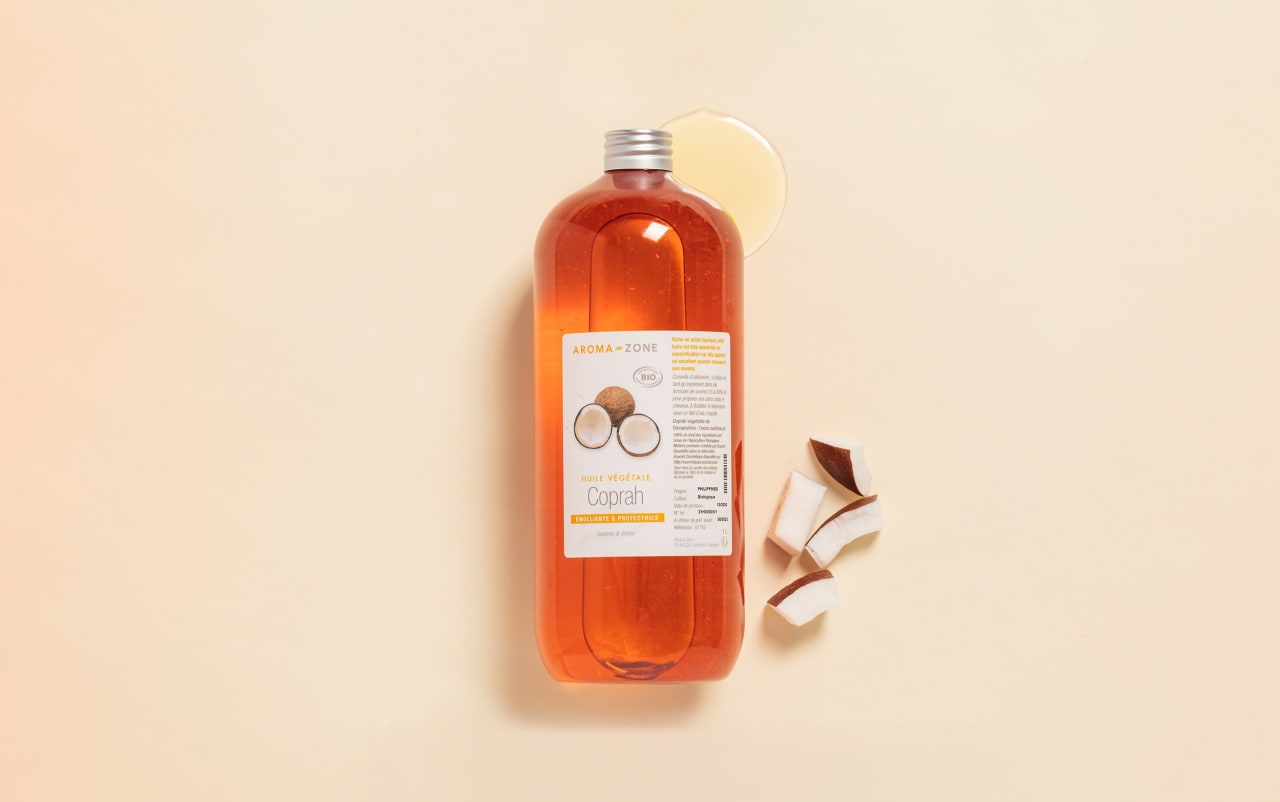
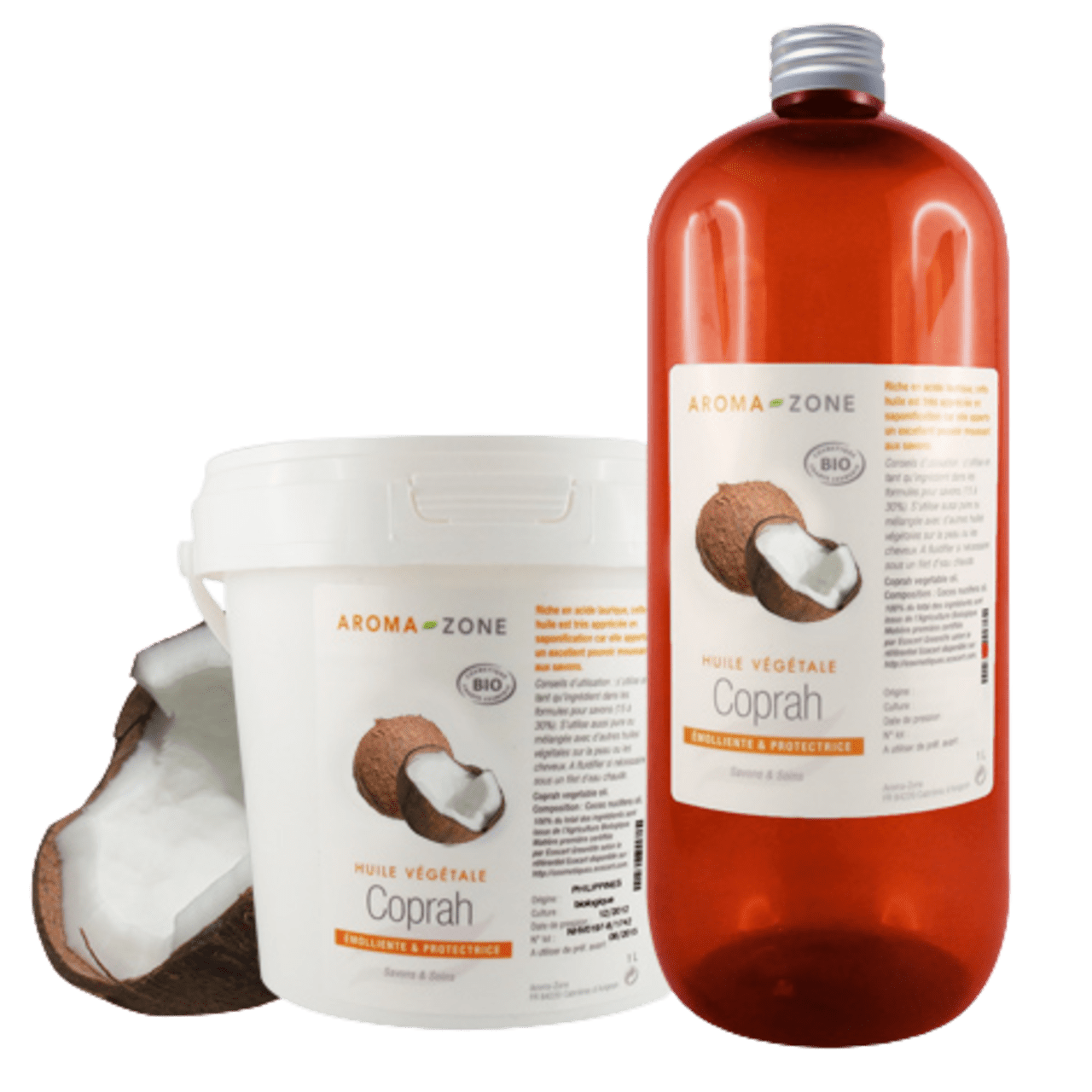
Organic Copra Oil
Repairing
Nourishing
free delivery up to £25 in United Kingdom
100% secure payment CB, Visa, Mastercard, Paypal, Apple Pay, Google Pay

Cosmos Organic

Ecocert

Cold Pressed

100% Pure And Natural
As a cosmetic ingredient, organic copra oil is recognised for its properties and benefits:
Widely used in soap making, it provides an excellent foaming ability, creaminess, and hardness to the soap, along with a good cleansing power.
Highly stable against oxidation, it does not easily go rancid.
With a neutral odour, copra oil is an alternative to virgin coconut oil for preparations where the coconut scent is not desired.
Very nourishing and protective, copra oil significantly reduces skin dehydration.
Skin types
Soaps for all skin types
Dry and damaged skin
Chapped, cracked skin
Rough skin lacking elasticity
As a hair care ingredient, organic copra botanical oil is renowned for its properties:
Nourishes and smoothes the hair fibre, leaving hair shiny and vigorous.
Hair types
Curly, frizzy and afro hair
Dry hair
Dull, limp hair
Split ends
Lice
Skin care
Homemade cold-saponified soaps
Melting body care oils or balms
Nourishing exfoliating balms
Tanning or aftersun repair oils
Lip balms
Hair care
Hair improver products
Afro hair care products
Shampoos and hair masks
Solid shampoos (with sodium coco sulphate or in the form of cold-saponified soaps)
This oil tends to solidify at temperatures below 25°C. This phenomenon has no effect on its quality.
We recommend reheating it if necessary before incorporating it into your mixture by placing the bottle under a stream of hot water for a few minutes to liquefy it. To liquefy a large quantity of oil, place the bottle in a hot water bath for 10-20 minutes, shaking from time to time.
To be added to the oil phase for homemade cosmetics.
We recommend using 15 to 30% of it in your cold-saponified "homemade" soap formulas to give them good foaming power and a very pleasant feel.
Synergies
In homemade soaps: organic palm oil, organic olive oil, shea butter, etc.
To add the scent of coconut and make luxury skincare products: coconut pulp, aromatic coconut extract, etc.
Skincare for black skin: yangu, brazil nut, Kalahari melon carrier oils, shea butter, etc.
For lip balms: shea butter, beeswax, etc.
For added vitality: Murumuru butter, mango butter, sal butter, shea butter, sapote oil, yangu oil, kukui oil
Culture
Organic, certified by Ecocert Greenlife in accordance with the Ecocert standard available at http://cosmetiques.ecocert.com
Benefits
Washing power
Highly nourishing and protective for skin and hair
Anti-lice
Quality
100% pure and natural, integral, unfractionated, refined and deodorised using methods that comply with the Ecocert standard.
Production process
Hot pressing, refining (using natural citric acid and natural earths), then vacuum deodorisation
Part of the plant used
Dried coconut pulp
Botanical name
Cocos nucifera
Botanical family
Arecaceae
Function
Cosmetic ingredients
Other names
Copra oil, deodorised coconut oil, deodorised coconut butter
Oxidative potential
Not very sensitive
Learn more
Copra oil, sometimes called deodorised coconut oil, is derived from the dried pulp of the coconut, unlike virgin coconut oil which is derived from the fresh pulp and retains a delicious coconut scent. Copra oil is refined and deodorised to guarantee an oil that is highly stable tooxidation, white in colour andneutral in smell. It is a good alternative to virgin Coconut oil for those who prefer a more neutral product or for scented products where the Coconut smell is not desired, but with similar benefits.
Copra oil is particularly interesting for soap-making because it is one of the rare carrier oils (along with Babassu oil and Palm kernel oil) to contain a high proportion of lauric acid.
This saturated fatty acid with a relatively short chain (12 carbons) has very interesting properties when saponified, as it solubilises quickly and easily inwater, producing a lovely light lather and giving soaps a very pleasant 'melting' effect. It also has good cleansing properties. For this reason, soaps containing too high a proportion ofCopra oil can have a drying effect on the skin. We recommend limiting the amount of Copra oil in your soaps to between 15% and 30% , to get the most out of its properties while keeping the soap very gentle on the skin. Being a partially 'solid' oil (due to its high content of saturated fatty acids), Copra oil will also contribute to the soap's hardness. An essential oil for making homemade soaps!
Organoleptic properties
Appearance: runny oily liquid or solid butter (depending on the temperature)
Colour: white to pearly ivory
Scent: neutral
Feel: fairly rich
Density
0.92
Saponification index
248-265
Conservation
Stable carrier oil.
Store in a dry place away from heat and light.
Warning
The properties, indications and methods of use described above are derived from scientific literature and/or reference books or websites in aromatherapy, hydrolatherapy and phytotherapy. This general information is provided for informational purposes only and cannot under any circumstances be considered as medical information. This information cannot under any circumstances replace a diagnosis, consultation or medical follow-up, nor engage our liability.
Environmental qualities and characteristics product sheet
Reference
0174201 - Organic copra oil 1 L
Main packaging material
RPET (recycled PET) bottle
Recycled material
Packaging contains at least 95% recycled material
Rewards and penalties
Aroma-Zone pays a penalty for managing this packaging: contains an element that disrupts sorting

EO = Essential Oil
VO = Carrier Oil or Macerated Oil
1 tablespoon Calendula macerated oil
1 tablespoon coconut oil
2 tablespoons sesame oil
50 g grated Cocoa butter
10 g Beeswax
Up to 20 drops of essential oil of your choice for fragrance
Procedure: Melt the wax in the oils in a bain-marie and mix. Remove from the heat and add the essential oils.
200 g Baking soda
100 g Citric acid
100 g Oat flour
15 ml Coconut oil
15 ml Wheat Germ Oil
30 ml Aloe vera gel
10 drops Mandarin essential oil
5 drops Ginger essential oil
6 g dried ground ginger root
Procedure: Mix the bicarbonate, citric acid and oat flour in a bowl. Mix the carrier oil and essential oil and add to the bowl. Mix well. Then add the Aloe vera gel and mix until you have a slightly moist paste that clumps together easily. Add the ginger powder and stir. Pour the mixture into the cake moulds and leave to dry for about an hour before removing from the moulds.
70 ml grape seed oil
10 ml Coconut oil
20 g stearic acid
10 g Shea butter
4 g Beeswax
15 drops aromatic Coconut extract
15 drops Vanilla extract
10 drops of ylang-ylang essential oil
6 drops of natural vitamin E
Procedure: Melt the beeswax in the carrier oil and steraric acid in a bain-marie. Remove from the heat and add the remaining ingredients. Pour the mixture into a glass jar and leave to cool. When the wax begins to set but remains soft, place a cotton wick in the centre of the glass. Light the candle, wait for the wax to melt and then extinguish the flame.
How to use: Apply the treatment to the skin or hair (the wax should be soft but cool!).
1 ml true lavender essential oil
1 ml German chamomile essential oil
10 ml virgin olive carrier oil
10 ml coconut oil
15 ml calendula carrier oil
15 ml aloe vera oil
Use: Very gently apply around twenty drops of the mixture to the affected area, repeating once or twice a day.
Olive oil: 1 tablespoon
Coconut oil: 60 g (or copra oil or any solid carrier oil)
Benzoin essential oil: 1 drop (optional)
Rosewood essential oil: 10 drops
Palmarosa essential oil: 10 drops (Sandalwood essential oil for men)
Procedure: Pour the olive oil and solid oil into a container and place in a bain-marie. Remove from the heat and stir to bring the mixture to a temperature close to 37°C. Add the essential oils and stir until fully incorporated. Transfer to a clean bottle and store in the fridge in summer only, or during hot weather. This product will not keep for more than 15 days! Use: Apply the cream to the face and neck. You can vary the consistency of this cream by adding more or less olive oil.
40 ml Coconut oil
30 ml Cocoa butter
10 ml Calendula macerated oil
18 g Oat flour
1 tbsp Lime blossom
Method: Melt the butter in the oils in a bain-marie. Add to the oat flour and lime blossom and mix until smooth. Pour into ice cube tray compartments and set in the freezer for 15 minutes Use: Use by melting in bath water.
1 teaspoon grated cocoa butter
1/2 teaspoon coconut oil
1 teaspoon sweet almond oil
1/2 teaspoon beeswax
1 teaspoon aloe vera gel
Instructions: Melt the cocoa butter and beeswax in the coconut oil and sweet almond oil over a bain-marie, remove from the heat, add the aloe vera gel and whisk the mixture. Pour into a small sterilised container and leave to cool completely.
80 ml Coconut water
3 tablespoons rice powder
2 tablespoons Coconut pulp
2 tablespoons Coconut Oil
15 drops of frangipani absolute (0.5% dilution)
20 drops grapefruit seed extract
7 drops of natural vitamin E
Procedure: Pour the rice powder and Coconut pulp into the bowl and mix with the mini whisk Add the coconut water and mix. Then add the Coconut oil and mix again. Then add the Frangipani absolute and blend once more. Finally, add the vitamin E and grapefruit seed extract. Mix well and pour into a 100 ml glass jar.
50 ml Coconut oil
50 ml Babassu oil
1 to 2 teaspoons of Urucum powder (depending on the desired intensity)
20 drops of aromatic Caramel extract
7 drops of natural Vitamin E
1 large pinch of Gold Mica
Use: Mix the carrier oils. Gradually add the Urucum powder, mixing with a whisk. Leave to macerate for a week, then filter. Finally, add the rest of the ingredients and mix well.
30 ml Palm oil (you can replace it with Babassu oil)
25 ml Coconut oil
20 ml Safflower oil
20 ml Sesame oil
5 ml Shea butter
Procedure: For 100 ml of oil: heat the Shea Butter and the Coconut and Palm oils in a bain-marie. When the mixture has melted, remove from the heat and add the remaining ingredients, mixing well.
Use: Apply before swimming or sunbathing.
110 ml organic coconut water
3 tablespoons rice powder
2 tablespoons organic cocoa powder
2 tablespoons coconut oil
30 drops grapefruit essential oils
20 drops grapefruit seed extract
7 drops of natural vitamin E
Procedure: Mix the Rice powder and Cocoa, add the Coconut water and mix. Add the Coconut Oil and mix again. Finally, add the rest of the ingredients and mix well.
Use: Apply once a week in a thick layer to the thighs, buttocks and stomach. Cover with cling film and leave on for 20 minutes before rinsing.
15 drops of gum rockrose essential oil
15 drops Benzoin essential oil
30 drops Spike Lavender essential oil
15 drops Italian Helichrysum essential oil
30 drops Rosewood essential oil
14 g Shea butter
14 g Cocoa butter
14 g Coconut butter
4 g beeswax
7.5 ml Rose carrier oil
5 ml avocado or Argan OIL
5 ml corn or arrowroot starch
Procedure: Melt the butters and wax in a bain-marie. Add the cornstarch and carrier oil, and whisk with a small whisk while heating (without boiling) for a few moments. Allow to cool, then stir in the essential oils. Whisk again and transfer to one or more jars. Label the jars.
Apply to the lesion after cleansing.
Cistus ladaniferus (gum rockrose) essential oil: 15 drops
Lavandula aungustifolia ssp angustifolia (true lavender) essential oil: 40 drops
Pogostemon cablin (patchouli) essential oil: 30 drops
Styrax benzoe dryander essential oil (benzoin): 15 drops
Daucus carota var. sativa (carrot) essential oil: 15 drops
Shea butter: 14 grams
Cocoa butter: 14 grams
Coconut (or copra) butter (or oil): 14 grams
Beeswax: 4 g
Chilean rosehip seed carrier oil: 2.5 ml
Argan or avocado carrier oil: 5 ml
Corn starch: 5 ml
Use: Melt the butters and beeswax in a bain-marie. Add the cornstarch and carrier oils. Using a wire whisk and whisk the mixture until well blended. Heat gently for a few moments. Allow to cool, then add the essential oils. Whisk again, then transfer to one or more glass jars. Label the jars.
Coconut (or copra) oil: 453.6 g
Palm oil: 397 g
Avocado oil: 226.8 g
Sweet Almond oil: 141.75 g
Shea butter: 113.4 g
Jojoba oil: 113.4 g
Caustic soda: 194 g (10% soda reduction)
Water: 538.7 g
Grapefruit seed extract: 12 g (Aroma-Zone note: this author recommends EPP to improve the conservation of soaps, probably because it has a slight antioxidant effect. Soaps are not sensitive to microbial contamination, so a preservative is not useful. Instead, we recommend adding an antioxidant such as vitamin E to prevent rancidity.)
Essential oil of your choice (optional): 35 ml (7 teaspoons)
Notes and precautions (Aroma-Zone): Before you start saponifying, we strongly recommend that you read our know-how sheet "Cold saponification" to fully understand the method. Be sure to read the precautions for using lye before you start and follow the instructions for diluting the lye.
Procedure: See our "Cold saponification" information sheet for details of how to make a soap. Weigh the soda accurately, dissolve in the water and set aside. Melt the solid oils, then add the liquid oils. While the mixtures are cooling, weigh any other ingredients. When the 2 mixtures are at around 27-38°C, pour the soda solution into the oils and mix well (preferably with a blender) until you see a "trace". Add any other ingredients and incorporate into the emulsion. Mix well then pour into moulds.
Coconut (or Copra) oil: 250 g
Olive oil: 550 g
Hemp carrier oil: 200 g
Pure caustic soda (solid): 140 g
Water: 290 g
Wild mint essential oil: 4 g
Cinnamon essential oil: 8 g
Pine essential oil: 8 g
Chlorophyll powder: 1 teaspoon
Optional: 1 tablespoon ground hemp seeds
Notes and precautions (Aroma-Zone): Before starting saponification, we strongly advise you to read our know-how sheet "Cold saponification" to fully understand the method. Be sure to read the precautions for using the lye before you start and follow the instructions for diluting the lye in the water.
Procedure: Weigh the soda precisely, dissolve in 290 g of water and set aside. Melt the Coconut oil, then add the Olive and Hemp oils. While the mixtures are cooling, weigh out the essential oils. Prepare the other ingredients: dilute the chlorophyll in 1 tablespoon of water and grind the hemp seeds in a coffee grinder. When the 2 mixtures are at around 45°C, pour the soda solution into the oils and mix well. Add the diluted chlorophyll before putting in the blender and blending until you see the "trace". Add the ground seeds to the essential oils and blend into the emulsion. Mix well then pour into a mould (the quantity is suitable for a large silicone cake tin).
Coconut oil: 453.6 g
Oil palm: 397 g
Wheat germ oil: 170.1 g
Hazelnut oil: 170.1 g
Avocado oil: 141.75 g
Sweet almond oil: 113.4 g
Cocoa butter: 113.4 g
Caustic soda: 201 g (10% soda reduction)
Water: 538.7 g
Grapefruit seed extract: 12 g (Aroma-Zone note: this author recommends EPP to improve the conservation of soaps, probably because it has a slight antioxidant effect. Soaps are not sensitive to microbial contamination, so a preservative is not useful. Instead, we recommend adding an antioxidant such as vitamin E to prevent rancidity.)
Essential oil of your choice (optional): 35 ml (7 teaspoons)
Notes and precautions (Aroma-Zone): Before you start saponifying, we strongly recommend that you read our know-how sheet "Cold saponification" to fully understand the method. Be sure to read the precautions for using lye before you start and follow the instructions for diluting the lye.
Procedure: See our "Cold saponification" information sheet for details of how to make a soap. Weigh the soda accurately, dissolve in the water and set aside. Melt the solid oils, then add the liquid oils. While the mixtures are cooling, weigh any other ingredients. When the 2 mixtures are at around 27-38°C, pour the soda solution into the oils and mix well (preferably with a blender) until you see a "trace". Add any other ingredients and incorporate into the emulsion. Mix well then pour into moulds.
Coconut oil: 453.6 g
Olive oil: 311.85 g
Oil palm: 226.8 g
Jojoba oil: 226.8 g
Cocoa butter: 226.8 g
Caustic soda: 187.5 g (10% soda reduction)
Water: 538.7 g
Grapefruit seed extract: 12 g (Aroma-Zone note: this author recommends EPP to improve the conservation of soaps, probably because it has a slight antioxidant effect. Soaps are not sensitive to microbial contamination, so a preservative is not useful. Instead, we recommend adding an antioxidant such as vitamin E to prevent rancidity.)
Essential oil of your choice (optional): 35 ml (7 teaspoons)
Notes and precautions (Aroma-Zone): Before starting saponification, we strongly recommend that you read our "Cold saponification" information sheet to fully understand the method. Be sure to read the precautions for using the lye before you start and follow the instructions for diluting the lye in the water.
Procedure: See our "Cold saponification" information sheet for details of how to make a soap. Weigh the soda accurately, dissolve in the water and set aside. Melt the solid oils, then add the liquid oils. While the mixtures are cooling, weigh any other ingredients. When the 2 mixtures are at around 27-38°C, pour the soda solution into the oils and mix well (preferably with a blender) until you see a "trace". Add any other ingredients and incorporate into the emulsion. Mix well then pour into moulds.
Palm oil: 300 g
Coconut (or Copra) oil: 220 g
Olive oil: 480 g
Pure caustic soda (solid): 139 g
Water: 350 g
Optional: 30 g essential oil of your choice
Optional: 1 large tablespoon dried marigold flower petals, for example
Notes and precautions (Aroma-Zone): Before you start saponifying, we strongly recommend that you read our know-how sheet "Cold saponification" to fully understand the method. Be sure to read the precautions for using the lye before you start and follow the instructions for diluting the lye in the water.
Procedure: Weigh the soda precisely, dissolve in 350 g of water and set aside. Melt the Palm and Coconut oils, then add the Olive oil. While the mixtures are cooling, weigh out the essential oil and prepare the other ingredients if required. When the 2 mixtures are at around 45°C, pour the soda solution into the oils and mix well (preferably with a blender) until you see the "trace". Add any essential oils and flower petals. Pour into a mould (the quantity is suitable for a large silicone cake tin).
10 g rosemary leaves
10 g dried chamomile leaves
100 ml coconut oil
Directions: Chop the rosemary leaves. Heat them in a bain-marie with the chamomile flowers and oil for 30 minutes, then remove from the heat, leave to cool and pour into a container with a screw-on lid. Close and leave to stand for a week. Then reheat the mixture and strain through a sieve to remove the herbs.
How to use: To use this product, take a dab of it with your fingertips and massage it into your hair and scalp. Comb through hair from root to tip. Wrap a warm towel around your hair and leave for 30 minutes. Then wash your hair (you may need to shampoo twice).
Supplier documentation
'The soapmaker's companion' De Susan Miller Cavitch
'The natural soap book' de Susan Miller Cavitch
'Je crée mes savons au naturel' by Leanne and Sylvain Chevallier
'La Bible de l'aromathérapie' by Nerys Purchon
'ABC des huiles essentielles' by Dr Telphon
'The Ultimate Natural Beauty Guide - 100 recipes you can prepare yourself in no time' by Joséphine Fairley
'90 recettes de beauté bio à faire soi-même' by Sophie Macheteau and Vanina Guet
'Mes petits cadeaux cosmétiques BIO' by Marie Bousquet and Christie Vanbremeersch
'Cosmétiques naturels, conseils et recettes plaisir pour préserver sa santé au quotidien' by Hélène Baron and Tiphaine Chagnoux
'Soins de la peau à base d'huiles essentielles', Les Cahiers de la santé vol.2, by Chantal Lacroix
http://www.desplantesdebonnevolonte.org
Frequently Asked Questions
Essential Oils
1 ml = approximately 35 drops (with our Aroma-Zone dropper caps)
Carrier Oils
1 pump (Aroma-Zone aluminium pump) = approx. 0.15 ml
Mass / Volume conversion (for a liquid)
Mass (g) = Density x Volume (ml) at 20°C
Further information
1 full teaspoon = between 3 and 4.5 ml
1 full tablespoon = between 7.5 and 10 ml
However, these spoon ratios depend on a number of factors (e.g. viscosity of the liquid, temperature, depth and size of the spoon, rheological behaviour of the liquid), and we strongly advise you to use precise measuring equipment, such as graduated test tubes, graduated pipettes, and precision scales.
Loading...
Coconut oil solved problems I had in completely crafting many formulations that I couldn't make sellable. It's a shame there isn't a 5kg size to save a little money because it's a product I intend to use and experiment with more and more. In winter, it makes any formulation hard as a rock. Knowing this, it's a characteristic that simplifies the creation of some products.
No coconut smell, texture suitable for soap making.
Essential oil in soap making
Good products and good quality of service
Great! The best and the cheapest
Associated products
£9.00
100 ml
£13.00
250 ml
2 options
£14.00
30 ml
Associated tips
Household tips
Hair care tips


