The "Cold saponification" Info Sheet

A complete guide to understanding and mastering cold saponification and learning how to make your own 100% natural homemade soaps.

By The Aroma-Zone editorial team

Reading time: 0 min.

What is cold saponification?

Soap is the product of a chemical reaction between a fat (plant oil, plant-based butter, animal fat, etc.) and a strong base (soda or potash).

Soda ash (sodium hydroxide) is used to make solid soap. Potash (potassium hydroxide) is used to produce pasty or liquid soaps (black soap, liquid Marseille soap). We will only be talking here about the production of solid soap using sodium hydroxide.

Oils and butters are mainly made up of fatty acid triglycerides. When sodium hydroxide is added, these are transformed into soap according to the reaction below (R represents the carbon chain of the fatty acid, a long chain of 12 to 22 carbon atoms for the fatty acids most commonly found in plant oils).


Gentle soaps rich in active ingredients!

Soaps made by cold saponification are naturally rich in glycerine, produced during the saponification reaction. It provides the soap with softness and moisturising properties.

In addition to fatty acid triglycerides, plant oils and butters contain an unsaponifiable fraction, i.e. compounds that will not react with the lye. These include phytosterols, tocopherols (vitamin E), carotenoids (vitamin A), terpenes, squalene, squalane and fatty alcohols.

These substances have highly beneficial effects on the skin, including antioxidant, nourishing, emollient, softening and protective effects… A homemade soap, made by cold saponification, will naturally contain the unsaponifiable portion of the oils and butters used, giving it unique properties.

The manufacturing process for industrial soaps, on the other hand, will often have denatured or even eliminated the unsaponifiable fraction.
Method

Superfatting rate: what is it?

The superfatting rate is the percentage (of the total weight of oils) that remains unsaponified in the finished soap. The soap is then "superfatted". In cold saponification, it is essential to superfat soaps. There are 2 ways of superfatting soap:

  1. Soda reduction

  2. Additional superfatting at the "trace" stage

1. Soda reduction

This means using less soda than is theoretically necessary to saponify all the oils in the mixture. In this way, all the soda will be consumed by the saponification process and a portion of unsaponified oils will remain in the soap. This means that the theoretical amount of soda is reduced by the % chosen.

The soda reduction is essential as a safety margin, because the saponification indices used to calculate the amount of soda to add are averages and may vary. We recommend that you always choose a soda reduction of at least 5% to be on the safe side.

A reduction of more than 5% means that the soap is "superfatted" and therefore softer. This is because a little of each oil/butter from your initial oily mixture will remain in the soap, and these unsaponified oils will contribute their properties to the skin. For this reason, the reduction in soda is sometimes called the "superfatting rate".

2. Additional superfatting at the "trace" point

Another way of superfatting soap is to add plant oil (or melted plant-based butter) at the 'trace' stage, i.e. at the end of the preparation process. Most (if not all) of this oil will remain unsaponified. This is particularly useful with expensive, temperature-sensitive oils, or oils and butters whose properties you want to take particular advantage of.

Adding oil at the end of the preparation process is also very useful for pre-dispersing other ingredients you wish to add (colourings, essential oils). This will make it easier to distribute them evenly throughout the soap paste.

3. Which superfat should I choose?

Total superfatting rate (%) = "Soda reduction (%) + Additional superfatting (%)".

For a very mild soap, we recommend a total fat content of between 8% and 10%. It is possible to go higher (to 12% or even 15%, for example), but be aware that a soap that is very "superfat" is likely to be soft. It may also be more susceptible to rancidity, especially if the oils used for super-fatting are sensitive to oxidation. In some cases, a soap that is "too superfat" may also ooze oil. In extreme cases, a soap that is too rich in oil may go out of phase during manufacture.

We strongly recommend that you combine a reduction in soda (of at least 5%) with additional "trace" superfat.

Several options are available:

  • Soda reduction of 5% as a safety margin and additional superfatting with a particular oil or butter of 3 to 7%.

  • Soda reduction of between 6 and 10% for superfatting in all the base oils and additional superfatting (2-3%) in a particular oil or butter at the "trace" stage.

  • Soda reduction of between 5 and 12% for a soap that is simply fatted with all the oils in the mixture if you don't want to add any particular oil.

  • Soda reduction of 1 to 4%, and in this case IMPERATIVELY superfatting so that you have AT LEAST 5% (at least 8% is recommended for a mild soap) of total superfatting**(not a recommended option** as there is always the risk of forgetting to add oils at the end of the preparation, or of having a mixture too thick too quickly to guarantee a homogeneous mixture of the oils added).

4. How to use

We've provided a calculator to help you work out how much soda to use. You can choose the "soda reduction" and "additional greasing" you want, taking into account our recommendations:

  • Enter all the oils in your base mix into the calculator. The calculator provides a results sheet, which will include a table showing the quantities of soda calculated with "reductions" from 1 to 12%.

  • Additional lubricating oils should not be entered in the calculator table when calculating the soda ash. However, you can enter the desired percentage of additional fat in the box provided. The results sheet will give you the weight of oil (or melted butter) in grams, to be added at the time of the "trace" to obtain this percentage of additional fat.

5. Focus on... Saponification temperature

We recommend that you make your melted oils/soda solution mixture at a temperature of between 35 and 50°C, or even up to 55°C in some cases. Choose a higher temperature (45-55°C) in the following cases:

  • if your formula is rich in 'hard' fats (butters, solid oils), to avoid the mixture setting too quickly

  • If you use wax in your formula, we recommend saponification at around 55°C.

  • if your formula is for a small volume (100 ml moulds), as these formulas will have less of a tendency to rise in temperature in the mould.

A high temperature (45-55°C) will accelerate the saponification process, and therefore generally favour a quick trace. On the other hand, too high a temperature (over 60°C) can break the emulsion (which takes on a "curdled" appearance). Choose a low temperature (35 to 40°C) instead in the following cases, if the formula allows:

  • if you are using additives that accelerate the "trace", such as honey, certain essential oils or fragrances to make marbling that require a paste that remains fairly fluid for some time.

Composition of a soap

A fatty substance

They form the basis of soap. Depending on their fatty acid composition, they contribute different properties to the soap: hardness, foaming power, softness, creaminess, etc.

Water

Preferably demineralised, to dilute the soda and allow the reaction to proceed correctly.

Additions

To colour, perfume or give the soap special properties or a particular 'look'. The addition of oils or butters is particularly recommended for very mild soaps.

Soda

Sodium hydroxide - in solid (pure) or liquid (diluted in water) form, it is used to transform oils into soap.

The ingredients in detail

A short guide to oils used in saponification

In theory, it is possible to saponify all types of fats (plant oils, plant-based butters, animal fats), but the choice of oils will greatly influence the appearance and properties of the soap: hardness, foaming power, softness on the skin, etc.

Depending on their chemical structure (saturated or unsaturated, and the length of the carbon chain: C12, C14, etc., depending on the number of carbon atoms), fatty acids will contribute different properties to the soap. The table below gives a generic guide to the properties of the main fatty acids found in plant oils and butters.

Lauric acid

  • Type of fatty acid: Saturated, C12

  • Hardness: Yes

  • Washing power: Yes

  • Foaming power: Yes

  • Firmness and creaminess of foam: No

  • Softness and properties on the skin: No

  • Examples of oils containing a high proportion: Coconut, Coprah, Babassu, Laurel berry, Murumuru and Tucuma butters.

Myristic acid

  • Type of fatty acid: Saturated C14

  • Hardness: Yes

  • Washing power: Yes

  • Foaming power: Yes

  • Firmness and creaminess of foam: No

  • Softness and properties on the skin: No

  • Examples of oils containing a high proportion: Murumuru and Tucuma butters.

Palmitic acid

  • Type of fatty acid: Saturated C16

  • Hardness: Yes

  • Washing power: No

  • Foaming power: No

  • Firmness and creaminess of foam: Yes

  • Softness and properties on the skin: No

  • Examples of oils containing a high proportion: Palm oil, Baobab oil, Cocoa butter, Kokum butter, etc.

Stearic acid

  • Type of fatty acid: Saturated C18

  • Hardness: Yes

  • Washing power: No

  • Foaming power: No

  • Firmness and creaminess of foam: Yes

  • Softness and properties on the skin: No

  • Examples of oils containing a high proportion: Shea, Cocoa, Cupuaçu, Kokum and Kpangnan butters.

Ricinoleic acid

  • Type of fatty acid: Monounsaturated, C18

  • Hardness: No

  • Washing power: No

  • Foaming power: Yes

  • Firmness and creaminess of foam: Yes

  • Softness and properties on the skin: Yes

  • Examples of oils containing a high proportion: Castor oil

Oleic acid

  • Type of fatty acid: Monounsaturated, C18

  • Hardness: soaps with a majority proportion of olive oil (>60%) are generally very hard after drying.

  • Washing power: No

  • Foaming power: No

  • Firmness and creaminess of foam: No

  • Softness and properties on the skin: Yes

  • Examples of oils containing a high proportion: Olive, Apricot, Sweet Almond, Camellia, Macadamia, Hazelnut, Rice bran, Argan and Avocado oils.

Linoleic acid

  • Type of fatty acid: Polyunsaturated, C18

  • Hardness: No

  • Washing power: No

  • Foaming power: No

  • Firmness and creaminess of foam: No

  • Softness and properties on the skin: Yes

  • Examples of oils containing a high proportion: Grape seed, Apricot, Sesame, Safflower, Hemp, Cotton, Evening Primrose and Kalahari Melon oils.

Alpha-linolenic acid

  • Type of fatty acid: Polyunsaturated, C18

  • Hardness: No

  • Washing power: No

  • Foaming power: No

  • Firmness and creaminess of foam: No

  • Softness and properties on the skin: Yes

  • Examples of oils containing a high proportion: Perilla, Inca inchi, Musk Rose, Camelina oils

Gamma-linolenic acid

  • Type of fatty acid: Polyunsaturated, C18

  • Hardness: No

  • Washing power: No

  • Foaming power: No

  • Firmness and creaminess of foam: No

  • Softness and properties on the skin: Yes

  • Examples of oils containing a high proportion: Borage oil, Evening primrose oil

The fatty acids that add hardness to soap are mainly saturated fatty acids, naturally present in high proportions in plant-based butters or 'solid' oils. The presence of a sufficient quantity (30 to 60%) of this type of oil in your soap will guarantee good hardness. You can also add stearic acid to your recipe to harden your soap.

The most detergent fatty acids are those with a short chain. The fatty acid that will provide the most effective washing power, as well as a beautiful, abundant lather, is lauric acid (C12: chain with 12 carbon atoms), present in large quantities in Copra, Coconut and Babassu oils. These oils are therefore very useful in the composition of your soaps, but it is often advisable not to use more than 30% of them, unless you want a very detergent soap. A proportion of 15-30% of this type of oil is ideal.

Unsaturated fatty acids (oleic, linoleic, linolenic) are of interest in saponification for their nourishing and skin-softening properties. You'll find them in most liquid plant oils: Olive, Apricot Kernel, Macadamia, Sweet Almond, Avocado, Hemp, etc.

Once you've tested several recipes and learned to see the effect of the different oils on the finished soap, you can experiment with more original recipes, but to get started, we recommend you follow these guidelines for your mixtures.

For a well-balanced soap formula, we recommend that you use the following in your mixture of oils for saponification:

  • 20 to 30% Coconut, Coprah or Babassu oil, to provide good foaming power and a good washing effect (all soaps can lather and wash, even without these oils, but their richness in lauric acid promotes abundant lathering and increases washing power).

  • 40 to 60% "hard" fats (butters, palm oils, etc.), including the percentage of coconut, copra or babassu oil, which are "hard" fats. This will add hardness to the soap and make it last longer. In general, if you use an average of 50% 'hard' fats, the formula will have satisfactory hardness.

  • The rest of the base can be made up of liquid plant oils, which add softness and properties for the skin.

Special mention should be made of Castor oil, which is rather unusual but particularly interesting for saponification. Due to its high ricinoleic acid content, it produces a very creamy, stable lather when combined with a 'foaming' oil rich in lauric acid. It also makes the soap very mild. It is best used at a level of 5-15% in the oil mixture. If too much is used, it will tend to produce soft soaps.

Olive oil, although mainly composed of unsaturated fatty acids (especially oleic acid), produces very hard soaps when used in high doses (>60%). It is even possible to make very satisfying 100% olive soaps, appreciated for their great mildness.

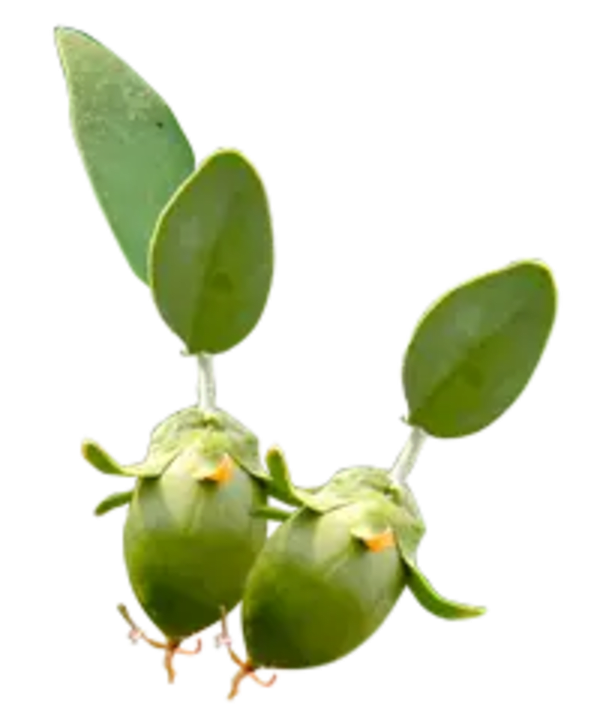
Jojoba oil is actually a liquid wax because it is made up of fatty acid esters rather than fatty acid triglycerides. Its saponification therefore does not produce glycerine. It has little foaming power and little washing effect, but its long-chain fatty acids are softening and it has the advantage of being stable to oxidation. It can be used in cold saponification, as long as low doses (10%) are used.

Prepare a caustic soda solution

To begin with, it's easiest to use caustic soda in liquid form, in solution (preferably at a concentration of around 30%).

If you use caustic soda in solid form, it will need to be dissolved in water for saponification. The calculator will give you a range of acceptable quantities of water. To start with, take the average of the range or a value in the upper half of the range.

Prepare your soda solution in a Pyrex or heat-resistant plastic container.

Place your container with the required quantity of cold water on a stable surface, preferably in a well-ventilated place, or in your kitchen sink for example.

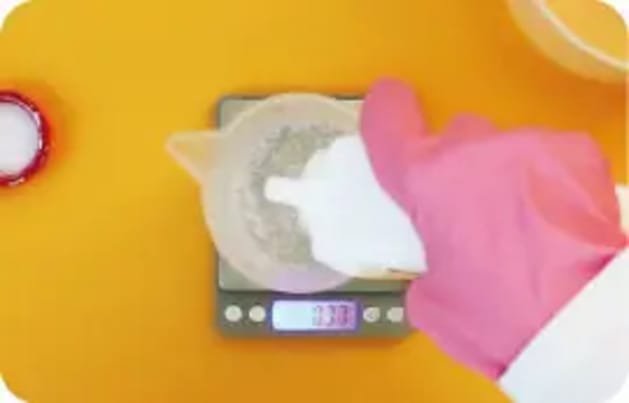
Weigh out precisely the amount of soda in another container, then add the soda to the water (not the other way round), stirring gently with a large plastic or stainless steel spoon. This will heat up and produce fumes. Do not breathe in the fumes.

Move away, leaving the container in place. Stir from time to time and wait for the soda to dissolve completely and for the solution to cool to around 35-50°C before using.

Warning

Be careful not to confuse caustic soda (sodium hydroxide) with soda crystals (sodium carbonate) or sodium bicarbonate, which cannot be used in saponification. Beware, too, of 'unblocker' products that are soda-based but contain other ingredients. Read labels carefully, and if in doubt, ask your retailer.

Soda is an extremely caustic product (highly corrosive, causes serious burns) that should be handled with the utmost care.

Please note

Note that at the end of the saponification process, after the cure period, all the caustic soda will have reacted with the oils to produce the soap. The finished soap no longer contains any caustic soda.

What is caustic soda?

Caustic soda or Sodium hydroxide is the reagent that transforms oils into soap. You can buy caustic soda in DIY shops or drugstores to make your soaps. It can be in solid form (pure), or diluted in water (lye). In the case of the latter, the concentration of the solution must be indicated on the bottle, so choose between 30 and 35% .

To begin with, we recommend using a commercial soda solution (soda lye at around 30%).

Precautions for using caustic soda

  • Store caustic soda with hazardous products, out of the reach of children and separately from acids.

  • Prepare your environment well: remove all clutter and keep children and pets away...

  • Protect yourself : long, thick gloves, safety goggles, closed shoes, "safe" clothes with long sleeves and legs covered and, if possible, an apron or smock.

  • Use resistant materials: Pyrex, glass, silicone, heat-resistant plastic, stainless steel (avoid other metals), etc.

  • For better control of your movements, do your work standing up.

  • When saponifying, always pour the soda solution into the oil mixture, not the other way round.

  • Beware of caustic soap paste splashes. Choose a suitably sized container and keep your mixer at the bottom of the mixture.

  • If any soda or soap paste is splashed onto the surface, rinse immediately with plenty of water.

  • Soap paste is still caustic when poured into moulds. Keep your gloves on and your filled moulds out of the reach of children.

  • Wear gloves again when unmoulding your soaps as they may still be caustic.

  • Also wear gloves when cleaning your containers and utensils. Do not throw soap paste down the sink: wipe up the excess with a paper towel if necessary, then wash thoroughly with water.

  • Allow a cure period of at least 4 weeks before starting to use your soaps.

How much water should I use?

  • If you're using commercial washing soda (with a concentration of between 30 and 35%), don't add any more water- the soda is already diluted in an appropriate amount of water.

  • If you are using solid soda, you will need to dilute it with water. Preferably use demineralised water, especially if your water is hard. The calculator will give you a range of acceptable water quantities.

The table below shows the effects of a rather low or rather high quantity of water (within the recommended range) to guide your choice.

  1. A low quantity of water

  1. Large quantity of water

To begin with, we recommend that you choose the middle of the range, or a value in the top half of the range, so that you have time to observe the different stages (gradual thickening of the paste) and make your additions and adjustments calmly.

If your recipe is very rich in "solid" butters and oils (Coconut, Babassu), the paste will tend to thicken quickly, so choose a high amount of water (value in the top half of the range).

Additions

Oils and butters

For additional fatting with a specific oil or butter, whose properties you want to take full advantage of, add them at the end of the preparation. As the saponification reaction is well advanced at this stage, the additional oil will only be slightly attacked by the soda.

Depending on the "soda reduction" chosen when calculating the soda, you can add up to around 10% of oils as additional superfatting (avoid having more than 12 to 15% "total superfatting", otherwise your soap will be too soft and go rancid more easily).

  • Nourishing: Avocado, Sweet Almond, Olive, Wheat Germ, Argan, Macadamia, Sesame oils, etc.

  • Anti-ageing and revitalising: Musk Rose, Raspberry, Evening Primrose, Borage oils, etc.

  • Soothing: Calendula oily macerate, Raspberry oil, Cranberry oil, etc.

  • Purifying: Nigella, Neem, Calophylla inophylla oils

  • For a very rich, creamy feel: Shea, Mango, Cocoa, Tucuma butters, etc.

Colours

  • Mineral colourants: mineral oxides, ochres, micas, coloured clays. For more even colouring, we recommend pre-dispersing these insoluble colourants in a small quantity of water or oil (which will then add an additional fat). Test beforehand what disperses them best, depending on the colours you're using. It's also possible to add them directly to the soap mixture at the "trace" stage, blending well afterwards to disperse the colourant. For a very white base, add white pasting to the "trace" in your soaps.

  • Plant dyes: madder or Manjishta powder ("old rose"), Urucum (magnificent bright orange), turmeric (reddish-brown), activated natural carbon (intense black, popular for marbling), caramel powder (caramel brown, to be pre-dissolved in the water before adding), nettle (green), Spirulina or Chlorella (dark green), cocoa powder (chocolate brown).

    Add the plant or seaweed powders just before the trace stage and blend with a blender. Test your powder in the presence of a little soda before you start, as some colours are altered by soda (in particular, the violet tones of anthocyanins such as beetroot juice or hibiscus powder turn grey and then brown). Plant powders can also be used in the form of an aqueous or oily macerate (depending on the solubility of the pigments) for a softer, grain-free result: Urucum macerated in oil gives an orange oil that will add colour to the soap (use it in your saponifying oil mixture for an intense result). Madder can be infused in soda water.

  • Coloured oils: adding Buriti oil, Wheat germ oil, Carrot macerate or Calendula macerate will add extra fat while slightly colouring the soap with a yellow-orange note.

Perfume

It is very difficult to predict how odours will hold up in cold saponification.

  • Essential oils: the way in which their fragrance remains in the soap and the way it is reproduced varies enormously depending on the essential oil. Generally speaking, the "base notes" will hold best, whereas volatile notes, particularly citrus, will be difficult to fix in the soap (to improve their hold, combine them with strong base notes). Add essential oils at a rate of 1 to 5% (in relation to the total weight of the oils) to your soap.

  • Essential oils that last well in soap:

    • Long-lasting base notes: Patchouli, Vetiver, Cinnamon, Nutmeg, Clove, Atlas Cedar, Amyris

    • Powerful heart notes: True lavender, Rosemary cineole, Peppermint, Spearmint, Thyme linalol, Palmarosa, Scots pine, Petitgrain bigarade, Black spruce, Geranium, Ylang-Ylang, Coriander, Hô wood

    • Intense top notes: Lemon Litsée, Lemongrass, Ginger, Eucalyptus, Bitter Almond

  • Natural cosmetic fragrances: here again, the scent is very unpredictable. They should generally be used in high proportions (at least 3-5%). Fragrances such as Eastern Touch, White Lilac, Body butter, Bee happy, Amber Treasure, Wild blackberry, Baby doll and Angel’s Touch generally give good results.

    Natural aromatic extracts do not hold up well in cold saponification.

The smell of saponified plant oils generally disappears completely. It is sometimes possible to retain a little scent with oils or butters added at the end of the preparation process (sesame oil or cocoa butter, for example).

Other ingredients: according to your creativity...

  • Honey powder, liquid honey (moisturising, softening). Be careful, honey tends to accelerate the trace and also turns the soap brown. Honey soaps can also heat up quite strongly if you use a large mould.

  • Colloidal oatmeal powder: very popular for sensitive skin, to be added at the "trace" stage.

  • Milks: We recommend using powdered milks so that they can be easily incorporated into the "trace" without adding too much water to the soap:

    mare's milk or donkey's milk powder for a very soft, creamy feel and nourishing, soothing properties. Milks tend to turn soaps brown.

  • Scrubs

  • Fruit or vegetable purées: carrot, avocado, banana, etc.

  • Dried flowers or plants, seaweed, etc.

If you add liquid ingredients or ingredients containing a lot of water (milk, purées), make sure you don't add too much or you'll end up with a soap that's too soft, takes a long time to dry or doesn't keep well. If you intend to add liquid ingredients at the end of the preparation, use a quantity of water at the lower end of the range recommended for dissolving the soda.

Antioxidants

If you are making soaps that are heavily superfatted with oils that are sensitive to oxidation, you can add Vitamin E (0.1-0.2%) or Rosemary CO2 extract (0.1-0.4%) at the "trace" stage, to prevent rancidity and extend the soap's life.

In practice

Stage 1: calculations

This is a very important step, because if the calculation is not correct, the soap may be caustic, i.e. corrosive to the skin.

Whatever the source of your recipe, we recommend that you always check the amount of soda indicated.

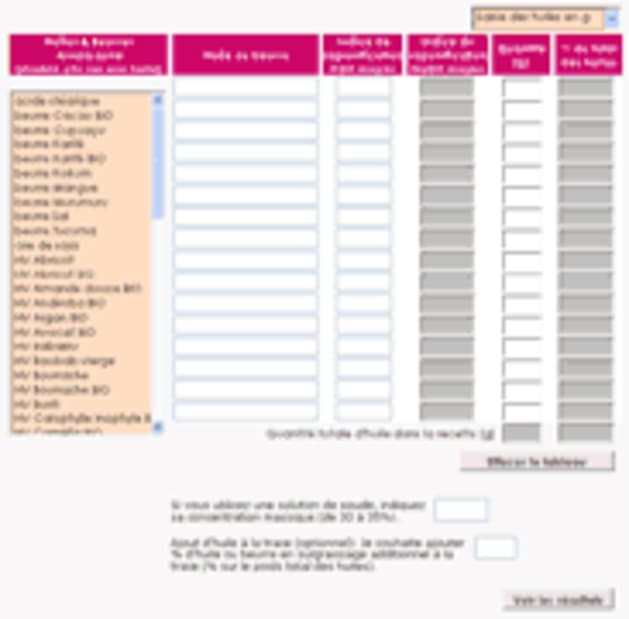
To make this easier, we've provided a calculator here. The results will appear in a results sheet that you can save or print out.

The soda calculator allows you to determine the amount of soda theoretically needed to saponify the oils in your blend. This quantity is then 'reduced' to ensure that there is no residual soda in the finished soap. The calculator's result sheet provides a table showing the quantities of soda calculated with different "soda reductions".

In the table on the result sheet, we advise you to choose a quantity of soda with a reduction of at least 5% to have a safety margin.

  • If you choose the "pure soda (solid)" option, the calculator will also give you a range for the amount of water to use to dilute the soda.

  • If you're using a commercial soda lye (a ready-made solution of soda in water) , enter the concentration (in %, it should be indicated on the bottle and be between 30% and 35%).

If you wish to add additional fat at the time of tracing, simply enter the desired percentage in the appropriate box (but do not enter this oil in the calculator table). The calculator will tell you the weight of oil to add at the end of the preparation.

If you substitute one oil for another, or change your oil quantities at the last minute, you will need to recalculate the quantity of soda to be added.

Find the Aroma-Zone saponification calculator here

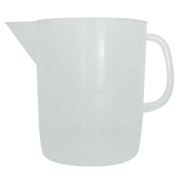
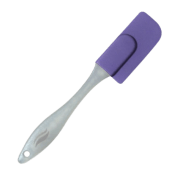
Step 2: the necessary equipment

Stage 3: Making

Step 1

Choose your recipe

Butters and oils in the base to be saponified and their quantities, and exact weight of these oils and butters in the preparation bowl (do not include any oils that may be used for additional greasing at the time of "tracing").

Step 2

Calculate the quantity of soda needed

Use our calculator to work out the quantity of soda required. Enter the quantities of oil you have weighed and run the soda calculator.

Step 3

Preparing the soda solution

With solid soda: weigh the soda accurately and prepare the solution as explained above ("Preparing a soda solution").

With liquid soda: accurately weigh out the quantity of liquid soda (30-35% concentration) indicated by the calculator. There's no need to add water.

Step 4

Preparing the oil mixture to be saponified

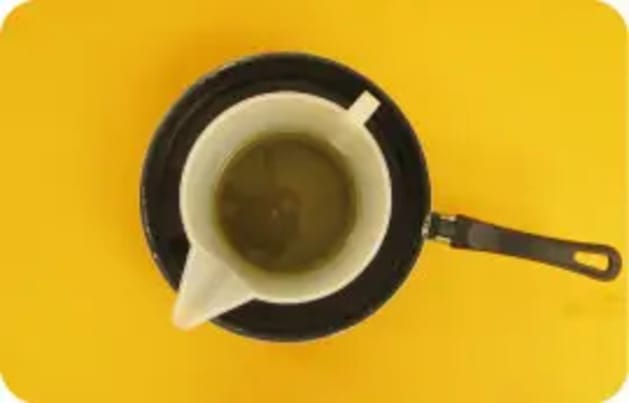
Heat the solid butters and oils in a bain-marie to melt them. Once the mixture is completely melted and homogenous, allow it to cool slightly to around 35-50°C. The mixture should remain completely liquid.

Step 5

Pour the soda solution into the oil (not the other way round!)

Start blending with the immersion blender, alternating with rest periods when you simply use the blender as a spoon to blend (if you keep your blender on for too long, you risk burning out the motor!).

Step 6

Add the additives

When the paste thickens and the "trace" is visible (see box below), add your additives (plant oil or melted butter for additional superfatting, colourings, essential oils or fragrances, exfoliating agent, etc.).

Step 7

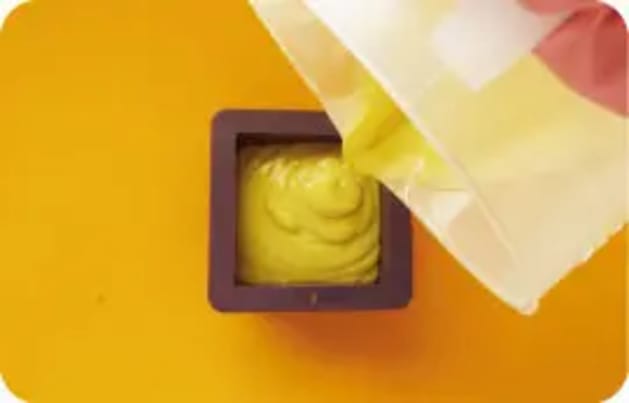
Pour the mixture into the moulds

You can lightly tap your moulds after filling to distribute the batter evenly and avoid air pockets in your soaps.

Step 8

Insulate the moulds

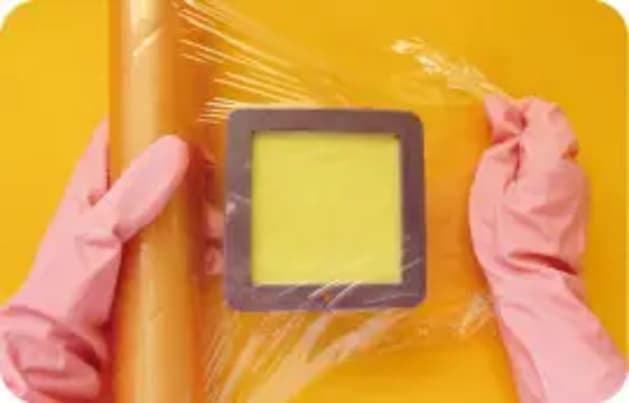
We recommend that you cover them with cling film before placing a towel or blanket over them to keep in the heat and speed up the saponification process. Leave the soaps to harden for 24 to 48 hours out of the reach of children and pets.

Step 9

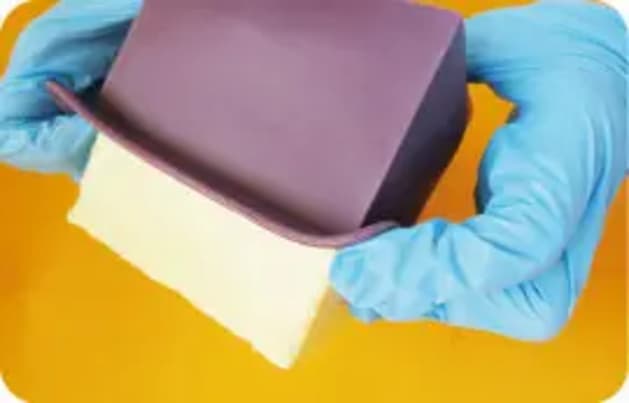
Unmould your soaps

After this time, you can remove the soaps from the mould carefully (they will often still be a little soft) and wearing gloves. If you're using a large mould, cut out your soaps after unmoulding. If you want to stamp your soaps, do so at this point too (after curing, they will be too hard).

Step 10

Leave your soaps to dry

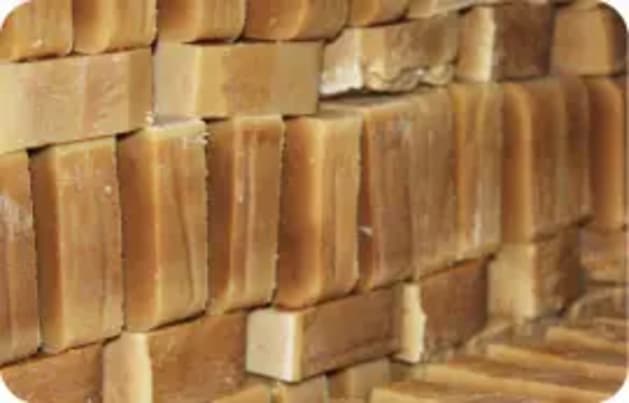
Place the soaps in a dry, well-ventilated place for a "cure" of at least 4 weeks, out of the reach of children and pets. The soaps will then dry and be ready to use.

Stage 4: Storage

Soaps can be stored for months or even years without any problem, in a dry, well-ventilated place away from light and heat.

Recipe ideas!

Ultra-simple Palm-Olive-Coconut base (1 kg)

Ultra-simple palm-free base (1 kg)

Shea butter soap (300 g)

Olive oil soap (300 g)

Cocoa butter soap (300 g)

Baobab oil soap (300 g)

The various possible problems

Help, I think my soap is caustic!

Caustic means corrosive, causing burns. The soda used to make soap is a highly caustic product. A caustic soap is one in which some of the soda has not been used up.

The pH of the soap will then be too high and the soap will be irritating to the skin, or even corrosive.

How to recognise caustic soap

  • On use: a caustic soap will have a slippery feel that persists on rinsing and will not rinse off well, and it will be low-foaming. If you notice tingling, irritation or redness on your hands during or after use, it's also likely that the soap is caustic.

  • Its pH: a normal soap naturally has a basic pH of around 9-10. Soap with a higher pH (11-14) is caustic.

  • With the "tongue test" : briefly touch your soap with the tip of your tongue. If you feel a "zap" sensation, like a violent tingling, your soap is caustic. Normal soap will simply taste soapy. In all cases, rinse your mouth thoroughly after this test.

  • Visually: if your soap has areas containing white crystals, or pockets full of aqueous liquid, it is very likely that it is caustic and that these areas contain badly mixed soda.

Possible causes

  • Soap that's too fresh: have you respected the 4-week minimum cure period? Even if you have, the first thing to try if your soap seems caustic is to wait a few weeks longer. A soap with a slightly too basic pH may simply need a slightly longer cure to complete the saponification process.

  • Too much lye: have you entered the oils used and their weights correctly in the calculator? Have you chosen sufficient superfatting (reduction of soda by at least 5% + additional superfatting)? Have you correctly incorporated all the oils originally planned and all the oil planned for additional fatting? Have you weighed the soda ash accurately enough?

  • Uneven mixing: did you use an electric mixer to mix your soap paste? You can mix the soap by hand, but it's much more delicate (and takes longer) and we strongly advise against it.

  • Uneven additional superfatting: if your paste was already very thick when you added your additional superfatting oil at the end of preparation, it's possible that it won't be incorporated evenly. This won't be a problem if you've chosen a soda reduction of at least 5% to be on the safe side.

  • Soap poured too early: if the paste is poured before it has reached the 'trace' stage, it may partially dephase and lead to uneven saponification.

What should I do with my caustic soap?

  • Never use caustic soap to wash yourself! Throw it away.

  • You can grate your caustic soap and use the flakes as laundry detergent.

If you have used the calculator correctly and followed the instructions for preparing the soap, there will be no soda left in the finished soap, so there's no reason to have a caustic soap.

Problems with the process: Help, things aren't going as planned...

I don't see the "trace".

If your recipe is correct and you are using an electric mixer, the mixture normally thickens fairly quickly and the "trace" point is reached in 5 to 15 minutes. If this is not the case, continue to blend for a little longer, but if the mixture does not thicken after 30 minutes, there is probably a problem: check your ingredients (are you using caustic soda: sodium hydroxide?) and your recipe (not enough soda?), and is the temperature within the recommended range (30-50°C)?

The mixture has become thick / has solidified very quickly

  • Either the temperature of your oil mixture and/or your soda solution is too low and your oils/butters are in the process of solidifying: to avoid this, preferably carry out your saponification between 35°C and 50°C (or even up to 55°C if your formula contains wax). Review your formula, as it may contain too many saturated fatty acids (butters, coconut oil, palm oil, babassu oil, stearic acid, wax). If your oil mixture partially solidified when the soda was added, you may see a false 'trace'. Continue to blend for a long time to make sure that the saponification is well advanced before pouring your mixture into the mould(s).

  • Otherwise the "trace" has appeared too quickly: some oily mixtures will thicken and reach the "trace" more quickly than others. High temperatures can also accelerate the trace. The addition of certain additives (certain essential oils or fragrances, for example) can also accelerate thickening. This is not very serious, but you may find it difficult to incorporate your additions evenly. Your soap may also be more difficult to pour into the moulds.

A rapid 'set' may also be due to certain additives, particularly synthetic fragrances.

The mixture becomes lumpy and changes phase

The temperature (of the oils and/or the soda solution) was probably too high. Respect the 35-50°C range.

The soap paste heats up very strongly in the moulds

This is normal, as saponification is an exothermic reaction (see insert below). If the temperature rises very high, do not insulate your moulds, as this will allow the heat to dissipate.

The soap paste takes on a slightly translucent gelatinous appearance once poured into the moulds.

This is the "gel phase", which is not a problem (see insert below).

The exothermic reaction: What is it?

The saponification reaction is exothermic, meaning that it produces heat. The soap paste will therefore rise in temperature during mixing and after moulding.

It is difficult to predict the rise in temperature because it depends on the oils used, the quantity of water, the initial temperature of the mixture, the temperature of the room, any additives (the addition of milk, honey or certain fragrances can increase the rise in temperature), the size of the mould (the soap will heat up more in a large volume mould than in an individual mould where the heat will be dissipated), whether or not the mould is insulated (etc.).

A rise in temperature is normal and should not be feared (increase of 10 to 30°C maximum).

Mould insulation

Itis advisable to insulate the moulds once they have been filled, i.e. to cover them (with a towel or blanket for example - place cling film over your soaps beforehand) to keep them warm. If necessary, place them in a heat-insulated place (such as a switched-off oven or an empty cool box) to retain as much of the heat produced during the saponification process as possible. This will speed up the saponification reaction.
In certain specific cases, it may be advisable not to insulate the moulds too much, or even to ventilate them to prevent the temperature from rising too high. This will be the case if you notice a very sharp rise in temperature, which can occur in large-volume moulds with certain milk or honey soaps. Experience will enable you to build up personal data on this. In individual or medium-sized moulds such as the ones we offer, the temperature rise will rarely be very great, and it's important to remember that the rise in temperature allows the soap to saponify properly, so we advise you to cover your moulds, which will allow saponification to take place in the best possible way.

Problems with the look and texture: my soap looks strange, is this an issue?

Problems with the look and texture: my soap looks strange, is this an issue?

Soap that is too soft or softens very quickly when used

Possible causes

  • Insufficient curing time

  • Too much superfatting

  • Unsuitable choice of base oils/butters (not enough saturated fatty acids)

  • Too much water or too much liquid added at the end of the preparation process

What should I do with my soap?

Try leaving the soap to dry for a few more weeks.

To avoid this next time

Review your recipe:

  • if the total superfatting was greater than 10%, reduce it.

  • Increase the proportion of "solid" butters or oils (coconut, copra, babassu) in your recipe.

  • Reduce the proportion of liquid active ingredients added at the trace stage.

  • Reduce the amount of water used to dissolve the soda if you are using solid soda (within the recommended range).

Soap covered with a fine layer of white to greyish powder

Possible causes

"Soda ash" (sodium carbonate): forms when the soda comes into contact with the ambient air. What should I do with my soap?

  • It's mainly a cosmetic problem. This layer is not dangerous and will disappear after the first use.

  • Scrape or remove the white layer with a "peeling" knife, for example, or by rubbing with a damp cloth.

To avoid this next time

  • Cover your moulds with transparent film to prevent the fresh soap coming into contact with the air.

  • Keep your soaps in the "filmed" moulds for longer (2-3 days).

Uneven colour, with dots

Possible causes

Poorly dispersed dye

What should I do with my soap?

Use it as normal, it's only a cosmetic problem.

To avoid this next time

Pre-disperse your colourant in a little oil or water, removing any lumps. Blend well in a mixer after adding.

Uneven colour, with unwanted patterns or shades

Possible causes

  • Gel phase

  • Fragrance poorly dispersed

What should I do with my soap?

Use it as normal, it's just a cosmetic problem.

To avoid this next time

  • See "The gel phase" insert

  • Pre-disperse your fragrances in a little oil (additional oiling).

Uneven appearance: the soap paste changes phase in the mould

Possible causes

  • The paste was poured into the moulds before reaching the "trace" point.

  • The paste was cooled too quickly after pouring into the moulds.

What should I do with my soap?

Throw the soap away, it's caustic.

To avoid this next time

  • Wait until the paste has thickened enough (medium consistency) before pouring it into the moulds.

  • Keep your moulds warm and cover them to keep the heat in.

Uneven appearance: the finished soap has cracks on the inside

Possible causes

  • If the cracks contain white crystals or are caustic: excess soda or poor mixing.

  • If the cracks are not caustic: sudden gel phase or major temperature variations.

What should I do with my soap?

  • Caustic cracks: throw the soap away.

  • Cracking due to temperature variations: only a cosmetic problem.

To avoid this next time

  • Check your recipe and the quantity of soda; use enough water to dissolve all the soda (range given by the calculator).

  • If you notice a very sharp rise in temperature, don't insulate the moulds.

Bubbles or pockets containing an aqueous liquid or white crystals

Possible causes

Too much soda or the wrong mixture

What should I do with my soap?

Throw the soap away, it's caustic.

To avoid this next time

  • Check your recipe carefully and calculate the amount of soda.

  • Use an electric mixer to make your soap.

Bubbles or air pockets

Possible causes

  • The soap paste was already very thick when it was poured

  • Whipped soap (small bubbles) or a lot of air incorporated during mixing

What should I do with my soap?

If the bubbles are just air, it's just a cosmetic problem.

To avoid this next time

  • Pour the mixture into the moulds before it becomes too thick, and tap your moulds to eliminate the bubbles.

  • Use an electric mixer (not a whisk) and hold it firmly to the bottom of the mixture so as not to incorporate any air.

The soap oozes oil

Possible causes

  • Partial phase shift (see above)

  • Too much superfatting - too much oil

  • Uneven mixing of the integrated oil at the end of preparation

What should I do with my soap?

  • Check that the soap is not caustic.

  • If it is, the soap can be used but may be too soft / melt quickly / go rancid more easily.

To avoid this next time

  • Wait for a sufficiently thick "trace" before running the soaps.

  • If the total superfatting was more than 10%, reduce it.

  • Add the additional oil before the paste is too thick and blend with a mixer.

Orange spots appear on the soap after a while

Possible causes

Rancidity

What should I do with my soap?

If it's just a few localised spots, you can remove them with the tip of a knife and use your soap as normal. To avoid this next time

  • Store your soaps in a well-ventilated place, away from light and heat.

  • Avoid plant oils that are sensitive to oxidation, especially when superfatted.

  • Reduce the amount of extra fat if it is high.

  • Add an antioxidant (vitamin E, Rosemary CO2 extract).

The gel phase: What is it?

This phenomenon can be observed (but not necessarily) in the hours after the soap has been poured into the moulds. The soap then becomes slightly translucent, with a "gel" appearance and the colour appears darker than in the initial paste.

The gel phase is observed when the temperature rises above a certain limit, which will depend on the oils used, but also on the quantity of water. As the rise in temperature also depends, among other things, on these parameters, the "gel phase" is fairly difficult to predict. The "gel" effect usually starts in the centre of the soap, then spreads towards the edges. The soap will then become opaque again and lose this gel appearance, but it is possible that traces of this "gel phase" will remain on the soap (unwanted patterns, colour shades, etc.). The gel phase is not essential for good saponification, although it can reassure you that the soap has reached the right temperature, which speeds up saponification. A soap that has not undergone a gel phase will need more time to complete saponification, which is done during the cure phase.

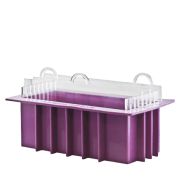
The gel phase generally occurs in large moulds, such as the Aroma-Zone separating mould, but more rarely in individual soap moulds.

Marbling techniques

There are various marbling techniques for creating pretty designs on your soaps. Here are some of the best-known, but don't hesitate to come up with your own ideas!

For marbling, you need to work fairly quickly because soap paste thickens quickly. We advise you to choose a formula with a fairly high water content (top of the range) to slow the setting a little. Start adding your colourings as soon as you see a fine trace.

Feather marbling

This highly aesthetic design is made in a divider mould. You can use from 2 to 6 different colours depending on the effect you want and the number of dividers used (1 to 5).

1

Divide your soap paste into several parts and colour each part with the dyes of your choice.

2

Pour your coloured soap paste between the dividers in your mould, alternating colours. Pat your soap paste into the mould as you fill it to prevent air bubbles from forming.

3

Gently remove all the dividers from the mould one by one, pushing the soap mixture with a spatula along each divider so as not to "carry" too much soap mixture. Tap your mould on the work surface to eliminate any air pockets.

4

Use a chopstick to apply the marbling using the following technique:

or

5

After unmoulding, cut your soap into 3 equal parts, then tip each part of soap onto its edge and cut into 3 lengthways to reveal the marbling.

Variation: After passing the chopsticks in a zigzag or figure of 8 pattern, you can also pass the chopstick around the edge of the soap, drawing concentric circles along the edge of the mould. You can draw around 5 to 10 circles depending on the desired effect. This will "train" the previously formed patterns to give them a circular movement.

Hanger marbling

This is best done in a long mould, such as the Aroma-Zone divider mould. If you also use the separators, you can create a "secret feather" marbling effect.

1

Before starting your mixture, bend a wire hanger to obtain a marbling tool the length of the mould.

2

Once you've made a fine trace, divide your soap paste into several parts and colour each part with the dyes of your choice.

3

Pour your coloured soap paste into the mould in layers of different colours. You can make a single coloured layer or alternate several colours.

4

Run the coat hanger through the soap paste as shown in the diagram to create the marbling.

5

After unmoulding, cut your soap into slices like a cake.

Tip: "Secret feather" marbling

Using the same principle, you can use the dividers to marble only part of the soap with a hanger, pouring your coloured layers only between 2 dividers. Remove the separators, then run your coat hanger through the middle of the coloured strip, making it stand out on one side of the soap.

Marbling with a spoon

This marbling is very easy to make in all types of mould. It can even be done with a fairly thick paste, but start with a medium trace to allow enough time, as it can take quite a long time to do, especially in a large mould. Remember to press the paste down well, tapping your tin as you go, to avoid air pockets.

1

Divide your soap paste into several parts and colour each part with the dyes of your choice.

2

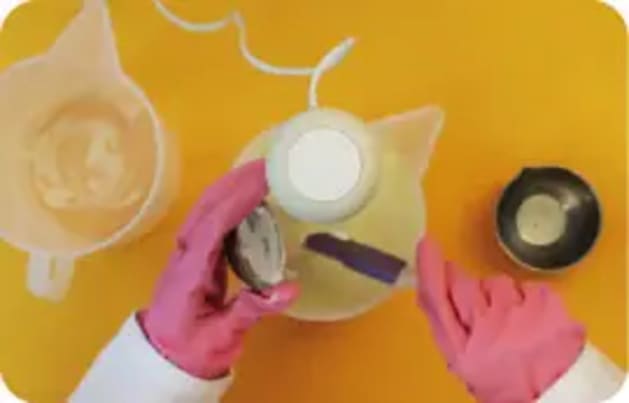
Using spoons, scoop out your different coloured soap pastes and scatter them along the length of your mould, alternating colours until your mould is completely filled.

Marbling with a funnel

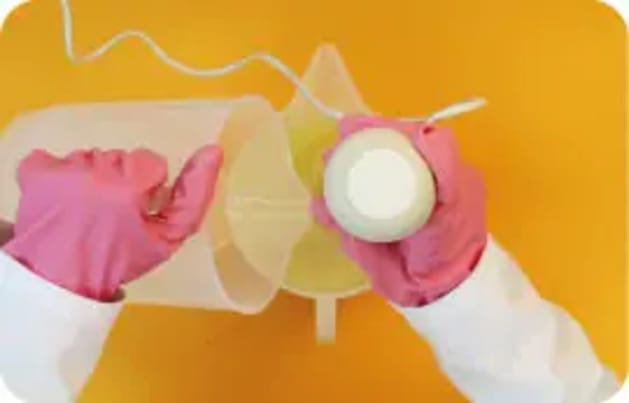
Use this marbling technique to create pretty concentric circles on your soaps, for psychedelic effects! Use a fairly fluid paste and work quickly so that the paste flows easily from the funnel.

1

Place a funnel in a fixed position above your mould (or have another person hold it, equipped with gloves, goggles, etc.).

2

Divide your soap paste into several parts and colour each part with the dyes of your choice. You can use as many different colours as you like.

3

Pour your coloured pastes alternately into the funnel, which will form concentric coloured streaks in the soap.

"Column" marbling

This type of marbling produces effects quite similar to funnel marbling, with a pattern of coloured streaks, but the streaks are not circular. Use a fairly fluid paste and work quickly so that the paste flows easily over the column. This marbling is done in a fairly large square or rectangular mould. For your "column", you will need a rectangular parallelepiped (resistant to caustic soap paste), for example a fairly thick rectangular piece of wood.

1

Place your column in the middle of the mould.

2

Divide your soap paste into several parts and colour each part with the dyes of your choice. You can use as many different colours as you like.

3

Pour your coloured pastes alternately onto the column, which will form coloured streaks in the soap.

4

Remove the column, then tap lightly to distribute the soap paste evenly in the mould before covering it.

Other making techniques

Industrial hot saponification

This is the type of process used to produce soaps on an industrial scale, as it allows the soda to react quickly and completely with the fats. Saponification takes place at high temperatures and in the presence of excess soda. The soap paste is "cooked", i.e. heated until the saponification reaction is complete. The paste is then washed, usually with salt water to remove the excess lye. During this operation, the glycerine is also separated from the soap and removed. This type of saponification cannot be carried out without industrial equipment.

The traditional process used to produce Aleppo soap or Marseille soap is also based on hot saponification.

Hot saponification at home

The process is similar to cold saponification, but saponification is accelerated by heating the soap paste in a bain-marie or even an oven.

The advantage is that saponification is normally complete by the end of the process, reducing the curing time. However, this involves heating the oils, which is not always desirable. On the other hand, the ingredients added at the end of the process are better preserved (particularly the fragrances).

Hot methods are much more delicate than cold saponification and require a high level of expertise. We therefore advise you not to try hot saponification unless you have good experience of cold saponification and a good understanding of the process.

A simpler variant is to carry out cold saponification, pouring the soap paste into moulds, then "baking" the soaps in their moulds in the oven (1 to 2 hours at around 80-90°C). This has the advantage of speeding up saponification and therefore reducing the curing time. However, all your ingredients will be heated and may be damaged (especially perfumes or sensitive oils added as an extra fat at the trace stage). Also, beware of "volcano" effects, as saponification is exothermic (produces heat) in itself, so there's a risk of overheating in the oven…

"Melt and Pour" soaps

"Melt and Pour" soaps are in fact soaps that have already been saponified, to which other ingredients have been added (in particular plant-based glycerine and a sugar: sorbitol) to obtain a formula that can be easily remelted in a bain-marie.

Making soaps with a "Melt and Pour" base is therefore very simple and does not involve any handling of soda. All you have to do is melt the soap in a bain-marie, add colourings, fragrances, active ingredients and exfoliants… according to your creativity, then pour your soaps into moulds. They are ready to use as soon as they have hardened, after a few hours.

"Soap-free" or "syndet" soaps

As their name suggests, 'soap-free' soaps or dermatological bars are not real soaps, i.e. they are not produced by saponifying oils.

They are mixtures of solid surfactants (often synthetic, of petrochemical origin, but some of plant origin) which are agglomerated and moulded under pressure to form soap bars. Their advantage is that they have a pH close to that of the skin, unlike real soaps, which necessarily have a basic pH. It's a shame, however, that the vast majority of 'syndets' are made from surfactants that are not very environmentally friendly (and sometimes potentially irritating too).

Find the Aroma-Zone saponification calculator here

Find out more

The trace: what is it?

This is the stage at which the soap mixture begins to thicken to the point that if you raise the mixer (switched off!), a trace will remain on the surface of the soap mixture for a few moments. A distinction can be made between:

Curing: What is it?

In cold saponification, it is essential to allow the soaps to 'cure' after demoulding before you start using them. This time is necessary to allow the saponification reaction to finish properly, and therefore softens the soap. Curing also allows the soap to dry and harden, which will extend its life (soap that is too 'fresh' melts very quickly).

We recommend a cure of at least 4 weeks to ensure that the saponification process is complete. Depending on the formula, and in particular the amount of water or wet ingredients used, a longer period may be necessary to obtain really hard soaps. Soap properties (lather, creamy feel, durability) generally improve with longer curing time.

The saponification index: What is it?

To use an oil or butter for cold saponification, you need to know its saponification value. This information is used to calculate the quantity of soda to be used.

The saponification indexes of oils and butters are sometimes measured by suppliers, but most of the time they are bibliographic data in the form of ranges of values. Our calculator uses the average value of the range for the calculation.
The saponification indices given in the bibliography are generally "KOH saponification indices", i.e. for saponification with potash (potassium hydroxide KOH) and not with soda (sodium hydroxide NaOH).

The KOH saponification index of an oil is the quantity (in milligrams) of potash needed to saponify 1 gram of this oil.

Our calculator is designed for saponification with soda (NaOH), not potash (KOH), but it automatically converts the KOH saponification number into the NaOH saponification number. When you use the Aroma-Zone calculator, the saponification numbers of each oil on the list are already integrated into the calculator and will be taken into account automatically in the calculation.

You can add oils or butters that are not on the list to the calculation, as long as you know their KOH saponification number, which you will need to enter in the "Average KOH saponification number" column.

Bibliography

1

The soapmaker's companion

Susan Miller Cavitch

2

The natural soap book

Susan Miller Cavitch

3