Myth or reality: collagen treatments – effective or just a fad?

Myth or reality: collagen treatments – effective or just a fad?


By Lou Dumas

Published on: Monday, March 16, 2026, Updated on: Friday, October 09, 2026

It’s a fact: marine collagen treatments are now everywhere – on social media, in wellness cafés and in beauty discussions. And, incidentally, there’s a flood of misconceptions: they’re pointless, they taste awful, you need huge doses, all supplements are the same… In this context, what does the science actually say? The interest in these treatments can be explained in particular by the fact that the body’s natural production of collagen gradually decreases with age, contributing to a loss of skin firmness and elasticity. Recent clinical trials and meta-analyses have found that collagen peptides do indeed have a real effect on certain skin parameters, notably hydration, elasticity and the appearance of wrinkles. However, this does not mean they are a miracle cure, nor does it imply that all products are equivalent. Here’s a detailed breakdown.

Contents

Related products

In brief

  • There are many misconceptions surrounding marine collagen treatments.

  • Studies have noted possible effects on hydration, elasticity and the appearance of wrinkles, but the evidence still needs to be more widely confirmed and further investigated over time.

  • The results observed appear after several weeks of treatment.

  • The quality of hydrolysed collagen peptides and their molecular weight can influence their bioavailability.

  • A collagen treatment forms part of a holistic approach to skincare and is no substitute for suitable skincare products or a healthy lifestyle.

Common misconception no. 1: Collagen powder doesn’t work

Several clinical trials have observed improvements in certain skin parameters following supplementation with collagen peptides. In a controlled study involving women aged between 45 and 65, daily intake of collagen peptides for eight weeks was associated with a reduction in the volume of wrinkles around the eyes and an increase in certain markers of the dermal matrix, such as type I procollagen andelastin (2). Other studies support these findings. A randomised, triple-blind, placebo-controlled study found that taking marine collagen supplements for 12 weeks was associated with an improvement in skin elasticity and the appearance of wrinkles in women with mild to moderate skin ageing (3). Another study using confocal microscopy (detailed cellular observation) also reported an improvement in dermal structure after several weeks of treatment (4). These highly promising results must nevertheless be interpreted with caution. A recent meta-analysis combining more than twenty clinical trials confirms overall improvements in hydration, elasticity and wrinkles following a course of collagen treatment. The authors conclude, however, that the current evidence remains limited and requires further studies to be substantiated (1).

In summary: the data support these effects, but research is still ongoing to explore the true extent of these benefits.
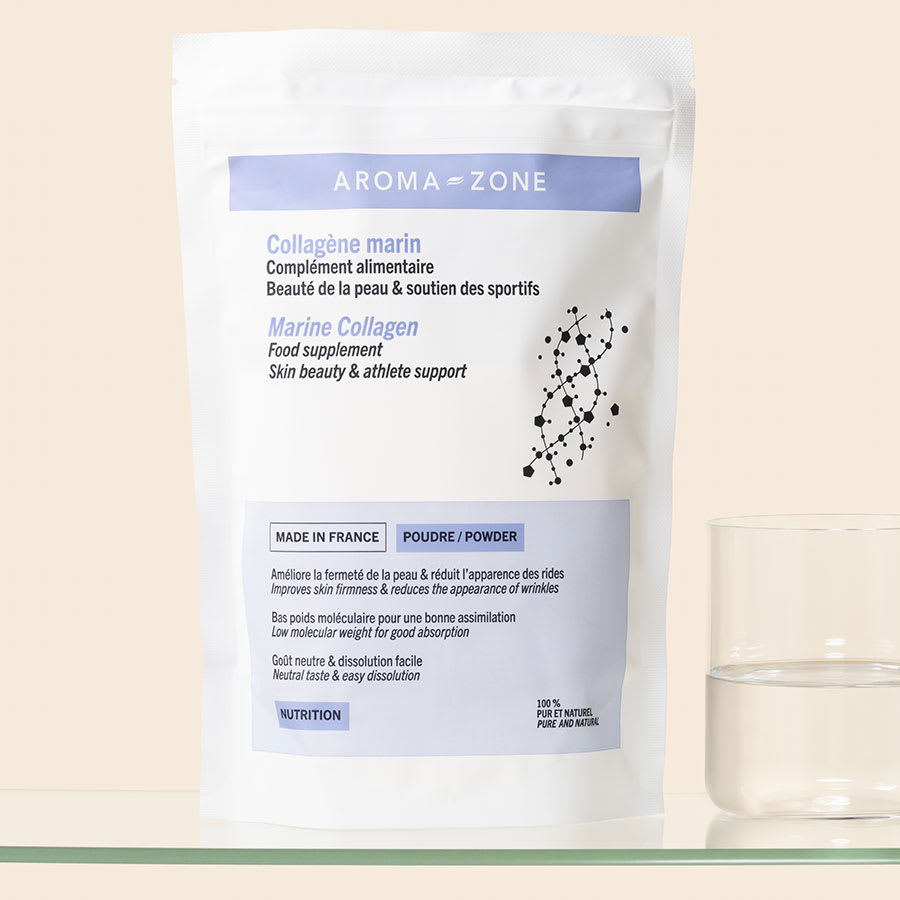

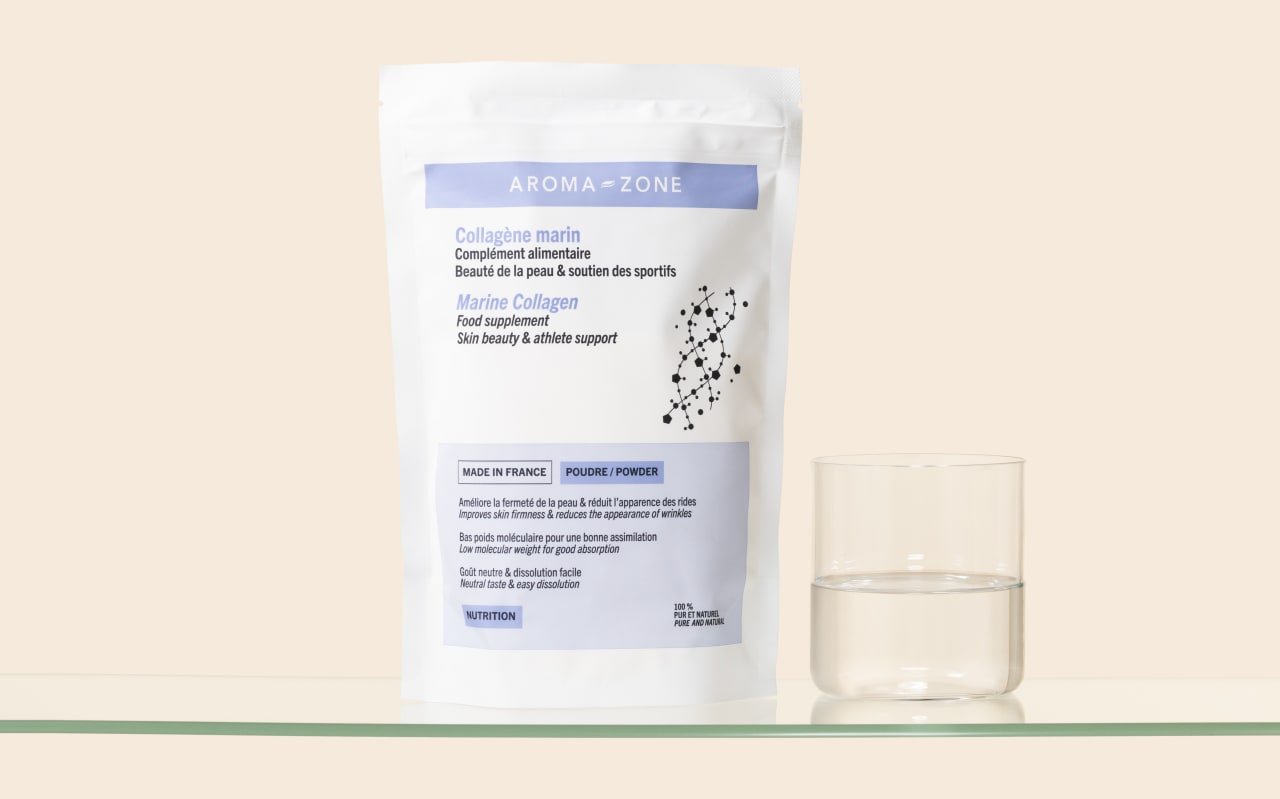
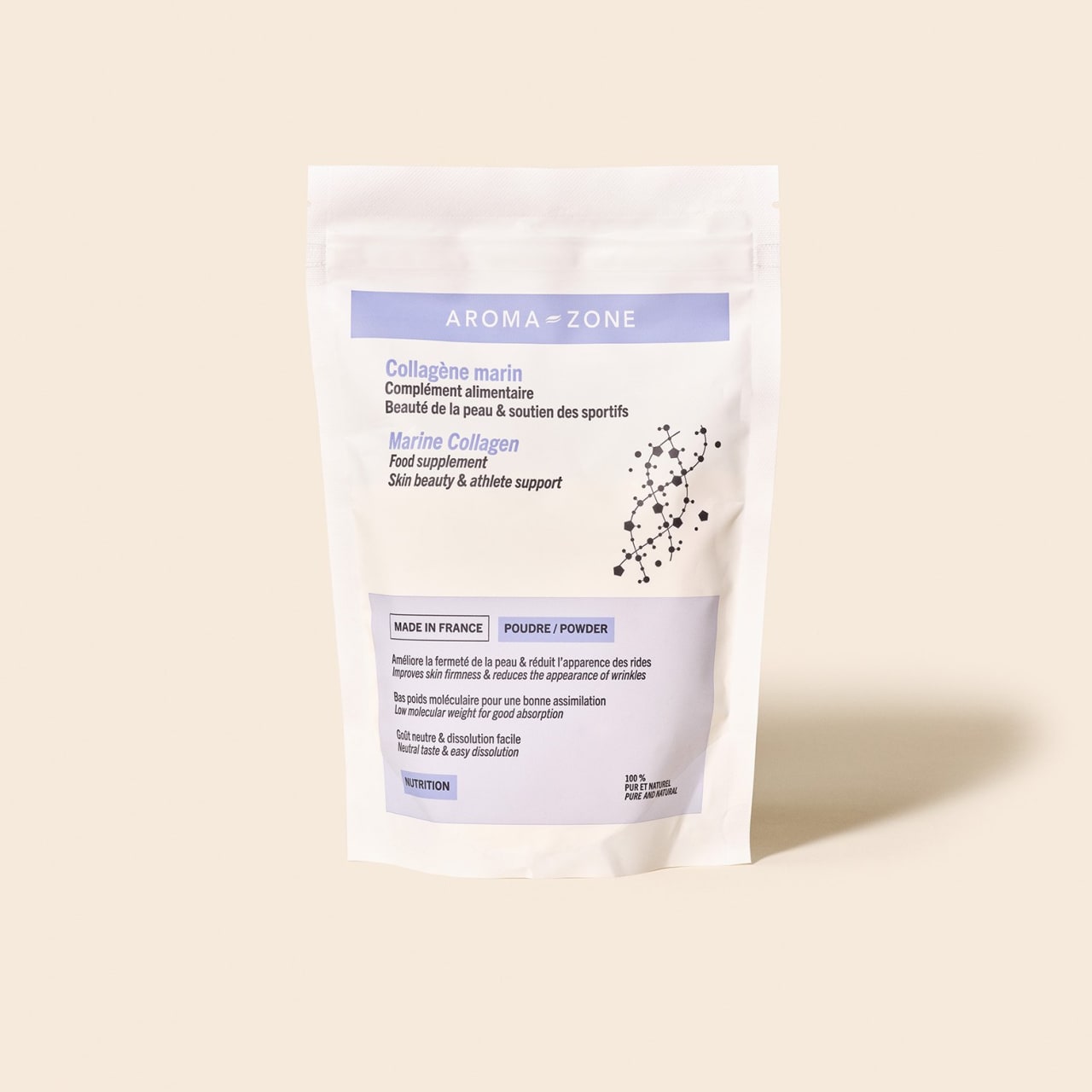
What about Aroma-Zone’s marine collagen? Our collagen powder is composed of hydrolysed type I collagen peptides, the form most commonly found in the skin. These peptides have a molecular weight of approximately 2,000 Daltons, obtained through enzymatic hydrolysis, which enhances their solubility and digestive absorption. This collagen is derived from purified and hydrolysed fish, and is supplied in powder form, making it easy to incorporate into a daily routine. Manufactured in France, this supplement has proven efficacy in improving skin beauty and firmness, as confirmed by three clinical studies. These randomised, double-blind, placebo-controlled clinical trials, conducted at the CPCAD (Nice University Hospital), assessed the effects of marine collagen peptides at doses of 2.5 g, 5 g and 10 g per day for 8 to 12 weeks. The results show, in particular, an improvement in skin evenness (+18 per cent), a reduction in wrinkles around the eyes (-17 per cent), and an increase in firmness (+15 per cent) and skin hydration (+23 per cent). A consumer trial involving 65 women over 28 days also reported that 77 per cent observed more hydrated skin after 14 days, and 91 per cent felt their skin looked better after 28 days.

Common misconception no. 2: if it were effective, the results would be immediate

False. Collagen supplements do not work as an instant treatment. Any effects they may have are generally observed over several weeks. In the available clinical trials, the protocols usually last between eight and twelve weeks before skin parameters are assessed. The improvements observed mainly relate to skin hydration, its elasticity or the appearance of certain fine lines (2)(3)(4). This timeframe is consistent with the biology of the skin. Cell renewal in the epidermis and the dynamics of the dermal matrix occur over cycles lasting several weeks. A nutritional programme cannot therefore produce visible results in just a few days.

In other words: a collagen treatment programme is part of a long-term approach, not an instant transformation.

What about Aroma-Zone marine collagen? For optimal effectiveness, and in line with the recommendations from the scientific studies mentioned, we recommend a 3-month course of our collagen.

Common misconception no. 3: all collagen products are the same

This is incorrect. The term ‘collagen’ actually refers to a large family of proteins. Scientists now recognise several dozen different types, found in the skin, bones, cartilage and tendons (5). In dietary supplements, the form found is mainly hydrolysed collagen, i.e. broken down into small peptides. This process facilitates its absorption in the digestive system. After ingestion, these peptides are broken down into amino acids and small peptide fragments which the body can use as building blocks for various tissues, including the skin (3). Clinical trials demonstrating effects on the skin have mainly focused on specific hydrolysed collagen peptides. It is therefore difficult to generalise the results to all forms of collagen.

In a nutshell: the source of the collagen, the hydrolysis process and its molecular weight can influence its properties and bioavailability.

What about Aroma-Zone’s marine collagen? Our collagen is composed of premium-quality hydrolysed marine collagen peptides with a low molecular weight for optimal absorption. Sourced from farmed fish, it is also certified as sustainable by Friend of the Sea. Highly pure (>99% collagen peptides in the dry product), this product is strictly monitored and analysed for every batch (heavy metals, microbiology, etc.). It has not undergone any ionisation or irradiation treatment.

Common misconception no. 4: you have to take very large amounts for it to work

Not necessarily. Contrary to popular belief, not all clinical studies use high doses. In some trials, effects were observed with relatively modest doses, around 2.5 g of collagen peptides per day for eight weeks (2). Other studies use higher doses, often between 5 and 10 g per day. However, direct comparisons between doses remain difficult, as studies differ in many respects: the type of peptides, the source of the collagen, the duration of the course of treatment, or the presence of other micronutrients in the formulation (1). The scientific literature therefore does not yet allow us to determine a universal optimal dose. The quality of the peptides, their hydrolysis and the protocol studied probably play a role at least as important as the quantity consumed.

Key takeaway: there is no single ideal universal dose, but rather a range of doses generally studied in the scientific literature (and it is not that wide...).

What about Aroma-Zone’s marine collagen? Our collagen courses involve doses ranging from approximately 2.5 g to 10 g per day, which are similar to those studied in several clinical trials focusing on skin health (2)(3)(4).

Common misconception no. 5: marine collagen powder has a strong taste

It is, above all, a question of formulation. The taste of a collagen powder depends largely on its raw material, its degree of purification and the quality of the hydrolysis. Some powders may have a slightly marine flavour, whilst others are almost neutral. This factor relates more to sensory experience than to biological efficacy. Scientific studies focus primarily on the composition and properties of collagen peptides, not on their flavour profile.

In short: taste is therefore more a matter of formulation than an intrinsic property of collagen.

What about Aroma-Zone’s marine collagen? Available in micro-granule form, our collagen dissolves quickly without forming lumps. Its neutral flavour makes it easy to incorporate into your daily routine: in a glass of water or fruit juice, in a coffee, a tea or even a smoothie. It withstands heating well and can be used in recipes that require cooking.

Common misconception no. 6: a collagen treatment alone is enough to improve the appearance of the skin

Unfortunately, no. Even in the most favourable studies, collagen supplementation is considered to be just one factor amongst many in skin health. Skin ageing depends on numerous factors: sun exposure, stress, smoking, diet, sleep and the quality of skincare. Dietary supplements can support a holistic approach, but they are no substitute for appropriate sun protection or well-formulated topical skincare products (1).

Conclusion : collagen supplementation can form part of a broader skincare strategy, but it does not act in isolation.

What about Aroma-Zone’s marine collagen? Provided there are no contraindications (kidney failure, hypercalcaemia, pregnancy or breastfeeding), our collagen has a place in a comprehensive skincare routine designed to support the skin’s beauty. It is particularly recommended for mature skin that has lost firmness or elasticity, or for dry skin lacking hydration. In this context, it can be used alongside other essential skincare steps such as sun protection, moisturising or the use of targeted active ingredients.

Common misconception no. 7: collagen treatments can have benefits across the board (beauty, joints, sport, etc.)

Surprisingly, it is. Collagen is a major structural protein found in many tissues of the body, including the skin, bones, cartilage and tendons (5), suggesting that supplementation has a wide-ranging effect. However, scientists have identified 28 different types of collagen, each with a specific role in the body. Type I collagen, for example, is the most abundant in the human body. It makes up a large part of the structure of the skin, tendons and bones. Type II collagen, on the other hand, is predominantly found in joint cartilage. Other forms, such as types III and V, also contribute to the structure of certain connective tissues (5). Collagen has no ‘memory’ and does not operate on the principle of ‘returning to the original tissue’. This is why collagen I or II peptides can be used interchangeably to reach the skin or joints without selectivity. 

In short: what determines the efficacy of the peptides is therefore not the type of collagen from which they are derived, but their bioavailability and the peptide sequences that make them up. 

What about Aroma-Zone’s marine collagen? Our collagen powder mainly provides type I collagen, the predominant form found in the skin. It is therefore particularly associated with beauty applications. In addition, it is also popular with some people who exercise regularly, who incorporate it into their nutritional support strategy.

A closer look at our award-winning marine collagen powder

marine-collagen 3 -(1)

Marine collagen powder 250 g

Voted best dietary supplement in 2026 and 2024 by the health experts on the Top Santé jury, this supplement is made from premium-quality hydrolysed marine collagen peptides. Thanks to their low molecular weight, these peptides are easily absorbed by the body. Sourced from farmed fish, this marine collagen—certified as sustainable by Friend of the Sea—is manufactured in France. It provides type I collagen, the form most commonly found in the skin, but is also popular in sports nutrition regimens.

Discover Aroma-Zone marine collagen

Our conclusion, based on the scientific literature

Myth or reality

Marine collagen treatments are neither merely a passing fad nor a miracle cure. Available scientific studies have observed effects on certain skin parameters, but results vary depending on the protocols used (1).

What they actually do

Current data suggest that collagen peptide supplements may help improve skin hydration and elasticity or the appearance of certain wrinkles after several weeks of supplementation (2)(3)(4). However, these effects must be interpreted within the context of a holistic approach.

Food for thought

Research into collagen-based dietary supplements remains a relatively recent field of science: researchers emphasise that the current positive results still need to be confirmed by large-scale independent studies (1). Another point often highlighted by scientists concerns the complexity of collagen itself. In the human body, this protein accounts for approximately 30 per cent of the body’s total protein and is the main structural component of many connective tissues, notably the skin, bones and cartilage (5). Its natural renewal gradually declines with age, which explains the growing interest in research into nutritional strategies that may support the extracellular matrix. However, the precise mechanisms by which collagen peptides might influence the skin are still being investigated. Some hypotheses suggest that peptides derived from digestion act as biological signals, potentially stimulating certain cellular functions involved in the synthesis of the dermal matrix (1)(2). Science therefore does not rule out the potential benefits of collagen as a course of treatment, but it emphasises that supplements must be rigorously evaluated.

Our expert’s opinion

A word from the dermatologist

"Collagen is a protein found in abundance in the dermis that contributes to the skin’s mechanical properties. Studies available to date show a modest improvement in skin hydration and elasticity when collagen is taken orally. The mechanism suggested is the stimulation of collagen synthesis by the skin."

Dr Reyhan Amode, dermatologist and member of the Aroma-Zone College of Dermatologists

Article written by Lou Dumas, Naturopath

Lou_Dumas_02.JPG

Lou graduated from HEC in 2012. She gained ten years of experience in marketing for cosmetics and perfumes before becoming an independent consultant in this field. She recently completed a three-year naturopathy program at the European College of Holistic Naturopathy (CENATHO, Paris) with the goal of supporting the physical and mental health of the people she works with through a holistic approach to lifestyle.

Bibliography

  1. Myung SK, Park Y. Effects of Collagen Supplements on Skin Ageing: A Systematic Review and Meta-Analysis of Randomised Controlled Trials. 2025.

    https://pubmed.ncbi.nlm.nih.gov/40324552/

  2. Proksch E et al. Oral intake of specific bioactive collagen peptides reduces skin wrinkles and increases dermal matrix synthesis.

    Skin Pharmacol Physiol. https://pubmed.ncbi.nlm.nih.gov/24401291/

  3. Evans M et al. Randomised, triple-blind, placebo-controlled study evaluating marine collagen on skin wrinkles and elasticity.

    J Cosmet Dermatol. 2021. https://pubmed.ncbi.nlm.nih.gov/32799362/

  4. Laing S et al. A dermonutrient containing special collagen peptides improves skin structure and function.

    J Med Food. 2020. https://pubmed.ncbi.nlm.nih.gov/32017646/

  5. Inserm. Does collagen really relieve pain? Canal Détox, 2025.

    https://presse.inserm.fr/canal-detox/le-collagene-pour-soulager-les-douleurs-vraiment/

Frequently Asked Questions

Frequently Asked Questions