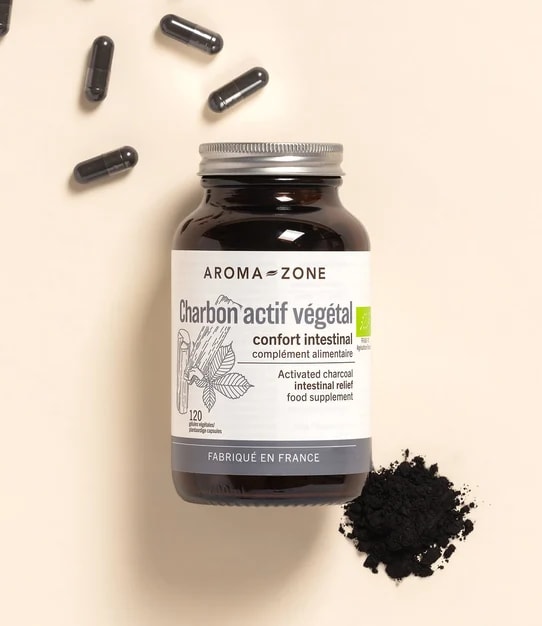

Aroma-Zone plant-based activated charcoal

ADSORBENT PURIFYING


Captures certain intestinal gases and limits their build-up


An active ingredient recognised for reducing gas and associated discomfort under the conditions studied; it removes impurities and can be used as a colouring agent.


Reading time: 0 min.

Plant-based activated charcoal Aroma-Zone Profile

INCI Name: Charcoal

NATURAL / SYNTHETIC

100% plant-based, 100% pure and natural. High-quality activated charcoal for cosmetic and food use.

VEGAN – CERTIFICATIONS

BIOCHEMICAL COMPOSITION

100% pure activated vegetable charcoal.

TRACEABILITY & SUSTAINABILITY

Aroma-Zone plant-based activated charcoal is 100% plant-based, 100% pure and natural. It is produced by calcining coconut shells, followed by thermal activation in the presence of steam (without the use of chemicals, unlike many other activated carbons). It has a specific surface area (BET) of 1,600–1,800 m²/g, which is an exceptionally high value and corresponds to excellent adsorption capacity.


Plant-based activated charcoal: What Effect Does It Have on the Body?

Activated vegetable charcoal is characterised by a microporous structure and an exceptional exchange surface area, making it a versatile adsorbent that is particularly effective at capturing organic and inorganic compounds. Its action is based on the physical mechanism of adsorption: thanks to its high surface reactivity, it is able to retain certain molecules upon contact.

In cosmetics, this unique ability offers a genuine solution for skincare. Used as an active ingredient in face masks, soaps or exfoliating treatments, it helps to remove impurities and pollutants that build up on a daily basis. Its hydrophobic nature enables it to target these unwanted substances whilst preserving the skin’s natural moisture balance.

This effectiveness is also observed in relation to gut health. Clinical studies confirm that activated charcoal helps to alleviate excess gas and feelings of bloating. In particular, it helps to reduce hydrogen levels measured in exhaled air, a key indicator of gas production in the colon.

Plant-based activated charcoal: Scientifically Proven Efficiency

The effectiveness of activated plant-based charcoal lies in its unique physical characteristics: a microporous structure and a very high surface area, which make it an ideal adsorbent for capturing organic compounds and pollutants. In cosmetics, these properties provide an effective solution for purifying the skin by trapping impurities on its surface.

This adsorption capacity is also central to its effect on gut wellbeing, as validated by several research studies*. Double-blind trials conducted on populations with varied dietary habits (notably in the United States and India) have demonstrated that activated charcoal helps to significantly reduce the production of colic gas. These studies measured a reduction in exhaled hydrogen levels (p < 0.05) compared with a placebo. Scientific data also show a reduction in feelings of bloating and abdominal discomfort associated with the presence of gas. Further research confirms its effectiveness in limiting the increase in episodes of flatulence and hydrogen concentrations following the consumption of a gas-producing meal.

*Please refer to the scientific bibliography for further information.

Digestive tolerance

A Note from Adeline Nalin, Head Pharmacist and Toxicologist at Aroma-Zone

“Activated vegetable charcoal is generally well tolerated by the body. Thanks to its highly porous structure, it acts like a sponge in the digestive system by trapping gases and certain substances present in the gut, which are then naturally eliminated in the stools. Due to its adsorbent properties and its effect on intestinal contents, it may cause mild digestive discomfort in some people; this is usually temporary and subsides once supplementation is stopped. Activated vegetable charcoal is intended for occasional use or over a short period, in accordance with the instructions for use.”


Adeline Nalin - Head Pharmacist and Toxicologist

A Plant Extract Safe for Your Health

A Note from Our Aroma-Zone Toxicologist

“Plant-based activated charcoal is considered safe when taken orally. As very little is absorbed by the body, its action is mainly confined to the gastrointestinal tract, which significantly reduces the risk of systemic effects. As its binding capacity is non-selective, it may reduce the bioavailability of other substances, nutrients or medicines. It is therefore recommended that it be taken well away from mealtimes, and separate from other dietary supplements and medication.”

Adeline Nalin – Head Pharmacist and Toxicologist

A Note from the Dermatologis

“Activated charcoal is characterised by a microporous structure that gives it a high adsorption capacity, enabling it to capture sebum, bacteria and certain pollution particles.

It has a detoxifying effect and provides mild anti-blemish action. It is easy to use as a face mask or incorporated into cleansers. It is compatible with active ingredients such as azelaic acid and glycolic acid. However, it should be used with caution on atopic and sensitive skin, with particular attention paid to moisturising after application to prevent dryness.”


Dr Reyhan Amode – Dermatologist

Formulation Focus with the Aroma-Zone R&D laboratory

Activated vegetable charcoal is used in formulations for its adsorbent effect, which explains its inclusion in so-called “detox” skincare products. As an insoluble powder, it does not dissolve in the aqueous phase and remains in suspension within formulations, requiring appropriate homogenisation to ensure even distribution. It is also incorporated into certain toothpastes, where its use is associated with a whitening effect, due to its ability to bind certain compounds on the surface of the teeth.

Who is it for?

Activated vegetable charcoal is mainly used in skincare products designed for skin exposed to environmental factors or visible skin imbalances. It is found in particular in formulations designed for skin exposed to pollution or stress, as well as for smokers’ skin, which is often associated with a duller complexion.

It is also incorporated into skincare products for acne-prone skin, where it is used as part of a so-called ‘skin detox’ approach, alongside routines designed to restore a clearer complexion.

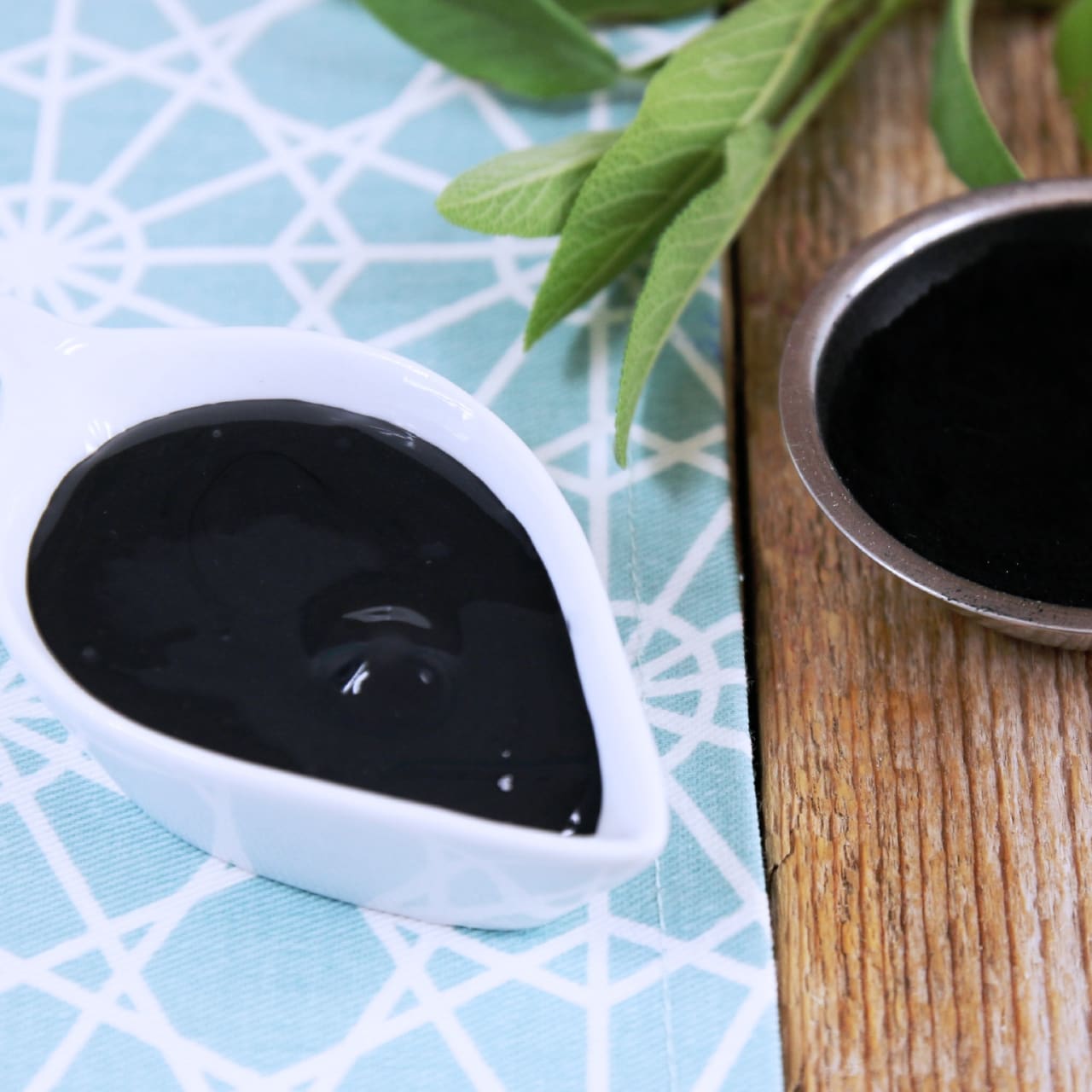
Finally, beyond its role in skincare, activated charcoal can also be used as a plant-based black colourant, offering an alternative for those wishing to avoid mineral oxides.

What Concerns Does This Address?

Activated vegetable charcoal helps to reduce excess intestinal gas and associated discomfort, such as bloating, under certain conditions of use.

In cosmetic formulations, however, activated vegetable charcoal is used in skincare products designed to address issues related to the appearance of the skin, particularly in so-called detoxifying and purifying masks, where it forms part of a process to cleanse and clarify the complexion.

It is also used in make-up products (mascara, kohl, eyeshadow) as well as in the colouring of soaps, particularly in cold-process soap-making, to impart an intense black hue or create contrasting visual effects.

What plant-based activated charcoal Does for the Body

In cosmetics, activated plant-based charcoal is a versatile solution for skincare and oral hygiene:

  • Adsorption capacity and ‘detox’ action: Thanks to its microporous structure and exceptional exchange surface area, it possesses a high adsorption capacity. This enables it to capture and retain compounds and pollutants present on the skin’s surface

  • Purifying care: It is used to cleanse the skin or teeth by attracting impurities. This property explains its frequent use in face masks, soaps and toothpastes to promote clear, healthy skin

  • Intense plant-based colourant: Beyond its technical properties, it acts as a natural black pigment. Highly effective even in small doses, it brings a unique visual and sensory dimension to cosmetic formulations.

Plant-based activated charcoal: An Essential Ingredient for the Body

Aroma-Zone plant-based activated charcoal is found in two must-have products: 

Precautions

Due to its high adsorption capacity, activated plant-based charcoal can capture various organic compounds and active substances. To minimise interactions, it is advisable to leave a gap between taking this product and any other products. It is also essential to always refer to the product’s technical data sheet to strictly follow the instructions for use and specific precautions. Finally, its use as an intense black colouring agent may cause stains on textiles or utensils when handled.

FAQ

How does activated charcoal differ from conventional ‘non-activated’ charcoal?

Activated charcoal differs from conventional charcoal due to a specific treatment process, which alters its structure and gives it a much larger surface area. This transformation increases its ability to retain certain compounds on its surface, which explains its use in various fields. Conversely, non-activated charcoal does not possess this level of internal structure and therefore has a more limited adsorption capacity.

Why is activated charcoal a good absorbent?

Its effectiveness is based on its high surface reactivity, which enables it to act via adsorption. In cosmetics, it is used in face masks, soaps and exfoliating products to remove impurities and toxins that accumulate on the skin on a daily basis. This same physical property is also utilised to promote gut comfort: clinical studies* show that activated charcoal helps to reduce gas by binding to certain compounds in the colon.

*See the Scientific Bibliography for further information.

Does activated charcoal have an effect on gas production after a meal?

Activated charcoal may influence the production of intestinal gas following the consumption of fermentable foods.

One study* in particular observed that consuming it helped to limit the increase in exhaled hydrogen levels – an indicator of fermentation in the colon – as well as reducing the increase in the number of flatulence episodes following a gas-producing meal.

Another study* confirms this trend, showing a measured reduction in gas production, reflected in lower levels of exhaled hydrogen.

*Please refer to the scientific bibliography for further information.

Spotlight on our specialist writer, Delphine Duc.

I'm Delphine Duc, a biological engineer specialising in cosmetology, and I've been passionate about the field of cosmetics for almost 10 years. I started making my own homemade cosmetics using Aroma Zone products to tackle my skin problems. Eventually, I decided to train as a cosmetologist and ultimately to create a bespoke cosmetics brand to address everyone’s individual skin concerns.

Bibliography

1

EFSA Panel on Dietetic Products, Nutrition and Allergies (NDA). Scientific Opinion on the substantiation of health claims related to activated charcoal and the reduction of excessive intestinal gas accumulation (ID 1938) and the reduction of bloating (ID 1938) pursuant to Article 13(1) of Regulation (EC) No 1924/2006. EFSA Journal. 2011;9(4):2049.

2

Hall RG Jr, Thompson H, Strother A. Effects of orally administered activated charcoal on intestinal gas. Am J Gastroenterol. 1981 Mar;75(3):192-6. PMID: 7015846.

3

Jain NK, Patel VP, Pitchumoni CS. Efficacy of activated charcoal in reducing intestinal gas: a double-blind clinical trial. Am J Gastroenterol. July 1986;81(7):532-5. PMID: 3521259.