Superfine Montmorillonite Green Clay (Smectite)
Cleansing
Anti-blemishes
£5.50
1 article = 500 g
Price per kg = £11.00
free delivery up to £25 in United Kingdom
100% secure payment CB, Visa, Mastercard, Paypal, Apple Pay, Google Pay
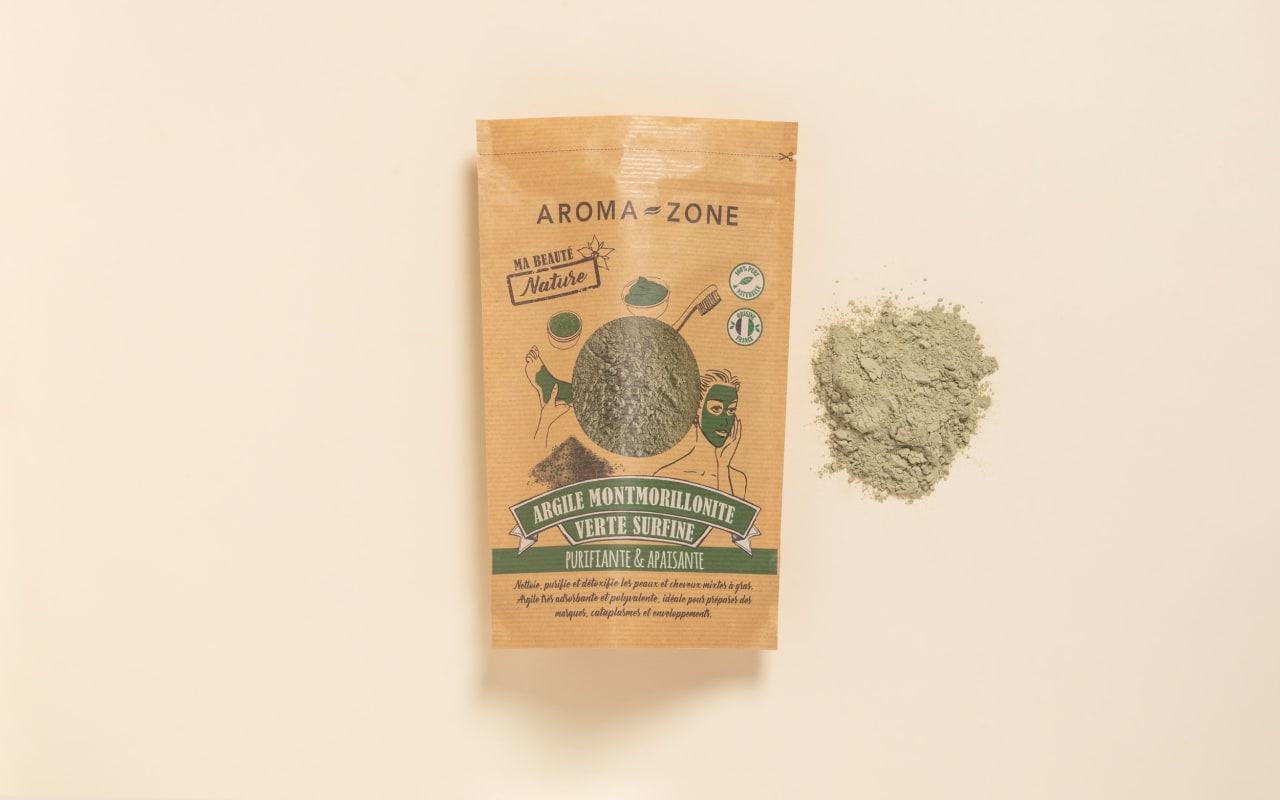
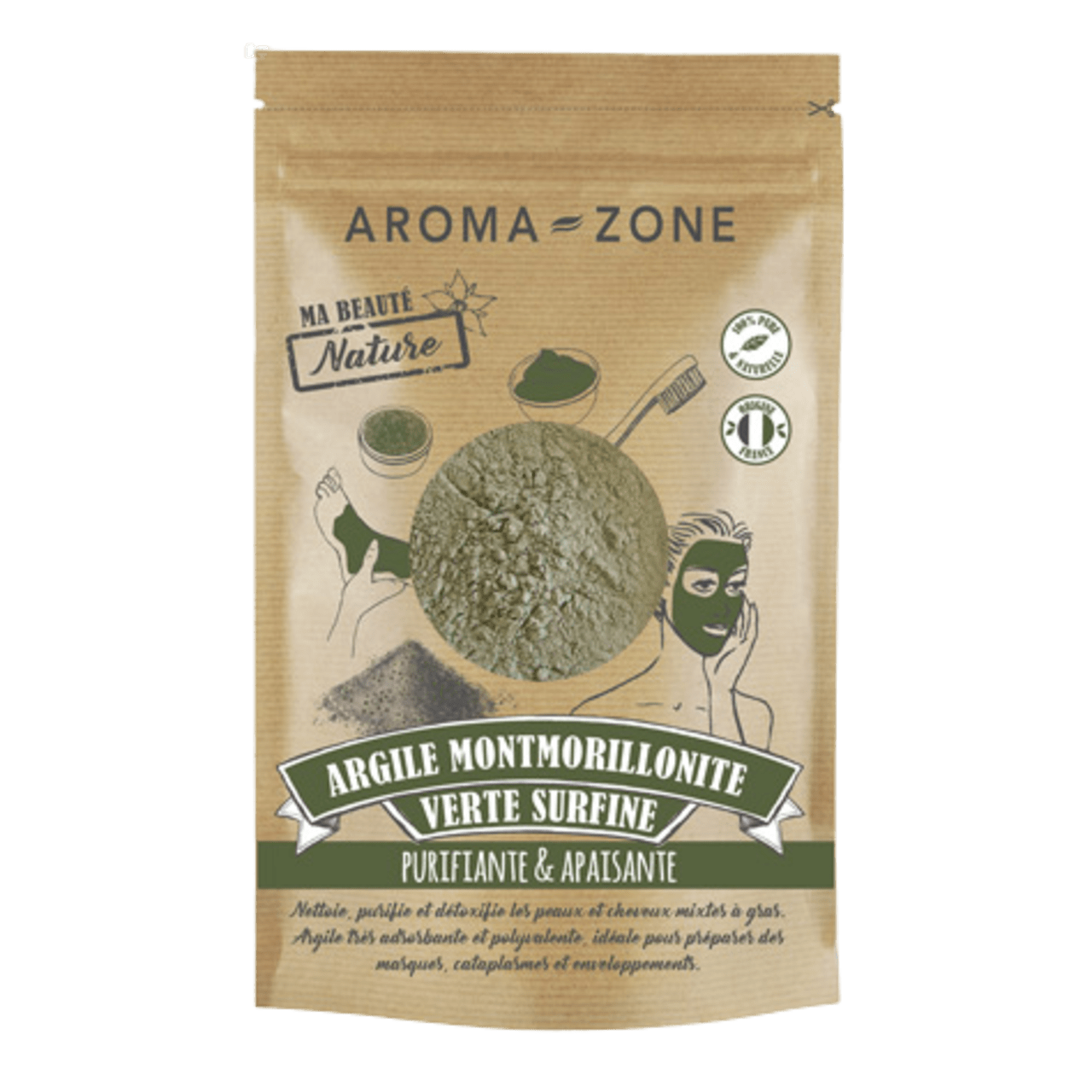
Superfine Montmorillonite Green Clay (Smectite)
500 g
100% natural origin
From France
Properties
As a cosmetic ingredient, superfine montmorillonite green clay (smectite) is recognised for its properties:
Absorbent and adsorbent
Detoxifying
Remineralising and toning
Purifies and clarifies skin
Restorative
Indications
Normal to oily skin
Dull skin
Skin prone to discomfort
Properties
As a hair beauty product ingredient, superfine montmorillonite green clay (smectite) is renowned for its properties:
Cleansing : known to absorb excess sebum and impurities
Purifying
Absorbent and adsorbent
Indications
Combination to greasy hair
Devitalized hair
Properties
In mouth care, superfine Montmorillonite green clay (smectite) is recognised for its properties:
Gently abrasive
Thickener for toothpaste
Sanitising
Neutralises acidity
Uses
Use montmorillonite green clay as an ingredient in your skincare products:
Masks for normal, combination and dull skin
Poultices and wraps
Shower gels and soaps
Detoxifying and purifying creams, gels and lotions
Instant recipe by Aroma-Zone
Detoxifying mask
Montmorillonite clay
1 tablespoon

Bog Labrador Tea hydrosol
2 tablespoons
Step 1
Mix the clay and water (or hydrosol) with a spatula until you get a homogeneous mixture.
Step 2
Apply to the entire face and leave on for 10 minutes. Rinse off with clean water.
Uses
Montmorillonite clay can be used as an ingredient in your hair preparations:
Shampoos for combination hair
Hair masks
Uses
Montmorillonite green clay can be used as an ingredient in your mouth care preparations:
In gentle toothpastes: because clay is a soft rock, it does not scratch enamel
In mouth rinses
General characteristics
Dosage
1 to 95% of the total weight of your mixture
Water-insoluble
Can be used as a paste or dispersion
oil-insoluble
Use in home cosmetics
Cream and lotions, shampoo, shower, soap, gel, mask, wrap, poultice, hair mask, toothpaste.
1 scoop 5 ml (level*) | 4.2 g |
1 scoop 2 ml (level*) | 1.9 g |
1 stainless steel spoon TAD (shaved*) | 1 g |
1 stainless steel spoon DASH (level*) | 0.4 g |
1 stainless steel spoon PINCH (level*) | 0.35 g |
* level: a spoon filled to the brim, where the excess has been removed by passing a spatula or the back of a knife over it.
5% Montmorillonite clay | 0.5 g |
10% Montmorillonite clay | 1.0 g |
20% montmorillonite clay | 2.0 g |
5% Montmorillonite clay 1 | 1.5 g |
10% Montmorillonite clay | 3.0 g |
20% montmorillonite clay | 6.0 g |
5% montmorillonite clay | 2.5 g |
10% Montmorillonite clay | 5.0 g |
20% montmorillonite clay | 10.0 g |
5% Montmorillonite clay | 5.0 g |
10% montmorillonite clay | 10.0 g |
20% montmorillonite clay | 20.0 g |
Preparation
Precautions
Precautions and allergens
Precautions for use
Allergens
Allergen-free
Make a recipe from A to Z
Montmoriollonite green clay can be used as an ingredient in your blends.
Incorporate montmoriollonite clay as an active ingredient in all your formulas containing water: creams, lotions, gels, lotions, soaps, etc.
Step 1
Add the montmorillonite clay, ideally pre-dispersed in a little cold water, at the end of the formulation.
Step 2
Shake to mix well.
Aroma-Zone Tip
For better dispersion of the clay in your emulsions or gels, pre-disperse it in a little water before adding it.
To make a mask, wrap or poultice
Montmorillonite clay can be mixed with other clays or plant powders to make masks, poultices or body wraps.
Step 1
Pour the montmorillonite clay with the other powders (other clays, plants, etc.) into a suitable container.
Step 2
Add water or hydrosol and mix to obtain a smooth, creamy paste.
Apply your mask in 3 steps
Immediately apply the mixture in a thick layer on the skin (face, neck, body) or hair, etc.
Leave on until the mask begins to dry. It is recommended to not let the mixture dry completely.
Rinse thoroughly with water to remove the mask.
Aroma-Zone tip
Clay pastes do not keep well and should be used as soon as possible after preparation (maximum 48 hours in the fridge).
If you wish to incorporate essential oils into a clay paste, we recommend adding a small proportion of oil or Solubol to solubilise them.
For best results, do not heat the clay and avoid contact with oxidisable metal. You can use stainless steel or plastic equipment. For mixing, use a plastic spatula.
Quality
100% natural origin, unwashed to retain all its mineral content, non-ionised.
Production process
Montmorrillonite green clay is extracted from natural quarries and then mechanically processed, without any chemical processes. It is crushed and dried. Powder grains are then sorted using a sophisticated and innovative vacuum selection process.
Function
Cosmetic ingredient for formulating masks, poultices, powders and soaps…
Benefits and properties
Detox
Purifying
Sebum regulator
Country of origin
France
INCI name
Montmorillonite, illite
Composition
Hydrated aluminium silicate
Presentation
Packaged in zipped bags
Learn more
Montmorillonite clay is a natural mineral belonging to the phyllosilicate family (like talc and micas). It is composed of hydrated magnesium and aluminium silicate. Its lamellar structure gives it excellent covering and swelling properties.
Focus on absorption and adsorption: Clays have the property of absorbing liquids such as water, filling up like a sponge. Clays also have the ability to adsorb , i.e., to bind molecules to their surface. This ability to bind molecules comes from the fact that clays are negatively charged. The negative charge is explained by the presence of minerals**(the higher the concentration of mineral salts in the clay, the more negatively charged it will be**). When clay is in a solution, it will attract the opposite positive ions in the solution and exchange them once in contact with the skin.
Clay will therefore help to remineralise and detoxify the skin, by exchanging its mineral salts with the toxins and impurities in the skin. This phenomenon allows the clay to carry active ingredients and return them to the skin.
Montmorillonite clay can be used as an ingredient in your blends. Very rich in mineral salts, it is best used in remineralising and detoxifying preparations. It is used in a wide range of industries, including bedding manufacture, wool degreasing, the oil and cement industries and the pharmaceutical industry, to treat gastroenterological problems, and in cosmetics, as an adsorbent and as a binder.
Organoleptic properties
Appearance: fine powder, oily to the touch
Colour: green
Odour: neutral
Cationic exchange capacity
Approximately 35-50 meq /100 g
Particle size
< 150 μm
Composition
High-purity ore: over 80% montmorrillonite and illite clay, no quartz
Storage
Store away from air, moisture and light. Close the sachet tightly after each use.
Precautions
Powdery product, do not use near a source of ventilation, do not inhale.
Keep out of reach of children.
As clay absorbs impurities and toxins, do not reuse clay that has already been used.
Environmental qualities and characteristics product sheet
Reference
00485 - montmorillonite green clay, superfine 500 g
Main packaging material
Paper bag
Recyclability
Most packaging can be recycled
EO = Essential Oil
VO = Carrier Oil or Macerated Oil
200 g of green clay to be added to the bath.
Green clay: 1 teaspoon
Cottage cheese: 2 teaspoons
Orange juice: 1 teaspoon
Mix all the ingredients together, then apply the mask.
Directions for use: Cleanse the skin with lotion or lotion and dry thoroughly. Apply the mask in the direction of massage and leave on for 10 to 20 minutes (remove immediately if tightness or tingling occurs). Rinse with warm water and spray with floral water. Apply your day (or night) cream or skincare oil.
Green clay: 1 tablespoon
Fruit or vegetable juice or herbal tea: 2 teaspoons
Carrier oil: 1 tablespoon
essential oil: 3 drops
Tip: Choose the essential oil, carrier oil, plant or fruit that corresponds to your skin type.
Directions: Mix all the ingredients together, then apply the mask.
Directions for use: On skin that has been cleansed with lotion or lotion and dried, apply the mask in the direction of massage and leave on for 10 to 20 minutes (remove immediately if tightness or tingling occurs). Rinse with lukewarm water and then spray with floral water. Apply your day (or night) cream or skincare oil.
This recipe is useful for restoring balance to combination skin with an oily tendency. Neem powder purifies, cleanses and tightens pores. Like jojoba carrier oil, it helps regulate excess sebum. Green clay is absorbent, cleansing and purifying.
Green clay: 1 tbsp.
Neem powder: 1 tsp.
Jojoba carrier oil: 2 tbsp.
Water: approx. 3 tbsp.
Directions: In a bowl, mix all the ingredients until you obtain a smooth, evenly mixed paste. Use: Apply this mask all over your face. Leave on for 10 minutes before rinsing.
The skin will quickly become purified and look smoother, and oily areas will be mattified. Repeat once a week.
Pregnant or breastfeeding women, or children under the age of 3 should not use neem powder. It can be replaced by green clay.
Supplier documents
'L’argile médecine ancestrale' by Philippe Andrianne
'Argiles thérapeutiques' by Gaël Sitzia
'The Healing Power of Clay: Repertory of Natural Medicine' by Raymond Dextreit
M. Isabel Carretero, Manuel Pozo, Clay and non-clay minerals in the pharmaceutical and cosmetic industries, Part II. Active ingredients
'Votre beauté au naturel' by Chantal Clergeaud
I haven't used it yet, but I'll get back to you as soon as I do.
Excellent quality
Very good
Good product
Clay dissolves very well and works very well for making masks
Associated products

£6.50
500 g

£4.00
250 g

£4.00
250 g

£4.00
250 g

£4.00
250 g

£2.00
15 g

£5.50
500 g