
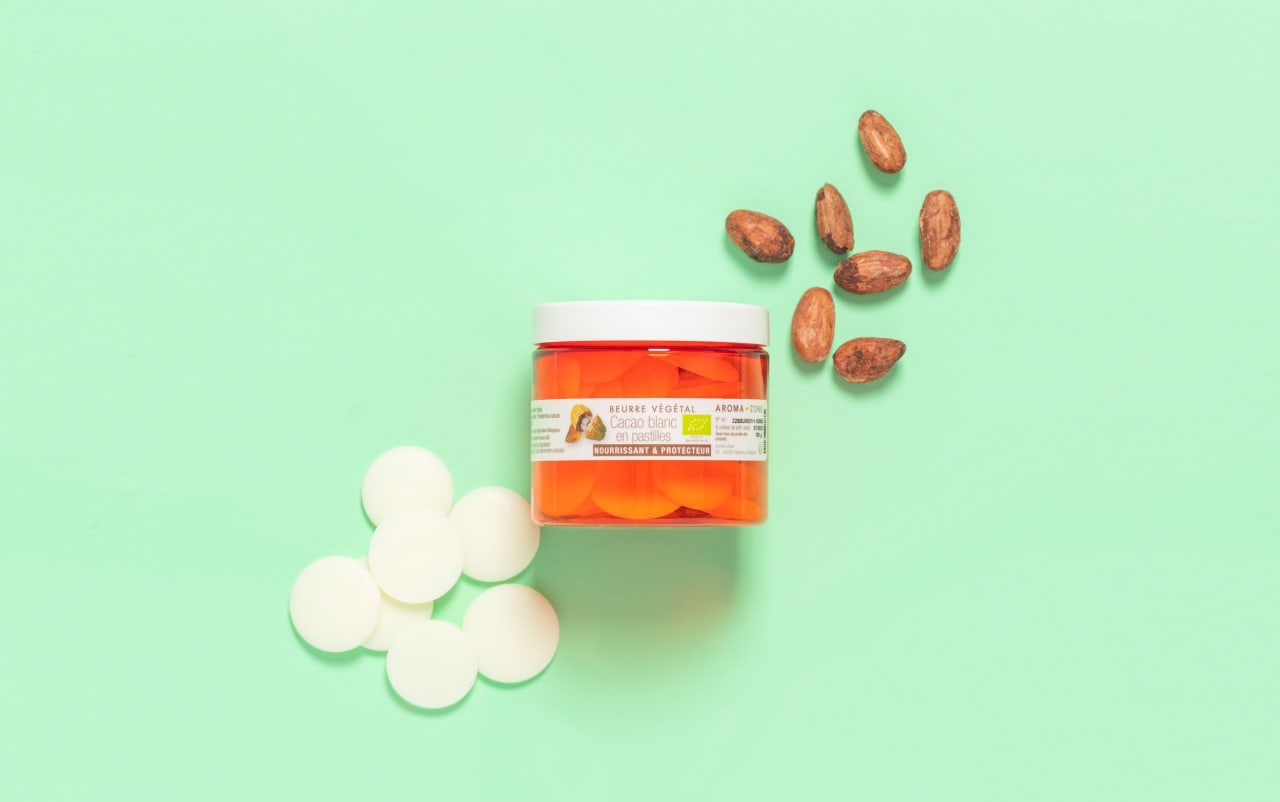
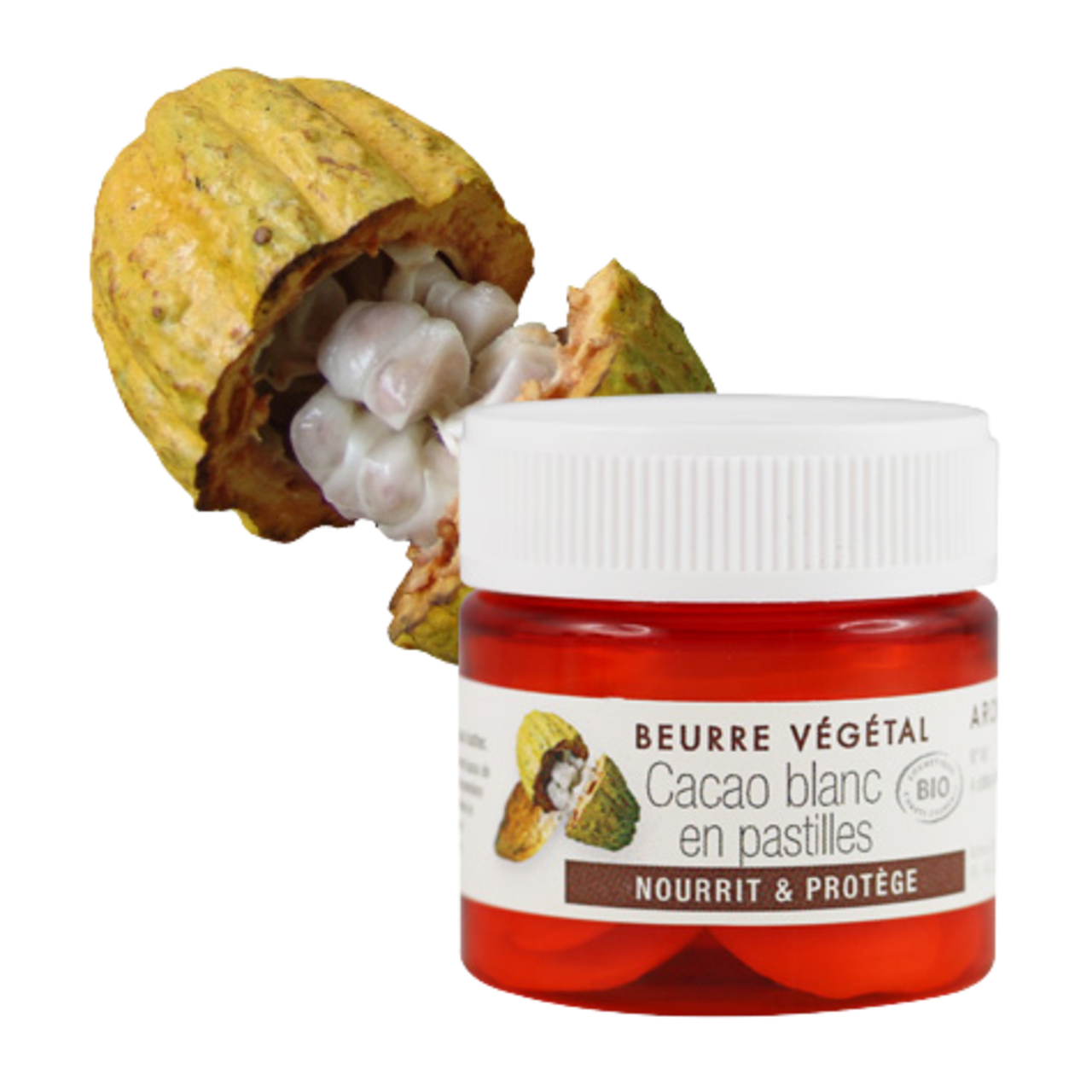
Organic White Cocoa Butter Wafers
Protective
Nourishing
Product out of stock. Learn more
free delivery up to £25 in United Kingdom
100% secure payment CB, Visa, Mastercard, Paypal, Apple Pay, Google Pay

Organic cosmetics

Ecocert

100% Pure And Natural
Properties
As a cosmetic ingredient, organic white cocoa butter tablets are renowned for the following properties:
Rich and nourishing, ideal for softening dry, rough skin, thanks to the cocoa butter's fatty acid composition.
Protective, leaves a film on the surface of your skin and prevents skin dehydration. It helps to regenerate your natural hydrolipidic film, rebalancing dry, dehydrated skin.
Restorative and soothing thanks to the phytosterols it contains.
Rich in unsaponifiables which are beneficial antioxidants to help combat the damaging effects of time.
Due to its high content of saturated fatty acids, this very hard butter has a thickening and hardening effect on your cold-saponified creams, balms and soaps.
Indications
Lips
Normal to dry skin
Rough and dehydrated skin
Mature skin, anti-ageing products
Production of cold-saponified soaps
Properties
As a hair improvement ingredient, organic white vegetable cocoa butter tablets are renowned for the following properties:
Nourishing, restores dry hair's vitality .
Protective, prevents hair dehydration.
Uses
Use as an ingredient in your preparations:
Balms and lip balms
Indulgent and sensual massage butters
Nourishing, soothing, and protective balms
Rich anti-aging creams
Luxurious skincare
In cold saponification: this butter helps to give soap its hardness.
Uses
Use as an ingredient in your preparations:
Nourishing hair masks and balms
Detangling shampoos and conditioners
Serums for dry ends
In practice
As this butter is very hard at room temperature, it needs to be blended into your oil-based preparation (rich in vegetable oils and butters) to make a balm (in a mixture of 1 to 70%) or incorporated as a fatty substance in an emulsion (at a rate of 1 to 5%)..
For example, to prepare a soft butter, ideal for massaging onto damp skin, try a mixture of 50% cocoa butter and 50% fluid oil preparation.
In cold saponification : cocoa butter is used in combination with other oils and butters, in small proportions (5 to 20%) to add hardness to the soap. Be careful, as too high a dose can make the soap too hard, less meltable, and crumbly.
Instant recipe by Aroma-Zone
Luxurious lip balm
Cocoa butter
3 g
Vanilla macerated oil
3g
Mimosa wax
1.5 g
Step 1
Melt the ingredients.
Step 2
Mix, pour into a small pot, and leave to set in the freezer.
Synergies
For gourmet scents: Chocolate aromatic extract, Coconut, Plum and Hazelnut carrier oils, Vanilla macerated oil.
For mature skin: Argan, Rose Hip, Borage, Evening Primrose and Prickly Pear carrier oils, Frankincense, Damask Rose, Linaloe Berry and Hô Wood essential oils.
For very dry skin: Wheat Germ, avocado, Olive and Sweet Almond carrier oils.
In cold saponification: Organic Copra, Organic Palm and Organic Olive oils
In lip balms : Organic Coconut oil, Plum, Sweet Almond and Hazelnut oils, Vanilla macerate, Cera bellina, Beeswax.
In practice
Cocoa butter is very hard and should be mixed with a liquid oil preparation to soften its very hard consistency: To prepare a soft butter that can be applied directly to the hair, mix 40% cocoa butter with 60% fluid oil preparation. Coat the hair, paying particular attention to the ends. Massage the hair and then wrap it in a warm towel. Leave on overnight if possible, then shampoo.
Incorporate into the oil phase (at a rate of 1 to 5% mixed with oils) when making hair balms and conditioners.
Instant recipe by Aroma-Zone
Luxurious balm for dry ends
Cocoa butter
25 g
Coconut botanical oil
25 g
Step 1
Melt the butter in the coconut oil.
Step 2
Apply a dollop of the balm to dry ends.
Synergies
Hair products for dry hair: coconut, pracaxi, piqui, castor, borage and avocado oils.
To improve hair condition and make it shiny: plant ceramides, ylang-ylang essential oil, kapoor kachli and orange ayurvedic powders.
To nourish hair: in emulsions (creams): Silk and Rice Proteins, phytokeratin, provitamin B5
Culture
Organic, certified by Ecocert FR-BIO-01
Quality
100% pure and natural butter.
Production process
The fruit is washed and the skin removed. It is then fermented, which reduces the pulp. The fermented seeds are what we know as cocoa beans, which are then roasted, cooled and pressed to produce cocoa mass. The cocoa butter is separated from this mass and then deodorised using steam under vacuum.
Part of the plant used
Beans
Botanical name
Theobroma cacao
Botanical family
Sterculiaceae
Function
Cosmetic ingredients
Oxidative potential
Not very sensitive.
Learn more about the oxidative potential of butters and oils...
Find out more
The cocoa tree is native to the tropical forests of Central and South America. Today, it mainly grows in West Africa, where it adapts well to the climate. The cocoa beans come from its fruits: pods. In their fresh state, the beans have no odour and are very astringent and bitter.
They are subsequently fermented, which gives them their brown colour, and roasted, which brings out their characteristic aroma.
The beans are separated from their shell, and the remaining nib is ground under a mill to produce cocoa paste. This paste is then pressed to yield cocoa powder for food use and cocoa butter. This process was developed by the Dutchman Van Houten, who gave his name to the famous cocoa powder brand.
Cocoa was regarded as the 'food of the gods' by the Mayans and the Aztecs, who consumed it as a drink with spices to provide energy. It was brought back to Europe by Spanish conquistadors, who added sugar to reduce its bitterness. It was not until the 19th century that cocoa butter began to be used for pharmaceutical purposes, particularly in the making of suppositories.
The fatty acid composition of this butter gives it an interesting texture. It is a very hard butter that adds body to balms, sticks, and soaps, but its melting point is relatively low and close to body temperature. It also melts very cleanly, giving it a pleasant melting sensation on the lips or skin (when mixed with a fluid oil to soften it).
Organoleptic properties
Appearance: very hard butter at room temperature; liquid oil above 35°C
Colour: pale yellow to yellow
Smell: sweet chocolatey, reminiscent of white chocolate
Feel: hard, not grainy
Density
0.92 (density corresponds to density at 20°C)
Melting point
35°C
Saponification index
188-198
Store in a dry place away from heat and light.
Warning
The properties, information and methods of use below are quotes from reference books or websites on aromatherapy, hydrolatherapy and phytotherapy. This general information is provided for informative purposes only and in no way constitutes medical guidance. Under no circumstances can this information be used as a substitute for a medical diagnosis, consultation or follow-up, nor can it incur our liability. We recommend that you consult the guide to essential oils before using them, so that you are aware of any precautions that need to be taken. If in doubt, consult a doctor before using essential oils.
Responsible Person
EU responsible person: Aroma-Zone FR-84220 Cabrières d’Avignon
UK responsible person: Obelis UK Ltd, Sandford Gate, Oxford, OX4 6LB, UK
Environmental qualities and characteristics product sheet
Reference
0268401 - 10 g Organic White Cocoa Butter Tablets
Main packaging material
RPET (recycled PET) pot
Recyclability
Most packaging can be recycled
Recycled material
Packaging contains at least 75% recycled material.
Rewards and penalties
Aroma-Zone gets a bonus for managing packaging made from recycled plastic.
Reference
0268501 - 100 g Organic White Cocoa Butter Tablets
Main packaging material
RPET (recycled PET) pot
Recyclability
Most packaging can be recycled
Rewards and penalties
Aroma-Zone gets a bonus for managing packaging made from recycled plastic.
Reference
0268601 - 500 g Organic White Cocoa Butter Tablets
Main packaging material
PP Pot
Recyclability
Most packaging can be recycled

EO = Essential Oil
VO = Carrier Oil or Macerated Oil
45 ml cocoa butter
9 g citric acid
15 g bicarbonate of soda
9 g Van Houten cocoa powder
30 drops peppermint essential oil
Directions: melt the cocoa butter in a bain-maire. Remove from the heat, add the citric acid, bicarbonate and cocoa powder and mix well. Then add the essential oil and pour into an ice-cube tray and place in the freezer for 15 minutes. Remove from the mould and melt in bath water.
2 teaspoons of beeswax
2 teaspoons of melted cocoa butter
2 teaspoons of sweet almond oil
1 teaspoon of shea butter
3/4 teaspoon of cocoa powder
4 drops of honey
1/2 teaspoon of vitamin E oil
1 drop of peppermint essential oil
Instructions: mix the beeswax, shea butter, cocoa butter, and sweet almond oil in a bain-marie and melt over low heat. Add the cocoa powder and stir. Add the honey and vitamin E oil. Finish with the essential oil. Pour into chosen containers and leave to harden in the fridge.
50 ml avocado oil
30 ml Cocoa butter
9 g Beeswax
3 g Arrow root or cornstarch
15 drops Geranium essential oil
15 drops True lavender essential oil
Method: melt the butter and wax in the carrier oil over a bain-marie, stirring well. Remove from the heat, add the arrow root and mix well, then add the essential oils after cooling slightly.
1 tablespoon Calendula macerated oil
1 tablespoon coconut oil
2 tablespoons sesame oil
50 g grated Cocoa butter
10 g Beeswax
Up to 20 drops of essential oil of your choice for fragrance
Procedure: Melt the wax in the oils in a bain-marie and mix. Remove from the heat and add the essential oils.
5 ml shea butter
5 ml cocoa butter
15 ml argan oil
15 ml calendula or rosebud macerated oil
3 g beeswax
3 g arrow root or cornstarch
Directions: melt the butters and wax in the oils over a bain-marie, stirring well. Remove from the heat, add the arrow root and mix well.
Use: use to moisturise the belly or soothe irritated nipples after giving birth.
Cocoa butter: 30 g
Shea butter: 80 g
True lavender essential oil: 4 drops
Carrot essential oil: 4 drops
Method : Gently melt the cocoa butter and shea butter in a bain-marie while stirring. Remove from the heat and stir in the essential oils. Place in a jar and leave to cool.
Cocoa Butter: 100 g
Oil of your choice: 70 g
Hydrolat of your choice: 100 g
Essential oil of your choice: 5 drops
Directions: melt the cocoa butter in a bain-marie and stir in the oil, then remove from the heat and add the hydrosol and essential oil.
6 fresh marogold (calendula) flowers or 20 g dried marigold flowers
Cocoa butter: 10 g
Beeswax: 20 g
Sweet almond or olive oil: 100 ml
Directions: remove all the marigold petals and place in a bain-marie. Add the other ingredients and heat gently until everything has melted, stirring gently. Leave on the heat for about 5 minutes, then pour the mixture into another container and strain through a sieve. Stir until the mixture has cooled completely and pour into a sterilised jar.
40 ml Coconut oil
30 ml Cocoa butter
10 ml Calendula macerated oil
18 g Oat flour
1 tbsp Lime blossom
Method: Melt the butter in the oils in a bain-marie. Add to the oat flour and lime blossom and mix until smooth. Pour into ice cube tray compartments and set in the freezer for 15 minutes Use: Use by melting in bath water.
Cocoa butter: 1 teaspoon
Coconut oil: 1/2 teaspoon
Sweet almond oil: 1 teaspoon
Beeswax: 1/2 teaspoon
Aloe vera gel: 1 teaspoon
Directions: Melt the cocoa butter and beeswax in the coconut oil and sweet almond oil over a bain-marie. Remove from the heat, add the aloe vera gel and whisk the mixture. Pour the mixture into a small sterilised container and leave to cool completely.
40 g of Sweet Almond carrier oil
23 g of Cinnamon hydrosol
9 g of Cocoa butter
2 teaspoons of Cocoa powder
10 drops of grapefruit seed extract
4 drops of Vitamin E
Directions: Melt the butter into the carrier oil in a bain-marie. Remove from the heat and gradually add the hydrosol while emulsifying. Add the rest of the ingredients and whisk until you have a smooth, fluid texture. Leave on the face for 10 minutes, then remove with a cotton pad soaked in Cinnamon hydrosol.
15 drops of gum rockrose essential oil
15 drops Benzoin essential oil
30 drops Spike Lavender essential oil
15 drops Italian Helichrysum essential oil
30 drops Rosewood essential oil
14 g Shea butter
14 g Cocoa butter
14 g Coconut butter
4 g beeswax
7.5 ml Rose carrier oil
5 ml avocado or Argan OIL
5 ml corn or arrowroot starch
Procedure: Melt the butters and wax in a bain-marie. Add the cornstarch and carrier oil, and whisk with a small whisk while heating (without boiling) for a few moments. Allow to cool, then stir in the essential oils. Whisk again and transfer to one or more jars. Label the jars.
Apply to the lesion after cleansing.
Fresh or dried marshmallow leaves: 60 g
Mineral water: 200 ml
Beeswax: 60 g
Cocoa butter: 60 g
Sweet Almond carrier oil: 50 g
Grapefruit Seed extract: 4 drops
Sweet Orange essential oil: 60 drops
Lemon essential oil: 60 drops
Directions: Place the marshmallow leaves and water in a saucepan, bring to the boil, and leave to simmer for around 60 minutes. Remove from the heat and leave to cool, then strain the mixture and pour 40 ml back into the saucepan. Melt the Beeswax and Cocoa butter in a bain-marie. Reheat the marshmallow mixture. When it is almost boiling, pour it into the Beeswax mixture a little at a time, mixing with an electric mixer to form an emulsion. Finally, add the Grapefruit Seed extract and the essential oils. Pour into a sterilised container and store in the fridge.
Coconut oil: 453.6 g
Oil palm: 397 g
Wheat germ oil: 170.1 g
Hazelnut oil: 170.1 g
Avocado oil: 141.75 g
Sweet almond oil: 113.4 g
Cocoa butter: 113.4 g
Caustic soda: 201 g (10% soda reduction)
Water: 538.7 g
Grapefruit seed extract: 12 g (Aroma-Zone note: this author recommends EPP to improve the conservation of soaps, probably because it has a slight antioxidant effect. Soaps are not sensitive to microbial contamination, so a preservative is not useful. Instead, we recommend adding an antioxidant such as vitamin E to prevent rancidity.)
Essential oil of your choice (optional): 35 ml (7 teaspoons)
Notes and precautions (Aroma-Zone): Before you start saponifying, we strongly recommend that you read our know-how sheet "Cold saponification" to fully understand the method. Be sure to read the precautions for using lye before you start and follow the instructions for diluting the lye.
Procedure: See our "Cold saponification" information sheet for details of how to make a soap. Weigh the soda accurately, dissolve in the water and set aside. Melt the solid oils, then add the liquid oils. While the mixtures are cooling, weigh any other ingredients. When the 2 mixtures are at around 27-38°C, pour the soda solution into the oils and mix well (preferably with a blender) until you see a "trace". Add any other ingredients and incorporate into the emulsion. Mix well then pour into moulds.
Coconut oil: 453.6 g
Olive oil: 311.85 g
Oil palm: 226.8 g
Jojoba oil: 226.8 g
Cocoa butter: 226.8 g
Caustic soda: 187.5 g (10% soda reduction)
Water: 538.7 g
Grapefruit seed extract: 12 g (Aroma-Zone note: this author recommends EPP to improve the conservation of soaps, probably because it has a slight antioxidant effect. Soaps are not sensitive to microbial contamination, so a preservative is not useful. Instead, we recommend adding an antioxidant such as vitamin E to prevent rancidity.)
Essential oil of your choice (optional): 35 ml (7 teaspoons)
Notes and precautions (Aroma-Zone): Before starting saponification, we strongly recommend that you read our "Cold saponification" information sheet to fully understand the method. Be sure to read the precautions for using the lye before you start and follow the instructions for diluting the lye in the water.
Procedure: See our "Cold saponification" information sheet for details of how to make a soap. Weigh the soda accurately, dissolve in the water and set aside. Melt the solid oils, then add the liquid oils. While the mixtures are cooling, weigh any other ingredients. When the 2 mixtures are at around 27-38°C, pour the soda solution into the oils and mix well (preferably with a blender) until you see a "trace". Add any other ingredients and incorporate into the emulsion. Mix well then pour into moulds.
Oil phase :
82 g coconut Oil
56 g olive Oil
12 g beeswax
4 g cocoa butter
4 g shea butter
4 g stearic acid
Water phase :
100 g rooibos tea infusion
20 g vegetable glycerine
4 g borax
4 g adraganthe gum gel
Directions: make an emulsion. At the end, scent with essential oils of your choice.
Note from Aroma-Zone: borax is an irritating and controversial raw material. You can choose to leave it out or replace it with an emulsifying wax.
'Cocoa polyphenols and their influence on parameters involved in ex vivo skin restructuring.'
Gasser P, Lati E, Peno-Mazzarino L, Bouzoud D, Allegaert L, Bernaert H. Int J Cosmet Sci., 2008, 30(5), 339-45.
'Biologically active substances in grated cocoa and cocoa butter.'
Kosman VM, Stankevich NM, Makarov VG, Tikhonov VP. Vopr Pitan., 2007, 76(3), 62-7.
'Composition of cocoa shell fat as related to cocoa butter.'
El-Saied HM, Morsi MK, Amer MM. Z Ernahrungswiss., 1981, 20(2), 145-51.
'Simultaneous determination of theobromine, (+)-catechin, caffeine, and (-)-epicatechin in standard reference material baking chocolate 2384, cocoa, cocoa beans, and cocoa butter.'
Risner CH. J Chromatogr Sci., 2008, 46(10), 892-899.
'Review of cocoa butter and alternative fats for use in chocolate—Part A and B.'
Lipp M, and Anklam, E. Food Chemistry, 1998, 62(1), 73-97 et 99-108.
Supplier Documentation
"Pharmacognosy. Phytochemistry and medicinal plants 3rd ed."
Jean Bruneton
"Natural Skincare Guide"
Josephine Fairley
'Votre beauté au naturel'
Chantal Clergeaud
'Délicieux savons'
Melinda Coss
'90 recettes de beauté bio à faire soi-même'
S. Macheteau et Vanina Guet
'Soins de la peau à base d’huiles essentielles'
Chantal Lacroix
'Making Aromatherapy Creams & Lotions : 101 Natural Formulas to Revitalize & Nourish Your Skin'
Donna Maria
'Mes petits cadeaux cosmétiques BIO'
Marie Bousquet and Christie Vanbremeersch
'The soapmaker's companion'
Susan Miller Cavitch
http://www.750g.com/truffes-aux-trois-chocolats-r61915.htm
Thuriès Gastronomie magazine n°214, 2009
http://lesrecettesdejuliette.fr/article-pate-a-tartiner-a-la-poudre-et-au-beurre-de-cacao-cru-vegan-123508574.html
http://www.cuisinefrancophone.com/?tag=beurre-de-cacao-recette
http://antigonexxi.com/2013/04/18/cookies-crus-a-croquer/
Frequently Asked Questions
Essential Oils
1 ml = approximately 35 drops (with our Aroma-Zone dropper caps)
Carrier Oils
1 pump (Aroma-Zone aluminium pump) = approx. 0.15 ml
Mass / Volume conversion (for a liquid)
Mass (g) = Density x Volume (ml) at 20°C
Further information
1 full teaspoon = between 3 and 4.5 ml
1 full tablespoon = between 7.5 and 10 ml
However, these spoon ratios depend on a number of factors (e.g. viscosity of the liquid, temperature, depth and size of the spoon, rheological behaviour of the liquid), and we strongly advise you to use precise measuring equipment, such as graduated test tubes, graduated pipettes, and precision scales.
Loading...
I am satisfied with the product
Truly natural product and very interesting for making very, very moisturizing lip balm with no particular scent, it's greasy but really lasts a long time, and makes the price with these products very, very interesting compared to buying lip balm in a supermarket or even a pharmacy. I highly recommend it.
I use it in my emulsions - excellent product and easy to dose
Great product but I wish the pastilles were a bit smaller.
For my cream, it's great. Soft skin and a pleasant feel. A little disappointed because in large quantities, it's often out of stock.
Associated products
Associated tip
Household tips


