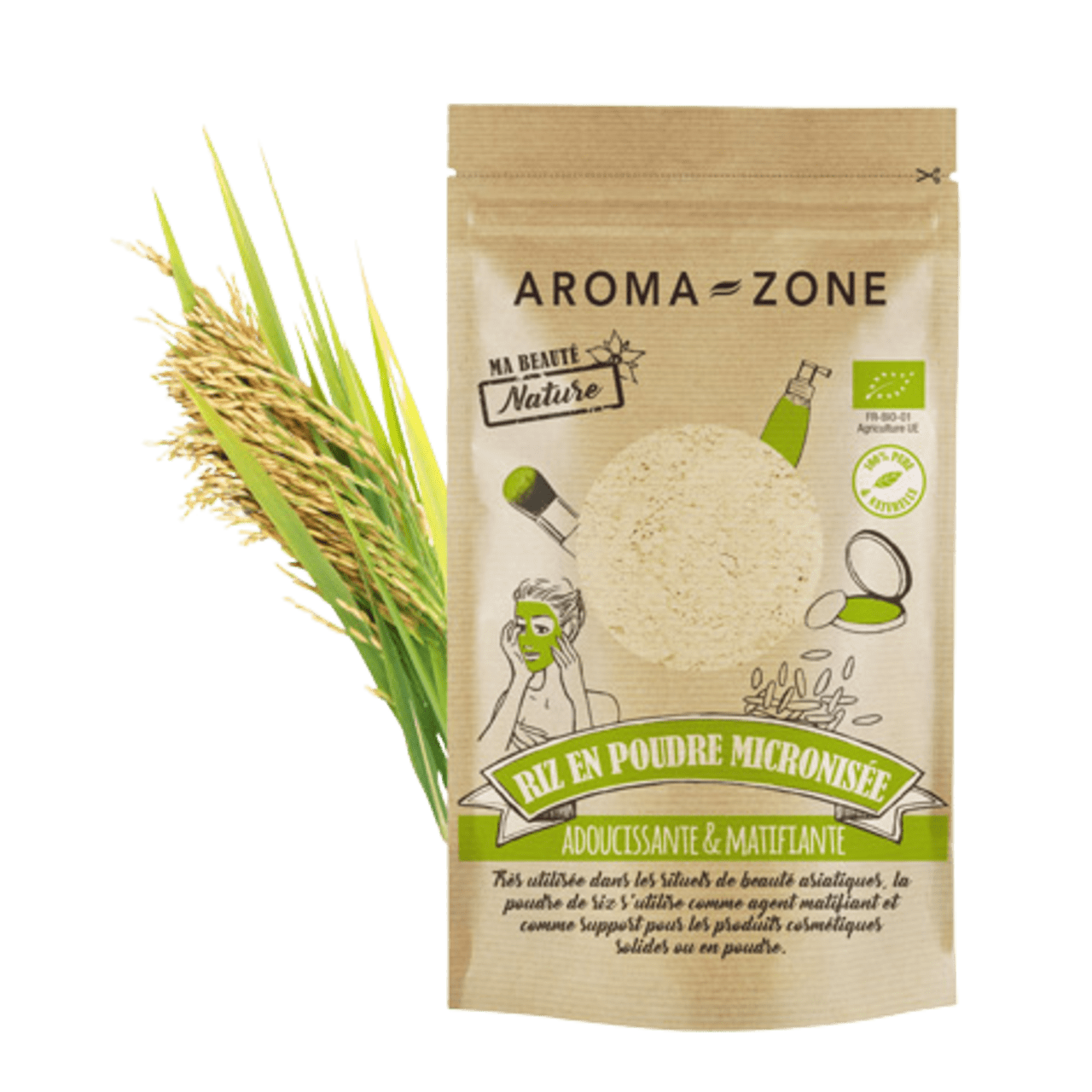
Organic Rice Micronised Powder
Mattifying
free delivery up to £25 in United Kingdom
100% secure payment CB, Visa, Mastercard, Paypal, Apple Pay, Google Pay
100% Pure And Natural
Organic Farming
From The Eu
Use as an ingredient in your preparations:
Skin care products
Powdered cosmetic mixtures (loose or compacted)
Dry shampoos
Dry perfumes
Deodorants
Thick liquid formulas such as milks, creams, and gels
Balms
Masks combined with plant powders, particularly Ayurvedic powders
Properties
In cosmetics, organic micronised rice powder is recognised for the following properties:
Acts as a thickening agent and texturiser for water-based products.
Provides a very soft, silky feel to powdery mixtures.
Has a mattifying effect on the skin.
Serves as an excellent base for dry cosmetic products.
Reduces the greasy feel when incorporated into balms.
Useful as a base for masks with plant powders: adds texture and cohesion, improves adhesion and hold on the skin, and allows the mask to be removed by gentle scrubbing once dry.
Indications
Combination and oily skin
Oily hair
Excessive sweating
Properties
In makeup, organic micronized rice powder is known for its properties:
Powdery base for all types of loose or compacted makeup powders.
Mattifying effect.
In powder mixtures: Incorporate the rice powder as it is, mixing thoroughly with the other powders. Using a mortar is ideal for makeup preparations.
In creams and gels: Add the rice powder at the end of the preparation, once cooled, and stir well until a homogeneous mixture is obtained.
In balms: Add the rice powder to the melted oil phase before pouring the balm.
In masks: Mix the rice powder with one or more plant powders and form a paste using water. After drying on the skin, the mask can usually be removed by gently rubbing it off.
Recommended dosages:
10 to 20% for incorporation into a cream
10 to 90% for preparing powder mixtures: blush, eye shadow, deodorants, perfumes, dry shampoos, etc.
1 to 10% for incorporation into a balm
10 to 50% in masks
Dosage
10 to 90% depending on use
Insoluble in oil
Dispersible in the oil phase
Slightly soluble in water
Perfectly dispersible in water when stirred
Use in homemade cosmetics
Balm, cream & lotion, gel, powder, pressed powder, mask
1 scoop 5 ml (level*) | 2.9 g |
1 scoop 2 ml (level scoop*) | 1.3 g |
1 stainless steel spoon TAD (leveled*) | 0.55 g |
1 stainless steel spoon DASH (leveled*) | 0.25 g |
1 stainless steel spoon PINCH (leveled*) | 0.19 g |
1 stainless steel spoon SMIDGEN (leveled*) | 0.08 g |
1 spoonful DROP (leveled*) | 0.02 g |
1 spoonful 0.05 ml (leveled*) | 0.03 g |
1 spoonful 0.5 ml (level*) | 0.28 g |
* leveled: a spoon filled to the brim with the excess removed using a spatula or the back of a knife
2% micronized rice powder | 0.3 g |
5% micronized rice powder | 0.75 g |
10% micronized rice powder | 1.5 g |
2% micronized rice powder | 0.6 g |
5% micronized rice powder | 1.5 g |
10% micronized rice powder | 3.0 g |
2% micronized rice powder | 1.0 g |
5% micronized rice powder | 2.5 g |
10% micronized rice powder | 5.0 g |
2% micronized rice powder | 2.0 g |
5% micronized rice powder | 5.0 g |
10% micronized rice powder | 10.0 g |
2% micronized rice powder | 5.0 g |
5% micronized rice powder | 12.5 g |
10% micronized rice powder | 25.0 g |
Cultivation
Organic, certified by Ecocert FR-BIO-01
Quality
100% pure and natural; gluten-free
Production process
Organic brown rice grains are steamed, flaked, ground, and then mechanically micronized to 30 microns using a hammer mill to obtain a very fine powder with a very soft feel.
Part of the plant used
Grains
Botanical name
Oriza sativa
Botanical family
Poaceae
Function
Softening, mattifying, dry base for makeup powders, provides a very soft feel.
Benefits and properties
Softener
Makeup
Mattifying
Soft feel
Country of origin
Italy
Other names
Rice flour, rice extract
INCI designation
Oriza sativa (rice) starch
Particle size
Approximately 30 microns
Presentation
Very fine off-white powder with a very soft feel and a covering effect, quite similar to the feel of bamboo powder, packaged in a zippered bag.
Learn more
Rice belongs to the botanical family Poaceae. Cultivated in hot, subtropical, and tropical regions, this cereal was first developed in China and later spread across the world, where it is now a staple food for more than half of the global population in 34 countries. In France, rice, which is now grown in the Camargue region, first appeared towards the end of the 14th century.
Rice cultivation is carried out using three main methods: rainfed cultivation, where the fields are not flooded; flooded cultivation, where the water level is not controlled; and irrigated cultivation, where the water level is carefully managed.
Brown rice differs from white rice, although both are hulled. White rice has had the bran and germ removed, whereas brown rice retains them. This makes brown rice easier to digest and more nutritious.
Rice powder is a classic ingredient in cosmetics. Traditionally used by geishas to lighten the complexion, it was also prized at the French court under the Ancien Régime by both women and men to mask imperfections and mattify the skin.
Storage
Store away from air, moisture, light, and heat. Close the container tightly after each use.
Precautions
Keep out of reach of children.
Powdery product, do not use near a source of ventilation. Wearing a dust mask is recommended when handling.
Environmental qualities and characteristics product sheet
Reference
02113 - Organic micronized rice powder 30 g per box
Main packaging material
Paper bag
Recyclability
Most packaging can be recycled
Reference
0102401 - 100 g organic micronized rice powder
Main packaging material
Paper bag
Recyclability
Most packaging can be recycled
EO = Essential Oil VO = Vegetable Oil or Oily Macerate
50 g of macadamia oil
50 g Himalayan salt
3 tablespoons of shea butter
2 tablespoons of dried lavender flowers
15 drops of propolis plant extract
Method: Crush the butter and oil with a pestle and mortar until you obtain a smooth paste. Add the rest of the ingredients and mix well.
Use: Use this scrub once or twice a week in the shower.
Rice powder: 1/2 cup
Cornstarch: 1/4 cup
Iris powder: 1 tablespoon
Essential oil of your choice: 3 to 4 drops
Method: Place the ingredients in a container that can be easily closed. Add the essential oil. Close the container and shake gently until the mixture is smooth.
Use: Apply the scented powder to the body.
Rice powder: 1/2 cup
Baking soda: 1 teaspoon
Borax (optional): 1 tablespoon
Method: Mix all the ingredients together.
Use: Massage the powder directly into the scalp and through the hair. It is best to stand over a sink while learning how to apply the powder. Leave the powder on for at least 15 minutes. Use a clean, dry brush and brush vigorously until all the powder has been removed.
Supplier documentation
'90 recettes de beauté bio à faire soi-même'
Sophie Macheteau and Vanina Guet
'Natural beauty at home'
Janice Cox
Frequently Asked Questions
I use it with enzymes to cleanse the skin, the quality is there.
I use it as a mattifying powder. It's a great product.
Ideal as a dry shampoo on light-colored hair!
My skin is often dehydrated and uncomfortable when I wear loose or compact powder. With this rice powder, I have no dehydration or discomfort. It's very fine and nicely evens out the complexion. It doesn't accentuate fine lines either. I'm delighted.
matches the description
Associated products

£4.00
250 g