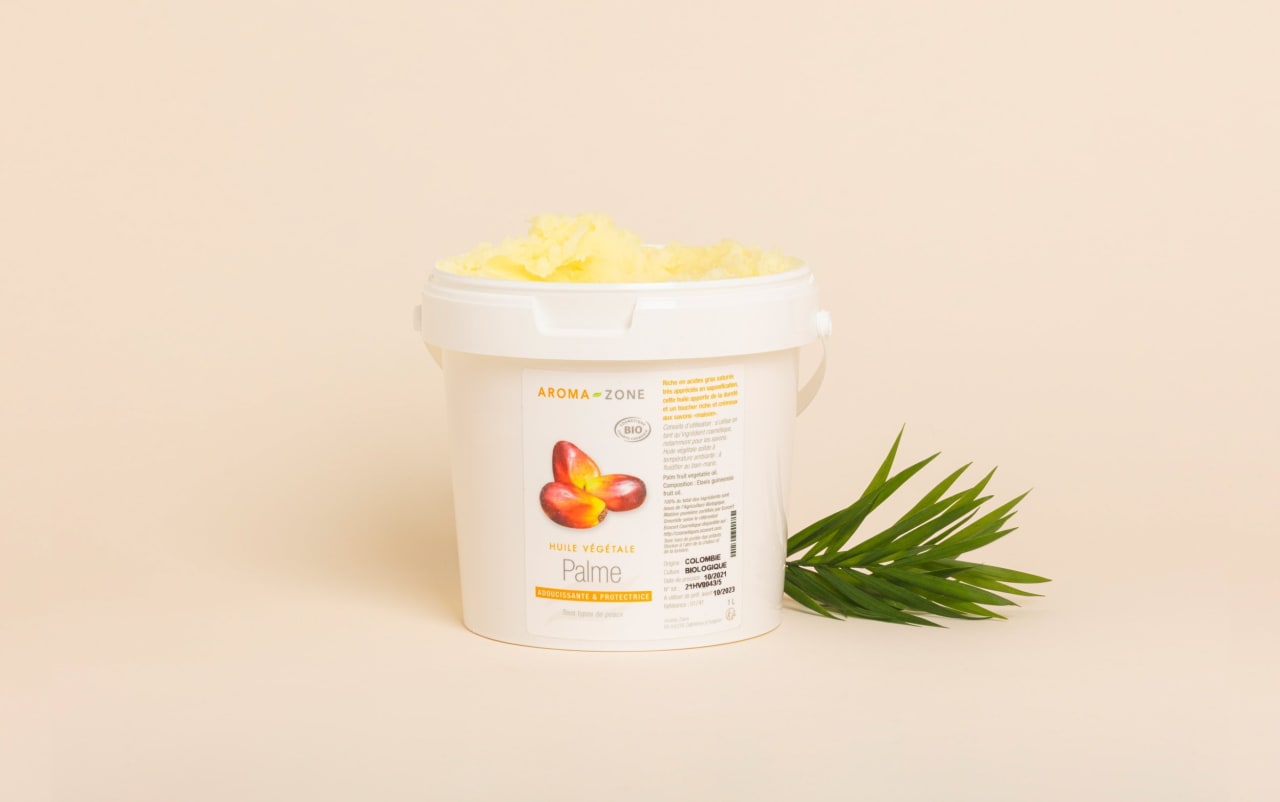
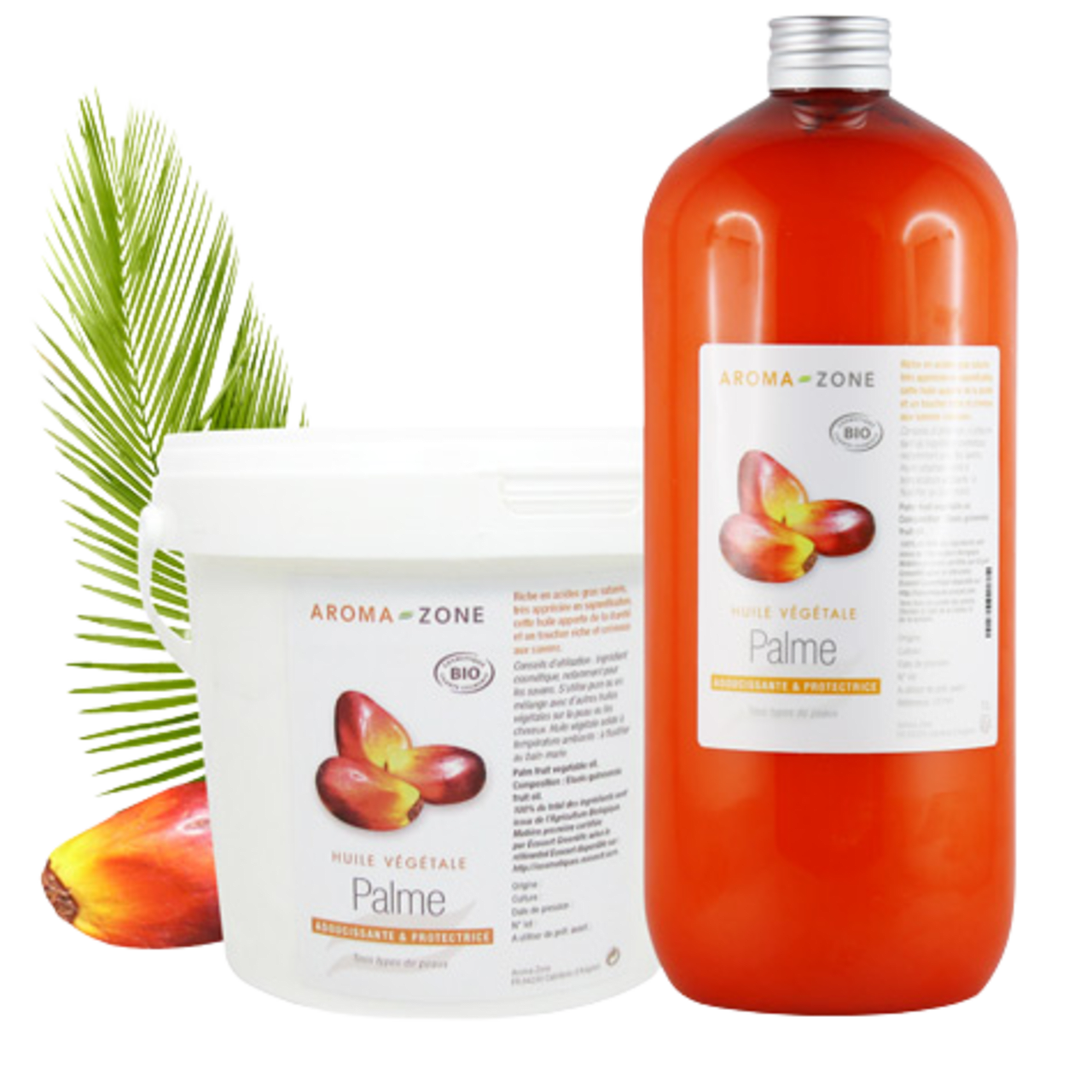
Organic Palm Oil
Protective
free delivery up to £25 in United Kingdom
100% secure payment CB, Visa, Mastercard, Paypal, Apple Pay, Google Pay

Cosmos Organic

Ecocert

Cold Pressed

100% Pure And Natural
Properties
As a cosmetic ingredient, organic palm oil is renowned for the following properties:
Widely used in soap-making, it produces very mild soaps and makes soaps harder.
Very stable to oxidation, it does not go rancid easily.
Highly nourishing, emollient and protective, palm oil prevents skin dehydration.
Indications
Soaps for all skin types, even sensitive skin
Skin care for dry and dehydrated skin
Chapped, cracked skin
Rough skin lacking elasticity
Properties
As a hair care ingredient, organic palm carrier oil is renowned for the following properties:
Nourishes and smoothes the hair fibre, leaving hair soft and shiny.
Protects hair from dehydration.
Indications
Curly, frizzy or afro hair
Dry, lifeless hair
Split ends
Uses
Use as an ingredient in the following products:
Making homemade soaps by cold saponification at a rate of 5 to 15%.
Rich, emollient ointments and creams
Melt-in body oils or balms
Tanning oils or restorative aftersun oils
Synergies
In "homemade" soaps: organic copra oil, organic olive oil and shea butter.
Uses
Use as an ingredient in the following blends:
Nourishing hair masks
Hair care and styling products for frizzy or very dry hair
Solid shampoos (with sodium coco sulphate or in the form of cold-saponified soaps)
Synergies
For a nourishing action: Murumuru, Mango, Sal and Shea butters, Sapote, Yangu and Kukui botanical oils, etc.
In practice
This oil comes in the form of a soft paste at room temperature, which is hard when cold. We recommend storing it at room temperature and removing it from the jar with a spatula or spoon. To use it in saponification or in emulsions and balms, you need to melt it by heating it in a bain-marie.
Use as an addition to your oil blends to make butters and balms, or as the oil phase in your emulsions.
Use in a mixture with other carrier oils to make your homemade cold process soaps (especially organic copra to improve the foaming intensity, and runny carrier oils to enrich the blend and prevent the soap from becoming too hard).
Culture
Organic, certified by Ecocert Greenlife in accordance with the Ecocert standard available at http://cosmetiques.ecocert.com
Quality
100% pure and natural, integral, non-fractionated, non-hydrogenated. Refined and deodorised using methods that comply with Ecocert standards. Cosmetic and food grade.
Production process
Pressing, refining (using natural citric acid, natural earths and filtration), then vacuum deodorisation
Part of the plant used
Fruit pulp
Botanical name
Elaeis guineensis
Function
Cosmetic ingredients
Oxidative potential
Slightly sensitive
Learn more
With the constant increase in global demand for edible oils, the last twenty years have seen a rapid expansion in palm oil production in tropical regions.
It is worrying to note that intensive oil palm cultivation in certain regions, notably Malaysia and Indonesia, is responsible for the destruction of primary forests and is having a serious impact on local ecosystems.
The cosmetics industry consumes around 10% of the world's palm oil production, which is very little compared with biodiesel or food production.
However, even on our own scale, it is important to prioritise sustainable production methods. The Roundtable on Sustainable Palm Oil (RSPO) was set up with this in mind. The industrialists who are members of the RSPO strive to discover new methods and collaborate in the sustainable development of the production and use of palm oil (implementation of best operating practices, improvement of land-use plans for new plantation areas).
Selling palm oil has been the subject of much debate at Aroma-Zone, and we only do so if we have very strict guarantees about its quality and sustainable production methods. That's why we've chosen an RSPO certified organic palm oil. This oil comes from 2 possible sources. The first is a plantation located in Colombia which only has old palm groves, established over 20 years ago on former pastures and fertilised with compost and legume seedlings. These plantations are strictly maintained according to the principles of organic, sustainable and humane agriculture, and provide work for the local community. Colombia encourages sustainable palm growing as an alternative to illegal coca and poppy cultivation to combat the domination of drug traffickers. The second source we work with is a network of small producers in Côte d'Ivoire. Their organic plantations have existed for at least 50 years, so there is no new deforestation.
Organoleptic properties
Appearance: Solid or pasty oil (depending on temperature)
Colour: White to light beige
Odour: Neutral
Feel: Rich, fairly oily
Density
0.91 (density corresponds to density at 20°C)
Saponification index
190-205
Stable carrier oil. Store in a dry place away from heat and light.
Warning
The properties, indications and methods of use described above are derived from scientific literature and/or reference books or websites in aromatherapy, hydrolatherapy and phytotherapy. This general information is provided for informational purposes only and cannot under any circumstances be considered as medical information. This information cannot under any circumstances replace a diagnosis, consultation or medical follow-up, nor engage our liability.
Environmental qualities and characteristics product sheet
Reference
01741 - Organic palm oil - 1 L
Main packaging material
PP Pot
Recyclability
Most packaging can be recycled

EO = Essential Oil
VO = Carrier Oil or Macerated Oil
30 ml Palm oil (you can replace it with Babassu oil)
25 ml Coconut oil
20 ml Safflower oil
20 ml Sesame oil
5 ml Shea butter
Procedure: For 100 ml of oil: heat the Shea Butter and the Coconut and Palm oils in a bain-marie. When the mixture has melted, remove from the heat and add the remaining ingredients, mixing well.
Use: Apply before swimming or sunbathing.
Coconut (or copra) oil: 453.6 g
Palm oil: 397 g
Avocado oil: 226.8 g
Sweet Almond oil: 141.75 g
Shea butter: 113.4 g
Jojoba oil: 113.4 g
Caustic soda: 194 g (10% soda reduction)
Water: 538.7 g
Grapefruit seed extract: 12 g (Aroma-Zone note: this author recommends EPP to improve the conservation of soaps, probably because it has a slight antioxidant effect. Soaps are not sensitive to microbial contamination, so a preservative is not useful. Instead, we recommend adding an antioxidant such as vitamin E to prevent rancidity.)
Essential oil of your choice (optional): 35 ml (7 teaspoons)
Notes and precautions (Aroma-Zone): Before you start saponifying, we strongly recommend that you read our know-how sheet "Cold saponification" to fully understand the method. Be sure to read the precautions for using lye before you start and follow the instructions for diluting the lye.
Procedure: See our "Cold saponification" information sheet for details of how to make a soap. Weigh the soda accurately, dissolve in the water and set aside. Melt the solid oils, then add the liquid oils. While the mixtures are cooling, weigh any other ingredients. When the 2 mixtures are at around 27-38°C, pour the soda solution into the oils and mix well (preferably with a blender) until you see a "trace". Add any other ingredients and incorporate into the emulsion. Mix well then pour into moulds.
Coconut oil: 453.6 g
Oil palm: 397 g
Wheat germ oil: 170.1 g
Hazelnut oil: 170.1 g
Avocado oil: 141.75 g
Sweet almond oil: 113.4 g
Cocoa butter: 113.4 g
Caustic soda: 201 g (10% soda reduction)
Water: 538.7 g
Grapefruit seed extract: 12 g (Aroma-Zone note: this author recommends EPP to improve the conservation of soaps, probably because it has a slight antioxidant effect. Soaps are not sensitive to microbial contamination, so a preservative is not useful. Instead, we recommend adding an antioxidant such as vitamin E to prevent rancidity.)
Essential oil of your choice (optional): 35 ml (7 teaspoons)
Notes and precautions (Aroma-Zone): Before you start saponifying, we strongly recommend that you read our know-how sheet "Cold saponification" to fully understand the method. Be sure to read the precautions for using lye before you start and follow the instructions for diluting the lye.
Procedure: See our "Cold saponification" information sheet for details of how to make a soap. Weigh the soda accurately, dissolve in the water and set aside. Melt the solid oils, then add the liquid oils. While the mixtures are cooling, weigh any other ingredients. When the 2 mixtures are at around 27-38°C, pour the soda solution into the oils and mix well (preferably with a blender) until you see a "trace". Add any other ingredients and incorporate into the emulsion. Mix well then pour into moulds.
Coconut oil: 453.6 g
Olive oil: 311.85 g
Oil palm: 226.8 g
Jojoba oil: 226.8 g
Cocoa butter: 226.8 g
Caustic soda: 187.5 g (10% soda reduction)
Water: 538.7 g
Grapefruit seed extract: 12 g (Aroma-Zone note: this author recommends EPP to improve the conservation of soaps, probably because it has a slight antioxidant effect. Soaps are not sensitive to microbial contamination, so a preservative is not useful. Instead, we recommend adding an antioxidant such as vitamin E to prevent rancidity.)
Essential oil of your choice (optional): 35 ml (7 teaspoons)
Notes and precautions (Aroma-Zone): Before starting saponification, we strongly recommend that you read our "Cold saponification" information sheet to fully understand the method. Be sure to read the precautions for using the lye before you start and follow the instructions for diluting the lye in the water.
Procedure: See our "Cold saponification" information sheet for details of how to make a soap. Weigh the soda accurately, dissolve in the water and set aside. Melt the solid oils, then add the liquid oils. While the mixtures are cooling, weigh any other ingredients. When the 2 mixtures are at around 27-38°C, pour the soda solution into the oils and mix well (preferably with a blender) until you see a "trace". Add any other ingredients and incorporate into the emulsion. Mix well then pour into moulds.
Palm oil: 300 g
Coconut (or Copra) oil: 220 g
Olive oil: 480 g
Pure caustic soda (solid): 139 g
Water: 350 g
Optional: 30 g essential oil of your choice
Optional: 1 large tablespoon dried marigold flower petals, for example
Notes and precautions (Aroma-Zone): Before you start saponifying, we strongly recommend that you read our know-how sheet "Cold saponification" to fully understand the method. Be sure to read the precautions for using the lye before you start and follow the instructions for diluting the lye in the water.
Procedure: Weigh the soda precisely, dissolve in 350 g of water and set aside. Melt the Palm and Coconut oils, then add the Olive oil. While the mixtures are cooling, weigh out the essential oil and prepare the other ingredients if required. When the 2 mixtures are at around 45°C, pour the soda solution into the oils and mix well (preferably with a blender) until you see the "trace". Add any essential oils and flower petals. Pour into a mould (the quantity is suitable for a large silicone cake tin).
Supplier documentation
Consom'action n°56, Biocoop magazine
http://www.actu-environnement.com/ae/news/huile_de_palme_conference_ICOPE_indonesie_CIRAD_greenpeace_rapport_climat_amis_terre_orangs_outans_3836.php
http://www.lefigaro.fr/assets/pdf/WWF%20huile%20plame.pdf
Trigueiro IN, Penteado Mde V., Stereochemical isomers composition and vitamin A value of Brazilian palm oils, Arch Latinoam Nutr. 1996 Dec;46(4):334-7.
Lau HL, Puah CW, Choo YM, Ma AN, Chuah CH, Simultaneous quantification of free fatty acids, free sterols, squalene, and acylglycerol molecular species in palm oil by high-temperature gas chromatography--flame ionization detection, Lipids. 2005 May;40(5):523-8. </p>
'The soapmaker's companion' by Susan Miller Cavitch
'The natural soap book' by Susan Miller Cavitch
'Je crée mes savons au naturel' by Leanne and Sylvain Chevallier
'Cosmétiques naturels, conseils et recettes plaisir pour préserver sa santé au quotidien' by Hélène Baron and Tiphaine Chagnoux
Frequently Asked Questions
Essential Oils
1 ml = approximately 35 drops (with our Aroma-Zone dropper caps)
Carrier Oils
1 pump (Aroma-Zone aluminium pump) = approx. 0.15 ml
Mass / Volume conversion (for a liquid)
Mass (g) = Density x Volume (ml) at 20°C
Further information
1 full teaspoon = between 3 and 4.5 ml
1 full tablespoon = between 7.5 and 10 ml
However, these spoon ratios depend on a number of factors (e.g. viscosity of the liquid, temperature, depth and size of the spoon, rheological behaviour of the liquid), and we strongly advise you to use precise measuring equipment, such as graduated test tubes, graduated pipettes, and precision scales.
ama<on
I am dissatisfied with the product packaging, which is bad because the product opened and spilled into the package. The bucket is empty.
It resembles shea butter in texture. I use it for body hydration. If you could change the packaging. The plastic bottle is not at all easy to use. I am forced to dip the bottle in hot water to melt the butter before use. Please put it in jars.
Alright
For preparing hair and body balms.