Field Horsetail (Equisetum arvense): Definition, Properties, and Benefits

Field Horsetail (Equisetum arvense): Definition, Properties, and Benefits


By Catherine Gilette

Published on: Thursday, November 28, 2024, Updated on: Wednesday, October 28, 2026

Horsetail has established itself as an essential ingredient in traditional medicine, as well as in natural cosmetics. It is one of the plants richest in silica, making it a key ingredient in natural health. We invite you to discover more about the many benefits of this ancient, fortifying, and remineralising plant.

Contents

Related products

What Is Horsetail?

Equisetum Arvense: One of the Plants Richest in Silica

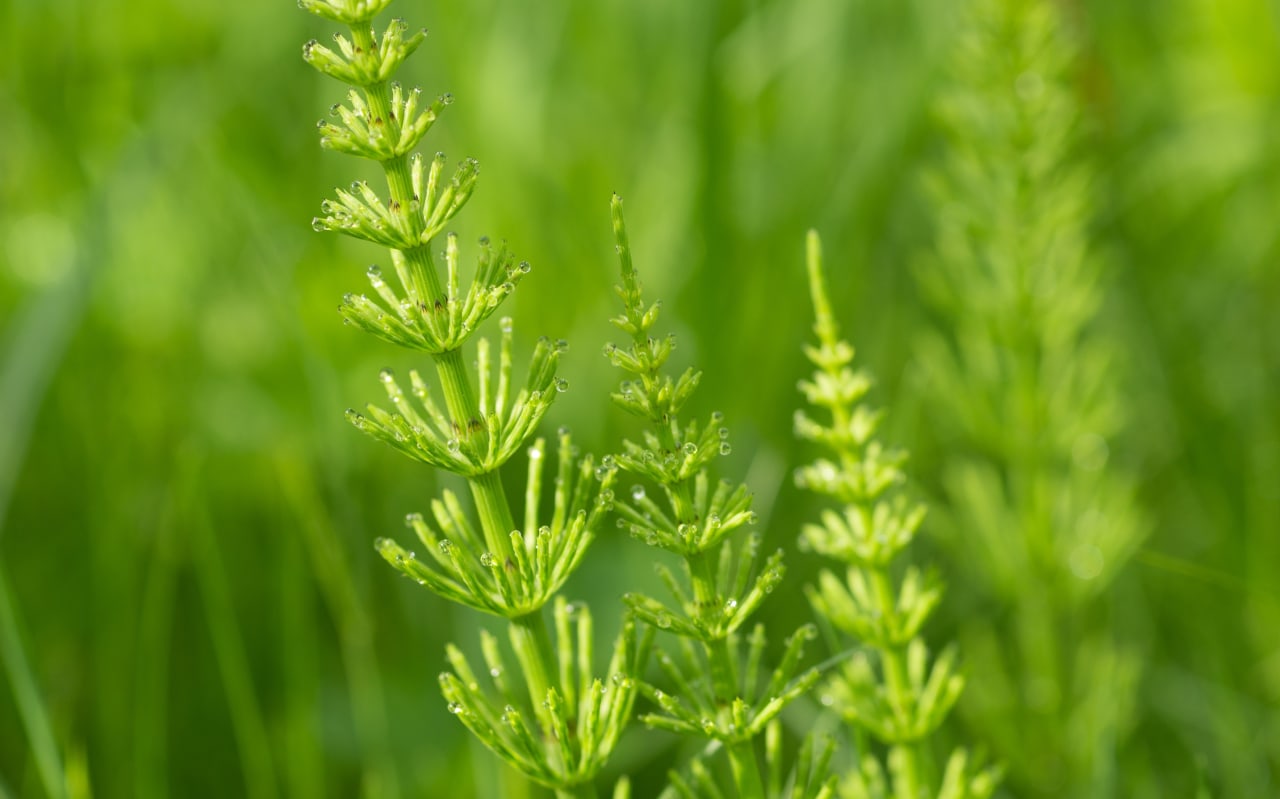
Horsetail, Equisetum arvense, is a perennial plant belonging to the Equisetaceae family. It is a survivor from the Carboniferous period, a geological era dating back hundreds of millions of years. Horsetail is, in fact, considered a ‘living fossil’. Equisetum means ‘horse’s mane’, while arvense means ‘fields’, hence its other name, ‘horsetail’.

The plant can grow up to 1 metre in height. Horsetail produces two types of stem: a fertile stem, which is smooth and brown in colour and bears the spores in spring. Once the spores have been dispersed, this stem withers. The second type is the sterile stem. This stem is green and resembles a horse’s tail, hence the plant’s common name. It is this stem that contains a significant amount of silicic acid, a soluble form of silica.

Field horsetail grows mainly in damp soils, including ditches, meadows, and cultivated fields. This species is found on most continents except Australia and Antarctica. Horsetail has been associated with human activities since at least ancient times: it was used by the Romans to polish metals such as copper and bronze. It is also used to make baskets, brushes, and brooms. Finally, its therapeutic properties have long been recognised.

Marsh Horsetail or Field Horsetail?

Only field horsetail is used in herbal medicine. It is therefore important to identify it correctly to avoid any confusion with marsh horsetail (Equisetum palustre), which is toxic to both livestock and humans.
The Main Properties of Horsetail

Remineralising Properties: A Benefit for Osteoporosis and Osteoarthritis

Horsetail is particularly rich in silica, an essential mineral for health that aids in the absorption of calcium. It therefore helps to strengthen bones, nails, and hair thanks to its mineral content, which strengthens the body in general and helps to prevent osteoporosis.

Diuretic Properties

Horsetail is also renowned for its diuretic properties, which help eliminate excess water from the body. This action helps to eliminate toxins from the body and helps to reduce water retention. It is also thought to help prevent urinary problems.

Haemostatic Properties

Horsetail is also known for its haemostatic properties, meaning it helps to stop bleeding, while also promoting better healing.

Cosmetic Properties for the Skin and Hair

Thanks to its high content of silica, flavonoids and Vitamin C, horsetail is used in cosmetics for its regenerating and restructuring properties. It helps to improve the skin’s elasticity and firmness. It is therefore used in anti-ageing skincare for mature skin. Thanks to its astringent and anti-inflammatory properties, it helps reduce inflammation associated with acne and improves the skin’s overall appearance. Horsetail is also frequently used in shampoos and hair lotions to strengthen the hair, stimulate growth, and add shine. Horsetail extracts are often found in shampoos and hair lotions.

What Are the Benefits of Horsetail?

Horsetail is recognised for the following benefits:

  • Helping to prevent osteoporosis and alleviate osteoarthritis, thanks to its remineralising and bone-strengthening properties

  • Strengthening nails and hair

  • Helping to prevent minor urinary disorders and water-retaining cellulite

  • Helping to reduce nosebleeds

  • Promoting radiant hair and skin, prevents skin ageing, and soothes irritated skin

Natural Uses of Horsetail

  1. As an Infusion or Decoction: Horsetail, rich in water-soluble silica (up to 70%), is ideal for these preparations. Infuse 2 to 4g of dried horsetail in 150mL of water and drink three to four times a day to help relieve minor urinary problems or support the body’s mineral balance. As a decoction, once cooled, it can be used to soothe skin irritations and superficial wounds or as a hair rinse to help strengthen the hair

  2. As a Dietary Supplement: Horsetail is available in capsules, tablets, or as a standardised extract, and is traditionally used to support bone, hair, nail, and connective tissue health

  3. In Cooking: Young field horsetail shoots can be eaten fresh, added to salads, or lightly sautéed, allowing you to benefit from their traditional remineralising properties

  4. In Cosmetics: Horsetail is used in creams, toning lotions, and hair care products due to its high silica content. It can be used in powder form, as an aqueous extract, or incorporated into homemade preparations to help maintain skin quality and strengthen the hair

Our Natural Aroma-Zone Solutions Featuring Horsetail

Organic Horsetail Powder

A true concentrate of plant-based silica, horsetail is an ingredient of choice for toning and firming the skin, strengthening the hair, and stimulating hair growth. With its astringent properties, it is also an ally in the care of oily and blemish-prone skin. A must-have in natural cosmetics!

Discover Our Organic Horsetail Powder

Our Aroma-Zone Recipes Based on Horsetail, to Make From Start to Finish

Precautions for Use

It is recommended that you consult a healthcare professional before using horsetail, particularly if you are pregnant, breastfeeding or if the product is intended for young children.

Excessive consumption can lead to a significant loss of potassium, so it is important to adhere to the recommended dosages.

Expert Advice

Horsetail and BambooField horsetail and bamboo have one thing in common: they are both rich in silica, which is essential for strengthening connective tissue. Like nettle, which is also rich in minerals, horsetail is often combined with it in natural preparations to support and revitalise the body.

Spotlight on Our Specialist Writer: Catherine Gilette

ada2d2_d8651e3eb63b4f06b1e322964cd90ca6-mv2.webp

Catherine is passionate about plants and their properties. She studied natural cosmetics at the École Lyonnaise des Plantes Médicinales in the early 2000s. Driven by curiosity, she has continued to explore the richness and potential of plants. This led her to train in aromatherapy at the École Française d’Aromathérapie Intégrative. She discovered an almost unexplored world in olfactotherapy, and valuable tools for getting to know herself better and practising what she calls inner ecology.

Bibliography

  1. European Scientific Cooperative on Phytotherapy Monographs

    The Scientific Foundation for Herbal Medicinal Products, 2nd edition, ESCOP, UK 2003

  2. Boeing, T., et al., Phytochemistry and Pharmacology of the Genus Equisetum (Equisetaceae)

    A Narrative Review of the Species with Therapeutic Potential for Kidney Diseases. Evid Based Complement Alternat Med, 2021

  3. Law, C. and C. Exley, New insight into silica deposition in horsetail (Equisetum arvense).

    BMC Plant Biol, 2011. 11: p. 112.

  4. Carneiro, D.M., et al., Randomised, Double-Blind Clinical Trial to Assess the Acute Diuretic Effect of Equisetum arvense (Field Horsetail) in Healthy Volunteers.

    Evidence-Based Complementary and Alternative Medicine, 2014. 2014: p. 760683.

Frequently Asked Questions

Frequently Asked Questions

Associated tip