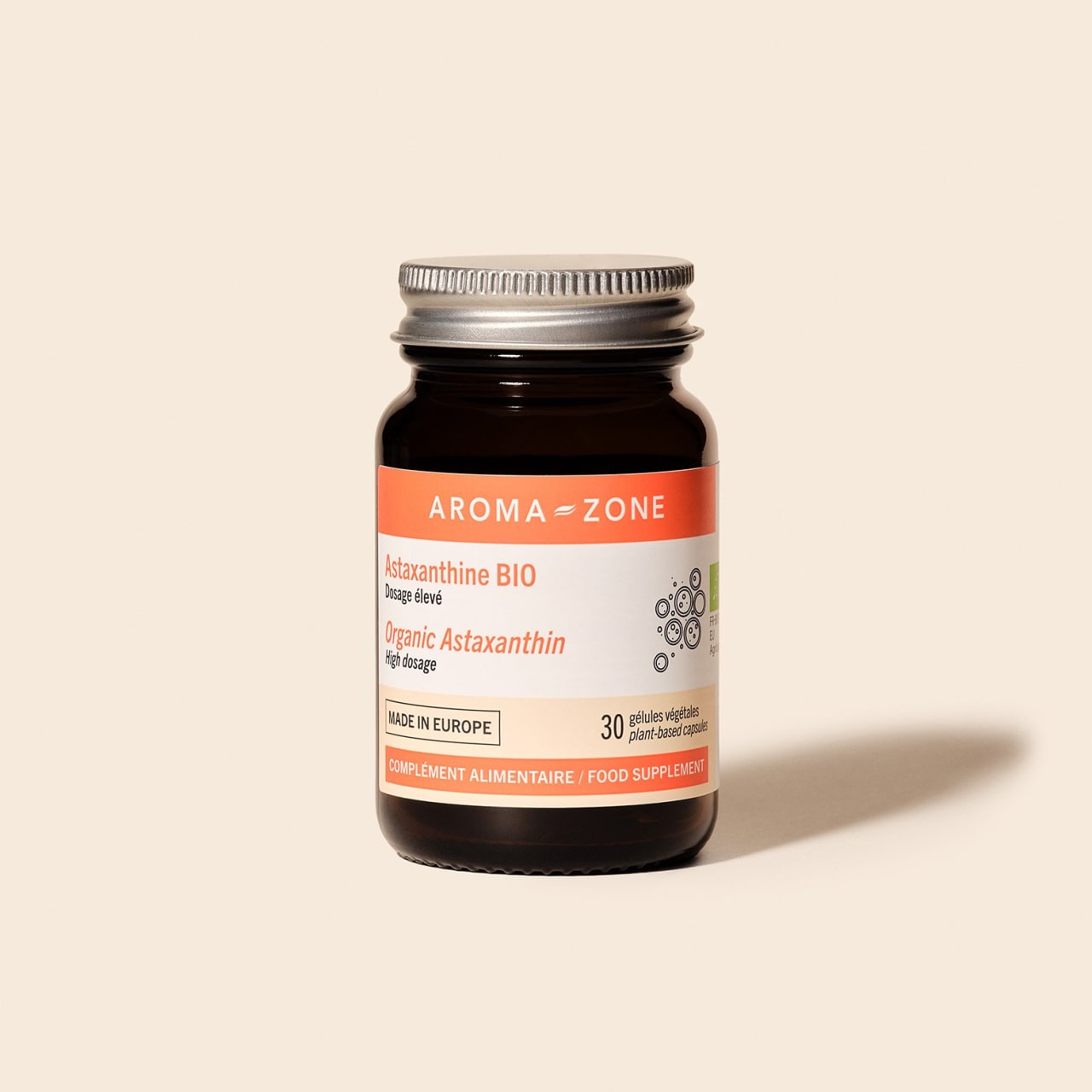
Astaxanthin - 30 Capsules
Tanning
Anti-ageing
£16.00
free delivery up to £25 in United Kingdom
100% secure payment CB, Visa, Mastercard, Paypal, Apple Pay, Google Pay
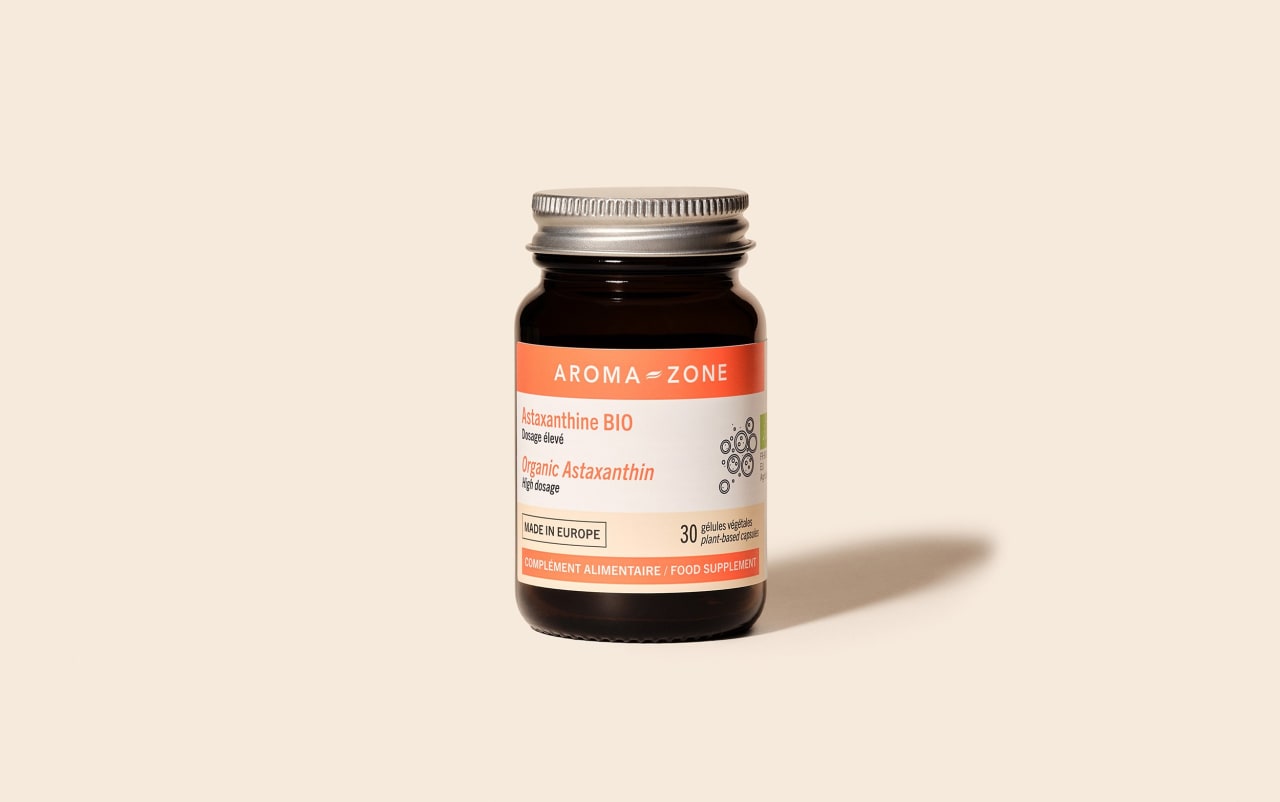
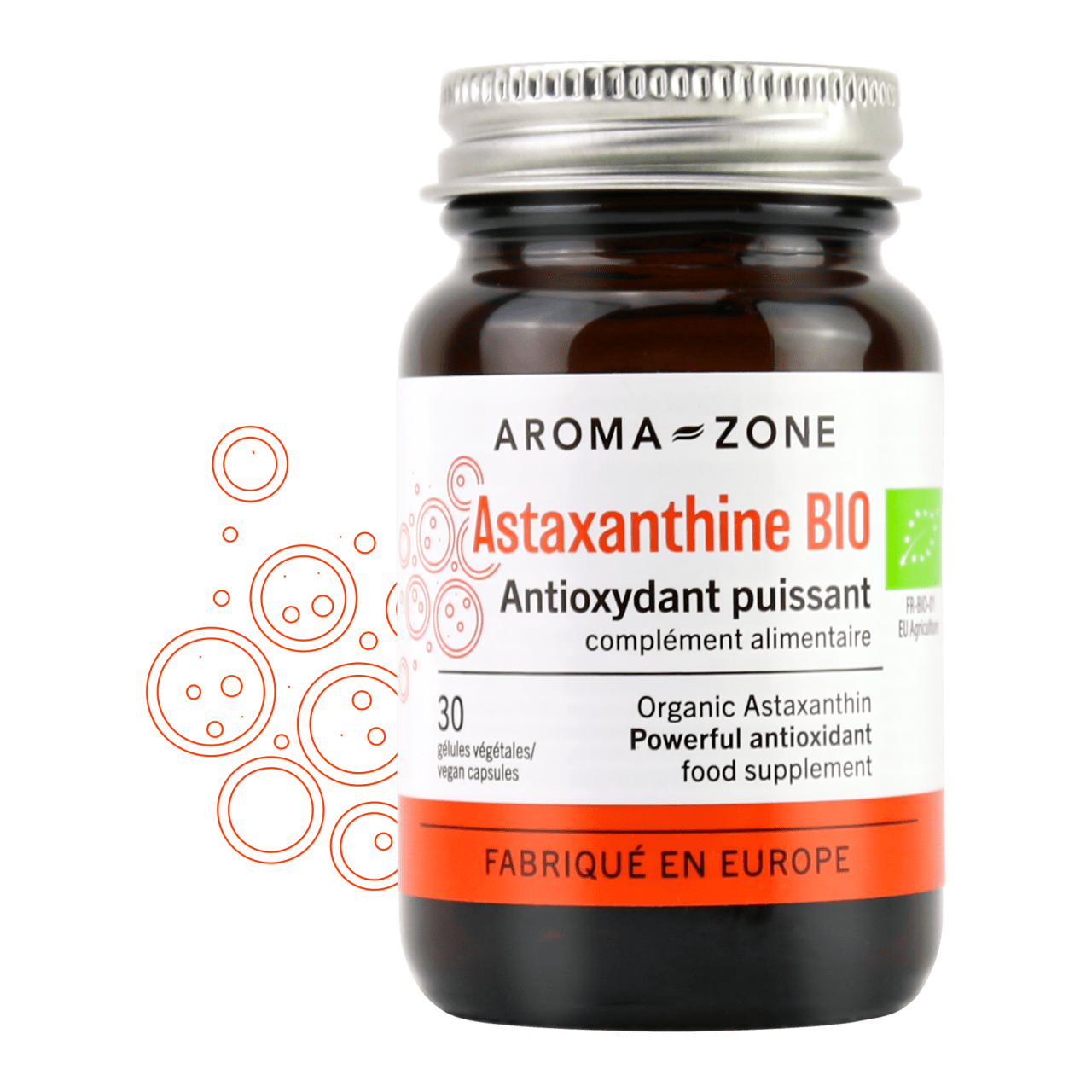
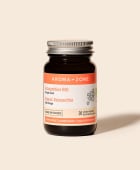
Astaxanthin - 30 Capsules
1 article

100% natural origin

Organic Farming

Organic

Vegan
Why we love it
Natural, Organic Astaxanthin, extracted from Haematococcus pluvialis algae grown in closed bioreactors
One of the most powerful natural antioxidants known
Helps protect the skin during sun exposure
Grown and extracted in Europe
Fights against premature skin ageing
100% plant-based capsules
Dosage: 1 capsule a day
From Europe
Use
How do I use Astaxanthin capsules?
Take one capsule a day with a glass of water.
1 jar = 1 month's worth of capsules
Why choose Aroma-Zone Organic Astaxanthin capsules?
Premium quality Astaxanthin, certified organic, 100% natural and vegan, extracted from Haematococcus pluvialis algae.
Seaweed is grown in Europe, in closed photo-bioreactors, free from any pollution, for a high-purity product
Extraction using supercritical CO2, a gentle, solvent-free technology that produces high-quality, concentrated plant extracts
The concentrated oleoresin extracted from the Haematococcus pluvialis algae is added to an oily base (organic olive oil), so the astaxanthin is absorbed better by the body and for optimum stability.
Astaxanthin in its natural form, enantiomeric 3S, 3'S configuration, which guarantees the best efficacy
High content of 80mg of oleoresin extracted from Haematococcus pluvialis algae, i.e. 8mg of pure Astaxanthin per capsule, which is the optimal and maximum dose authorised in Europe for an effective intake at a rate of 1 capsule per day
Why take Astaxanthin?
To combat oxidative stress after sun exposure: A powerful antioxidant, Astaxanthin may help neutralise free radicals, in particular singlet oxygen, which is generated within the skin by UV rays.
To combat premature ageing: Studies suggest that Astaxanthin helps maintain skin elasticity and supports a youthful, plump appearance.
For sportspeople: Research indicates that Astaxanthin can support endurance training and exercise performance, while helping to neutralise free radicals produced during intense physical activity.
For eye health: Astaxanthin is commonly included in food supplements aimed at maintaining vision.
For overall well-being: Scientific studies suggest potential benefits in supporting metabolic health and general vitality as we age.
What are the properties of Astaxanthin?
To date, no health claims have been authorised for Astaxanthin-based food supplements. However, numerous scientific studies highlight its powerful antioxidant properties. Astaxanthin is of particular interest in nutricosmetics for promoting healthy, radiant skin from within, in sports nutrition, for maintaining vision, and for supporting healthy ageing.
Function
Food supplement
Country of origin
Astaxanthin: Seaweed cultivated and extracted in the Czech Republic. Food supplement packaged in France.
Capacity
30 vegetarian capsules
Find out more
For this food supplement, we have chosen a premium-quality astaxanthin. Produced in Europe, it is 100% natural and certified organic. It is extracted from the unicellular micro-algae Haematococcus pluvialis and grown in a closed environment in large glass tubes, known as photo-bioreactors. This closed culture medium prevents any external contamination. The production unit is located at the foot of the Krkonose mountains in the Czech Republic, and has been designed with sustainability and eco-responsibility in mind.
Natural sunlight is used as much as possible to help the algae grow, using glass roofs. The heat and electricity required are supplied by renewable sources. The algae are grown using high-purity mountain water from a local source that is regularly monitored. The water is filtered and recycled after the algae production cycle. The strains of microalgae used are non-genetically modified. The algae naturally go through a growth stage, where they are green in colour, and then the "red" stage, where they produce the precious astaxanthin molecule, which gives them an intense red colour. The algae are then filtered and dried, and the biomass obtained is extracted using supercritical CO2 to obtain an oleoresin concentrated in astaxanthin.
What is astaxanthin?
Astaxanthin is a molecule in the carotenoid family, plant pigments widely renowned for their intense colours and antioxidant properties. More specifically, it belongs to the xanthophyll sub-group, along with lutein and zeaxanthin. Unlike carotenes, xanthophylls such as astaxanthin are not precursors of vitamin A, so there is no risk of vitamin A overdose. Astaxanthin is widely renowned for its powerful antioxidant effect, which is said to be up to 6 times greater than that of beta-carotene and 1000 times greater than that of vitamin E! It also has the advantage of never becoming pro-oxidant, unlike vitamin E, for example, which can become pro-oxidant in high doses.
Astaxanthin is found naturally in certain foods, such as salmon, prawns and lobsters, to which it gives their pretty pink colour. It is found in these species through their consumption of phytoplankton and krill, the tiny crustaceans from which krill oil is extracted, also valued for its natural richness in astaxanthin. Using astaxanthin extracted from a cultivated microalgae rather than krill has the advantage of being totally respectful of marine ecosystems, since no species is taken from the environment. What's more, the use of concentrated oleoresin from Haematococcus pluvialis provides a much higher astaxanthin intake than you would get from shrimp or salmon.
Astaxanthin can also be obtained synthetically, but the molecule is then obtained in the form of a mixture of enantiomers (structural variations in the molecule), which is less effective than the pure natural 3S,3'S enantiomer produced by Haematococcus pluvialis.Another method of producing astaxanthin uses genetically modified Phaffia rhodozyma red yeast, but here again, the form obtained is not the same: the enantiomer produced by the yeast is the less effective 3R,3'R, and the astaxanthin is in di-esterified form, which appears to be less well assimilated by the body in the studies. Astaxanthin derived from Haematococcus pluvialis algae is recognised as the best source of astaxanthin, providing the more effective 3S,3'S enantiomer, mainly in monoesterified form for optimal absorption.
As astaxanthin is a lipophilic molecule, soluble in fats, it is best absorbed by the body in the presence of lipids. For this reason, the presentation on an oily base - in our food supplement, organic olive oil - is ideal for good absorption. To optimise absorption, we also recommend taking your capsule with a meal containing fat.
Aroma-Zone dietary supplements: Quality, Efficacy, Safety
To respond to our customers' demand for natural, effective and safe dietary supplements, we are proud to present our dietary supplements. To meet your expectations, we developed our supplements with three keywords in mind: Quality, Safety and Efficacy. All while ensuring they are affordable. Find out more about our commitments regarding these dietary supplements below:
Clean label approach and transparency of composition
No unnecessary additives, no magnesium stearate, no titanium dioxide, no nanoparticles: we have chosen to avoid unnecessary ingredients in our formulas, such as fillers, excipients, colourants, preservatives, coating or release agents, etc. There are no hidden additives; our compositions transparently list all ingredients.

Priority given to effectiveness
The ingredients used in our dietary supplements have been selected for their recognised properties and their concentration of active ingredients. We use optimum doses for safe and effective use. We use active ingredients with high bioavailability (bioavailability indicates the proportion of active compound available to produce effects in the body), which means your body can absorb and use them effectively.

Controlled sourcing and traceability
All the raw materials used in our food supplements are rigorously selected for their quality, concentration of active ingredients, microbiological purity and absence of contaminants. Each batch is checked on receipt against strict specifications.
Capsules of plant origin
The capsules are made out of 100% HPMC, which does not contain colouring agents or gelatine. Derived from plant cellulose, HPMC (hypromellose or hydroxypropylmethylcellulose), this allows our dietary supplement capsules to be certified organic. This type of capsule protects the active ingredients from air and humidity exposure, guaranteeing the long-term stability of our dietary supplements. Pure and free from controversial additives, these capsules have been used for a long time and are proven to be safe.

Packaged in glass jars with metal lids
We use the minimum packaging required, and all of it is recyclable. Dispose of in the appropriate recycling sorting bins.
Quantity (mg): for 1 capsule
Oleoresin extracted from organic Haematococcus pluvialis: 80 mg
including Astaxanthin: 8 mg
Food supplement based on astaxanthin-rich oleoresin extracted from Haematococcus pluvialis algae.
Ingredients: extra virgin olive oil*, capsule shell: hydroxypropylmethylcellulose, astaxanthin-rich oleoresin extracted from Haematococcus pluvialis algae*.

*Ingredients from Organic Agriculture. Product of Organic Agriculture, certified by FR-BIO-01.
Storage
Store away from light, heat and moisture, closing the jar the supplements come in tightly.
Precautions
Keep out of reach of children.
Not a substitute for a varied and balanced diet and a healthy lifestyle. Do not exceed the recommended daily dose.
This dietary supplement must not be taken if you take other dietary supplements containing astaxanthin esters on the same day.
For adults only.
Not recommended for pregnant or breastfeeding women.
This dietary supplement does not provide sun protection in any way. It does not mean that you should stop applying sun cream or your usual measures for protection and sensible exposure to the sun.
Environmental qualities and characteristics product sheet
Reference
0469001 - Organic Astaxanthin food supplement 30 capsules
Main packaging material
Glass jar
Recycled material
Packaging containing at least 40% recycled material.
Recyclability
Most packaging can be recycled

Systematic Review and Meta-Analysis on the Effects of Astaxanthin on Human Skin Ageing. Nutrients.
Zhou X, Cao Q, Orfila C, Zhao J, Zhang L.
Effects of Astaxanthin Supplementation on Skin Health: A Systematic Review of Clinical Studies.
Ng QX, De Deyn MLZQ, Loke W, Foo NX, Chan HW, Yeo WS. J Diet Suppl.
Cosmetic benefits of astaxanthin on human subjects.
Tominaga K, Hongo N, Karato M, Yamashita E.
Effects of astaxanthin-rich Haematococcus pluvialis extract on cognitive function: a randomised, double-blind, placebo-controlled study.
Katagiri M, Satoh A, Tsuji S, Shirasawa T. J
Astaxanthin Influence on Health Outcomes of Adults at Risk of Metabolic Syndrome: A Systematic Review and Meta-Analysis.
Leung, L.Y.-L.; Chan, S.M.-N.; Tam, H.-L.; Wong, E.S.-W.
Effect of astaxanthin supplementation on muscle damage and oxidative stress markers in elite young soccer players.
Djordjevic B, Baralic I, Kotur-Stevuljevic J, Stefanovic A, Ivanisevic J, Radivojevic N, Andjelkovic M, Dikic N.J
Benefits and Safety of Astaxanthin in the Treatment of Mild-To-Moderate Dry Eye Disease. Front Nutr.
Tian L, Wen Y, Li S, Zhang P, Wang Y, Wang J, Cao K, Du L, Wang N, Jie Y.
Astaxanthin sources: Suitability for human health and nutrition.
Capelli, B.; Talbott, S.; Ding, L.Funct. Foods Health Dis.
Comparison of the effect of non-esterified and esterified astaxanthins on endurance performance in mice.
Aoi W, Maoka T, Abe R, Fujishita M, Tominaga K. J Clin Biochem Nutr.
"Astaxanthin from Haematococcus pluvialis prevents oxidative stress on human endothelial cells without toxicity."
Régnier P, et al.Marine drugs 13.5 (2015): 2857-2874
"Synthetic astaxanthin is significantly inferior to algal-based astaxanthin as an antioxidant and may not be suitable as a human nutraceutical supplement."
Capelli B, Bagchi D, and Cysewski G.
Frequently Asked Questions
No, taking astaxanthin as a food supplement does not cause the skin to turn orange, unlike other carotenoids.
You can take your Organic Astaxanthin capsules at any time of day. But for best absorption, we advise taking this food supplement with a meal, preferably one containing fat, as fat helps the body to absorb astaxanthin.
The recommended dose is one capsule of our Organic Astaxanthin food supplement per day, i.e. 80mg of oleoresin extracted from Haematococcus pluvialis algae, corresponding to 8mg of astaxanthin per day. The efficacy of astaxanthin has been demonstrated in numerous clinical studies on doses ranging from 2 to 16mg per day. An 8mg per day is considered to be potent, optimal and safe for most people. European Regulation 2017/2470 authorises the use of oleoresin extracted from the alga Haematococcus pluvialis as a 'novel food' in food supplements (excluding children and teenagers under the age of 14) at a dose of 40 to 80mg of oleoresin per day, equivalent to a maximum of 8mg of astaxanthin per day.
Astaxanthin is generally taken in 1 to 3-month courses. A pot of 30 capsules corresponds to a 1-month course.
No, astaxanthin food supplements should not be taken during pregnancy or while breastfeeding.
Loading...
Excellent product. Since I started using it, I've noticed a more intense tan and it lasts longer, with a complete disappearance of the sunburn I used to suffer from.
I HOPE YOUR PRODUCTS ARE AS ADVERTISED
Excellent supplement.
So far, I can say that the product shows promise, although more time needs to pass to evaluate its effects.
Product well tolerated, but I've been taking it for about 10 days, so it's still too early to give an evaluation. We'll see over time.
Associated products
£15.00
article
£20.00
1 article
£10.00
10 ml
£7.00
article
£16.00
1 article