The basics of calculation

The basics of calculation


By The Aroma-Zone editorial team

Published on: Friday, August 12, 2022, Updated on: Friday, October 02, 2026

A comprehensive guide to everything you need to know about calculating quantities for homemade cosmetics, plus our tips and advice to help you make your own preparations.

Contents

What is density?

calcul_11

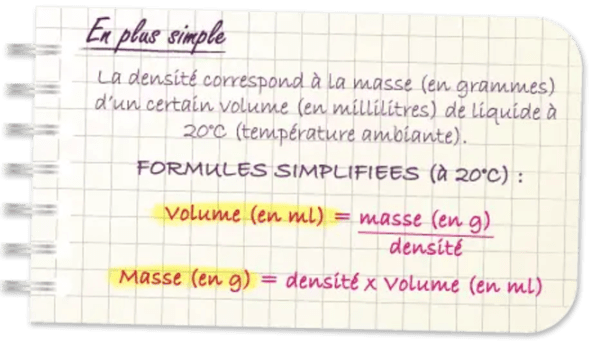
Density is a value that primarily characterises liquids. It is the ratio of the density of the chosen ingredient to that of water (at 20°C); density being a physical quantity that characterises the mass of an ingredient per unit volume.

Density is useful for measuring quantities of all types of liquid products: vegetable oils, hydrolates, glycerine, liquid active ingredients, etc.

It is used to convert mass into volume and vice versa to adapt the recipe to the equipment you have available (scales, graduated cylinder, graduated pipette, measuring jug, tablespoon, coffee cup).
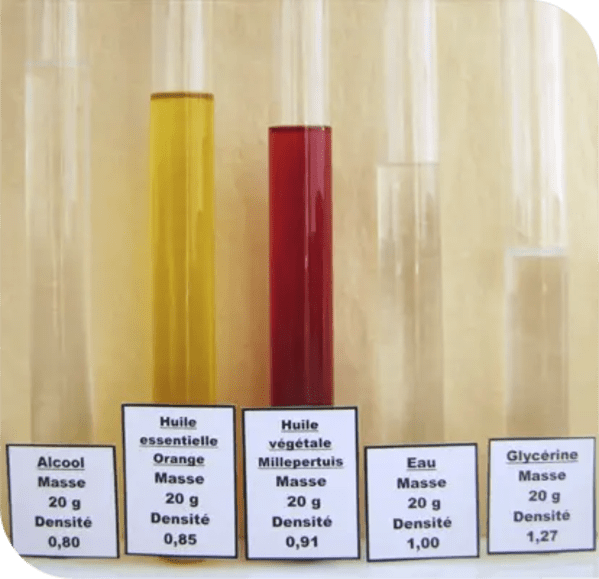
Density can vary enormously from one liquid to another

img_mp_16

There are two ways to measure a quantity of liquid when preparing a recipe:

  • By mass (in grams) : this quantity is expressed in grams and can be measured using a set of scales.

  • By volume (in millilitres) : this quantity is expressed in millilitres and can be measured using a graduated cylinder or a graduated pipette

To convert these quantities to suit your equipment, you will use density.

Example

undefined

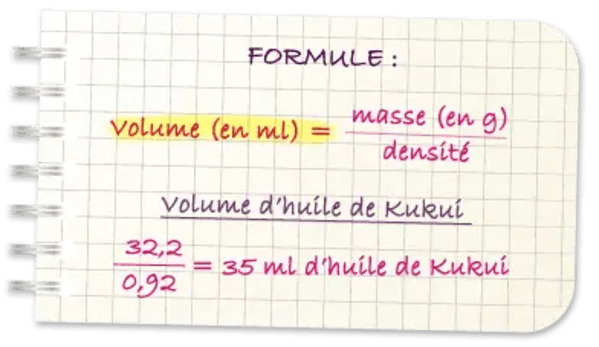
Calculating the volume (ml) of kukui oil

calcul_36

I have 32.2 grams of kukui oil to add to my recipe. I’d like to measure it using my measuring cylinder as I don’t have a set of scales.

So I’m doing the calculation to convert the mass (grams) of oil into volume (millilitres). According to the technical data sheet, the density of this vegetable oil is 0.92.

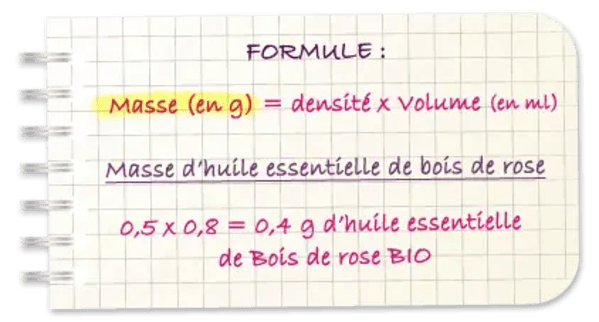
Converting the weight (g) of organic rosewood essential oil

calcul_39

I have 0.5 millilitres of rosewood essential oil to add to my recipe. I want to weigh it using my scales as I don’t have a measuring cylinder.

So I’m doing the calculation to convert my volume (millilitres) into mass (grams). According to the technical data sheet, the density of this essential oil is 0.88.

The Aroma-Zone Tip

As the density of water or a hydrosol is 1, it is therefore easy to conclude without any calculations that:

1 gram of water or hydrosol = 1 millilitre of water or hydrosol.

The same applies to all preparations with a density close to 1, such as: shower gels, water-based gels and lotions.

How do you convert millilitres to grams?

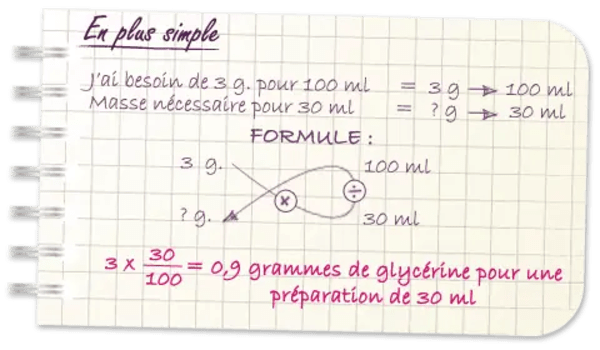
The ‘Rule of 3’ or ‘Cross-multiplication’

calcul2_05

This is a simple calculation method used, for example, to convert the quantity of an ingredient per 100 ml to the quantity required for 30 ml on a proportional basis.

Example: The recipe specifies 3 grams of glycerine per 100 ml of preparation. I want to make a 30 ml batch of this recipe; how many grams of glycerine should I add to my preparation?

Measuring in drops

sf_base-calcul_carnet-goutte_16_0

For certain liquids sold with a dropper (essential oils, active ingredients, preservatives, etc.), quantities can be expressed in drops. This method is very practical but far less accurate than measuring by volume or mass. This is because certain factors influence the volume of the drops, such as temperature, the type of dropper and the viscosity of the product…

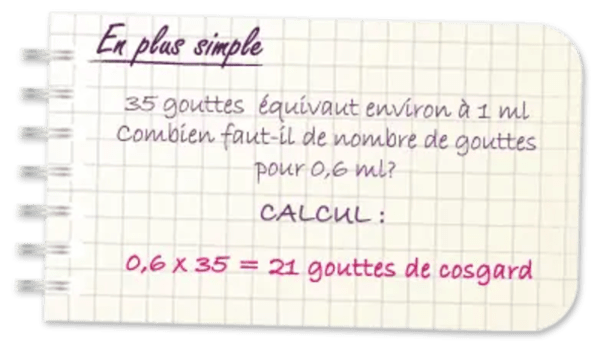
To put it very simply, and to work out how many drops you need to add, all you need to know is that 1 ml is roughly equivalent to 35 drops.

The number of drops is calculated based on the required volume (not the mass).

Example:

If I have 0.6 ml of Cosgard preservative to add to my mixture, I multiply by 35 to convert this volume into the number of drops.

Adding an active ingredient or an essential oil to a base

For many cosmetic ingredients (active ingredients, preservatives, emulsifiers, etc.), it is standard practice to express the optimal dosage of the ingredient as a percentage (e.g. 0.5–2%).

A percentage is a way of expressing a proportion of a total mass. The percentages in our recipes and the recommended dosages for our ingredients are by mass.

For example: 3 per cent glycerine corresponds to 3 grams of glycerine to be added to a preparation totalling 100 grams.

To work out the amount you need to add to your mixture, simply convert the percentage into grams: 3 per cent = 3 grams in a 100-gram mixture. If your base does not amount to 100 grams, it is important first to weigh the quantity in grams of your neutral cream, cleansing base or aloe vera gel using a set of scales. You will then need to carry out a cross-calculation to determine the quantity of active ingredient to add.

The Aroma-Zone Tip

For creams, shower gels and lotions with a density close to 1, you can assume that 100 ml is equivalent to 100g.

Example

The maximum recommended concentration of essential oils is: 2% for facial products, and 5% for active body products.

undefined

Estimating the quantity of a formulation needed to fill a container

The aim is to work out the mass of the mixture you need to make to fill a container of a certain volume.

Depending on your container and the density of your finished product, you’ll be able to fill your bottle to a greater or lesser extent.

To ensure you get the quantity right, simply estimate the density of the finished product. Here are a few examples of very general but simple average densities:

Please note: you will always experience some product loss when transferring the mixture into your jar or bottle.

Density

0.9

Suitable container for the quantity prepared

i.e. 45 g of mixture to fill one 50 ml bottle

Frequently Asked Questions

Frequently Asked Questions