
A perfume evolves after it is applied. Some scents are noticeable immediately, whilst others unfold gradually and linger longer on the skin. There are three distinct types of notes: top notes, middle notes and base notes (1,2).
How to Make Your Own Perfume
By The Aroma-Zone editorial team
Published on: Wednesday, March 29, 2023, Updated on: Friday, October 30, 2026
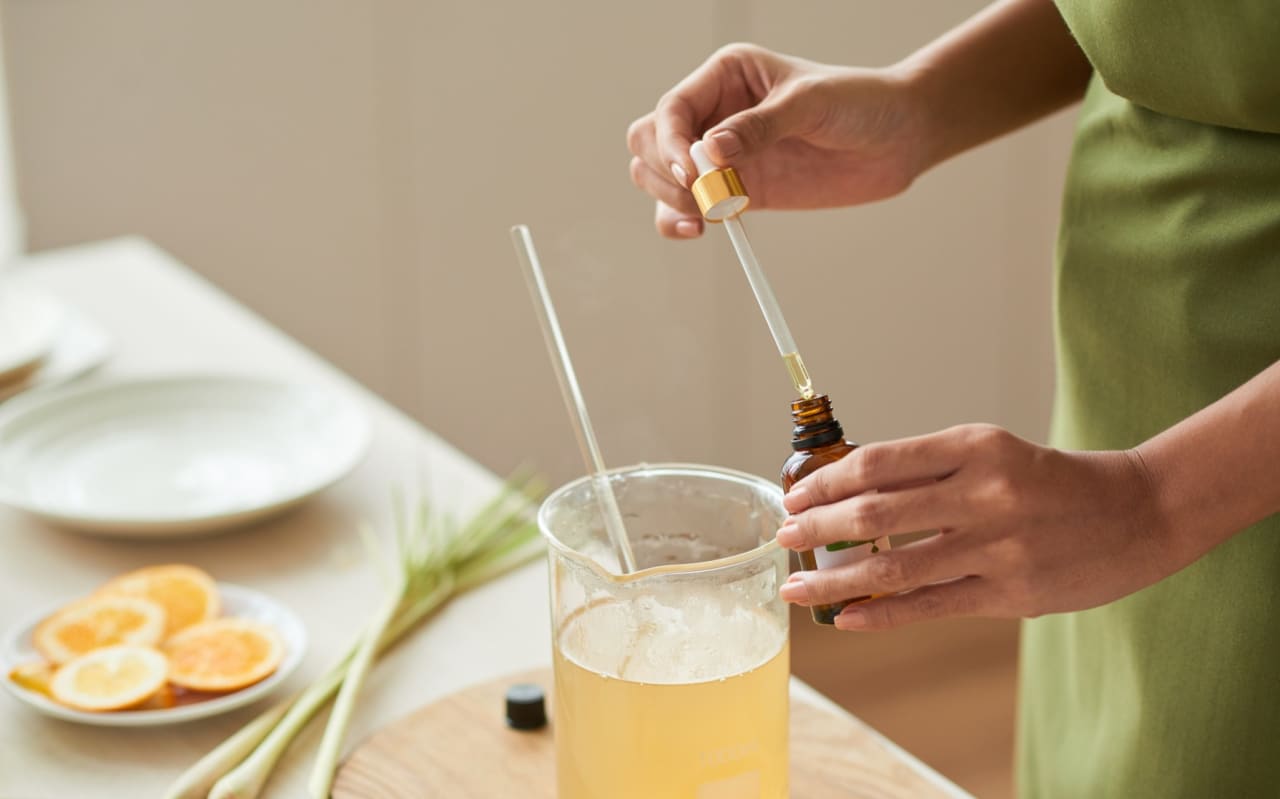
Floral, woody, fresh, citrus or gourmand: every perfume explores a different olfactory world. To create your own, it all comes down to the choice of raw materials and how you combine them. Ingredients, accords, base notes: discover the basics of natural perfumery to create a bespoke fragrance.
Contents
In brief
• Making your own natural perfume allows you to create a unique, personalised fragrance free from synthetic substances that are harmful to health, using essential oils. This page introduces the basics of perfumery, from the olfactory pyramid to the citrus, floral, woody, spicy and amber fragrance families, helping you choose a signature scent that suits your personality.
• The creation process follows a structured method: selecting the notes, balancing their placement within the olfactory pyramid, incorporating a fixative and choosing a suitable base. The concentrations outlined range from 15 to 30 per cent for a perfume, with a claimed longevity of several days. The formulation process, the various bases and the subtleties of blending are detailed in the article.
• The article also explains the differences between perfume, eau de parfum, eau de toilette and eau fraîche, as well as the role of the fixative and the necessary equipment, such as perfumer’s pads or pipettes. The choice of ingredients, concentration and base deserves particular attention to create a coherent composition suited to the intended use.
What are the different notes in a perfume?
Type of note | Features | Related scents |
Top notes | Light and fleeting, these are the first notes you notice. They set the tone for the fragrance before fading quickly. | Citrus, green, aromatic and fresh notes |
Heart notes | These emerge as the top notes begin to fade and linger longer on the skin. They give the fragrance its character. | Floral, fruity and spicy notes |
Base notes | Deeper and less volatile, they appear later and linger longer on the skin. They contribute to the fragrance’s longevity and sillage (1). | Woody, vanilla, amber and musky notes |
What are the main fragrance families in perfumery?
In perfumery, scents are grouped into broad families according to their olfactory characteristics. Citrus, floral, woody or amber notes help us to better identify the scents we like and choose the raw materials to combine when making our own perfume. Some classifications also distinguish families such as fougères, chypres or leather notes (3).
Fragrance family | Characteristics | Associated notes |
Citrus | Fresh and lively, it combines the scents of citrus fruits and zest. | Orange, Grapefruit, Mandarin, Clementine |
Green | Herbal and fresh, it is reminiscent of cut grass, crumpled leaves or sap. | Galbanum, violet leaf, blackcurrant bud |
Aromatic | Fresh and green, it combines the characteristic scents of plants and aromatic herbs. | Lavender, Mint, Sage, Rosemary, Thyme |
Fruity | Mild, sweet or tangy, it evokes the different facets of fruit. | Apricot, Peach, Cherry, Coconut |
Floral | It brings together scents inspired by a single flower or a bouquet, ranging from the lightest to the most opulent. | Tuberose, jasmine, Damask rose, neroli, ylang-ylang |
Spicy | Warm and intense, this category adds depth to a fragrance composition. | Cinnamon, Cardamom, Ginger, Pink peppercorns |
Woody | Warm and deep, it evokes wood, bark and sometimes the undergrowth. | Sandalwood, patchouli, vetiver, cedar |
Amber | Warm, sweet and enveloping, it traditionally combines balsamic, vanilla and spicy notes. | Vanilla, benzoin, labdanum, tonka bean, Peruvian balsam |
Fougère | Fresh and aromatic, it is traditionally based on a blend featuring lavender, woody and mossy notes. | Lavender, woody and mossy notes |
Chypre | Contrasting and deep, it traditionally combines fresh notes with woody and mossy facets. | Citrus, patchouli, woody and mossy notes |
Leather | Intense and deep, it evokes the smoky, woody or animalic scents of leather. | Birch, juniper, labdanum, styrax, tobacco |
The Composition of a Perfume
To make your own perfume, you generally combine three types of ingredients:
Fragrance materials: essential oils, absolutes and other aromatic extracts. These are what give the perfume its various scents and enable you to create fragrance accords (3)
A carrier: perfume base, alcohol or an oily carrier. This dilutes the fragrance ingredients and helps achieve the desired perfume formulation (4)
An optional fixative: low in volatility, it helps prolong the fragrance’s longevity by slowing down the evaporation of certain aromatic compounds. Certain base notes may also act as fixatives, although the two concepts are not equivalent (1).
In natural perfumes, iris is particularly prized for the fixing properties of its rhizomes (5). Iris root powder or CO₂ extract of iris can be used in formulations, as can benzoin absolute or the essential oils of vetiver, patchouli, cedar, clary sage, guaiac wood or sandalwood, all of which can help prolong the fragrance’s longevity.
Which base materials should you choose when making your own perfume?
The choice of base determines not only the form of the perfume, but also its texture and method of application. It can also alter the way in which the fragrance compounds are released and perceived (4). Alcohol, oil or a solid base: there are several options available for making your own perfume.
Alcohol-based perfume
This is the most common form in perfumery. The fragrance ingredients are diluted in alcohol, usually ethanol, which effectively dissolves the fragrance compounds and evaporates quickly after application, leaving the fragrance on the skin (1). As alcohol is flammable, it must be handled in a well-ventilated area, away from flames and heat sources, and then stored in a suitable, tightly sealed container.
To create this type of perfume, our Perfume Base provides a ready-to-use base into which the fragrance ingredients can be incorporated.
Oily perfume
An oil-based perfume involves diluting fragrance ingredients in a vegetable oil. It is important to check beforehand that the chosen ingredients are fully soluble in the oil. This type of perfume is used in small quantities, usually on pulse points such as the insides of the wrists or the neck.
Solid perfume
Also known as ‘perfume concrete’, solid perfume is based on an oily base with a balm-like texture. The fragrance ingredients are incorporated into a mixture that may contain a vegetable oil, a vegetable butter and a wax or stearic acid. Compact in form, it is applied in small quantities with the fingertips, particularly to the inside of the wrists or behind the ears.
If you prefer a ready-to-use formula, the Orange Blossom Scented Body & Hair Care Mist delicately scents the skin and hair with just a few sprays.
What perfume should you create to suit your scent preferences?
A personalised perfume is created using the scents you love and the combinations that bring them to the fore. Whether fresh and herbal, floral, woody, sweet or spicy, the various olfactory profiles allow you to compose a fragrance to suit your preferences (3).
The world of scents | Characteristics | Main ingredients |
Fresh and citrusy | Lively, fresh and zesty | Mandarin, Bergamot, Grapefruit, Sweet Orange, Yuzu, Lemon* |
Green and aromatic | Plant-based, fresh and herbaceous | Galbanum, lavender, mint, rosemary, sage, petitgrain |
Floral | Soft, fresh or more opulent depending on the flowers chosen | Damask rose, Neroli, Jasmine, Ylang-ylang, Tuberose, Geranium |
Fruity and indulgent | Mild, sweet or tangy | Vanilla, Tonka bean, Benzoin, Coconut, Peach, Apricot, Cocoa |
Woody | Deep, dry or enveloping | Sandalwood, Cedar, Vetiver, Patchouli, Guaiac Wood |
Spicy | Warm, intense and contrasting | Cinnamon, cardamom, ginger, pepper, clove, coriander |
Amber | Warm, rounded and enveloping | Vanilla, benzoin, labdanum, tonka bean, Peruvian balsam |
Floral and sunny | Luminous, generous and exotic | Ylang-ylang, frangipani, jasmine, tuberose, vanilla, coconut |
These elements can, of course, be combined. Citrus notes can add freshness to a woody fragrance, amber notes can warm up a floral composition, or spices can add depth to a gourmand accord. By combining the ingredients and adjusting their proportions, you can then achieve the desired balance and create a fragrance to suit your taste.
*Some citrus essences and essential oils may be photosensitising. After application to the skin, exposure to sunlight is therefore not recommended.
Making My Own Perfume
To make your own perfume, start by selecting a few raw materials based on the scents you’re looking for: 1 to 3 for the top, middle and base notes will be enough for your first attempts.
Step 1: Prepare your equipment and raw materials
Make sure you have a few 5 ml glass vials, labels, perfume swatches, a dropper pipette and a notebook to record your measurements accurately. Some raw materials, such as absolutes, must be pre-diluted in your chosen carrier before use. Always check their technical data sheet to ensure they are soluble in the carrier you have chosen.
Step 2: Create the top, middle and base notes
Prepare three bottles labelled ‘top note’, ‘heart note’ and ‘base note’. In each, mix one drop of the chosen raw materials, then gradually adjust the proportions until you achieve the desired accord. Work with small quantities and note down each addition: this will enable you to easily reproduce the chosen formula.
Step 3: compose the final blend
Next, combine your three accords in a new bottle, drop by drop. Test different proportions and smell each sample on a perfumer’s strip: immediately to detect the top notes, after about 1 hour for the heart notes and after 3 hours for the base notes. Once you’ve found the right balance, you can still add a raw material in small touches to refine the composition.
Step 4: Dilute the accord in your chosen base
Your final accord is ready: all that remains is to reproduce it in the desired quantity and dilute it according to the type of perfume you have chosen.
For an alcohol-based perfume: add the fragrance ingredients of your choice to the organic neutral perfume base, formulated from organic plant-based ethanol. Follow the recommended measurements for each ingredient, then mix the preparation before pouring it into a suitable bottle. 6
For an oil-based fragrance: mix the fragrance blend with a vegetable oil that is relatively odourless and not prone to going rancid, such asjojoba oil, after checking the solubility of the ingredients. Then pour the mixture into a suitable bottle
For a solid fragrance: melt the vegetable oil, butter and wax or stearic acid, then stir in the fragrance ingredients. Pour the mixture into a small jar and leave to cool until it solidifies.
Step 5: Packaging and storing your perfume
Store your perfume in a suitable, tightly sealed glass bottle, away from light and heat. These precautions help to minimise evaporation and the deterioration of the fragrance ingredients. Certain essences, particularly citrus ones, are particularly sensitive to oxidation when exposed to air (3). The shelf life depends on the formula, the base and the ingredients used: refer to the storage instructions specific to each raw material.
Precautions for use
When making your own perfume, follow the recommended measurements and safety precautions specific to each raw material. Before applying it to your skin, carry out a patch test on the inside of your elbow and wait 48 hours to ensure there is no reaction.
Essential oils are powerful natural concentrates. Please refer carefully to the intended uses and precautions for use on each technical data sheet. Store them in a suitable glass bottle, away from light and air. Keep out of reach of children. Do not use on pregnant or breastfeeding women, or on children under 6 years of age. Avoid contact with the eyes and mucous membranes. Please consult the general safety information sheet for essential oils as well as the specific information sheet for each essential oil.
Expert advice
To create your own perfume, start with simple blends using just a few ingredients. Add them gradually and make a precise note of the quantities used in each trial: just a few drops can be enough to alter the balance of a fragrance. Also, take the time to smell your blend at different times, as a perfume evolves over the course of several hours and may reveal notes that are very different from those perceived immediately after it is created.
Bibliography
Teixeira, M. A., Rodríguez, O., Gomes, P., Mata, V., & Rodrigues, A. E. (2009), The diffusion of perfume mixtures and the odour performance, Chemical Engineering Science
https://doi.org/10.1016/j.ces.2009.01.064
Santana, V. V., Martins, M. A. F., Loureiro, J. M., Ribeiro, A. M., Rodrigues, A. E., & Nogueira, I. B. R. (2021), Optimal fragrance formulation using a deep learning neural network architecture: A novel systematic approach, Computers & Chemical Engineering
https://doi.org/10.1016/j.compchemeng.2021.107344
Sharmeen, J. B., Mahomoodally, F. M., Zengin, G., & Maggi, F. (2021), Essential oils as natural sources of fragrance compounds for cosmetics and cosmeceuticals, Molecules
https://doi.org/10.3390/molecules26030666
Di Nicolantonio, L., Gigliobianco, M. R., Vargas Peregrina, D., Angeloni, S., Ilorini, L., Di Martino, P., & Censi, R. (2022), Impact of the interactions between fragrances and cosmetic bases on the fragrance’s olfactory performance: An attempt to correlate SPME-GC/MS analysis with that of an experienced perfumer, Cosmetics
https://doi.org/10.3390/cosmetics9040070
Friščić, M., Maleš, Ž., Maleš, I., Duka, I., Radonić, A., Mitić, B., Hruševar, D., Jurić, S., & Jerković, I. (2024), Gas chromatography–mass spectrometry analysis of volatile organic compounds from three endemic Iris taxa: Headspace solid-phase microextraction vs. hydrodistillation, Molecules
https://doi.org/10.3390/molecules29174107

Frequently Asked Questions
Associated tip
Home Fragrances


