
Hair conditioner
free delivery up to £25 in United Kingdom
100% secure payment CB, Visa, Mastercard, Paypal, Apple Pay, Google Pay
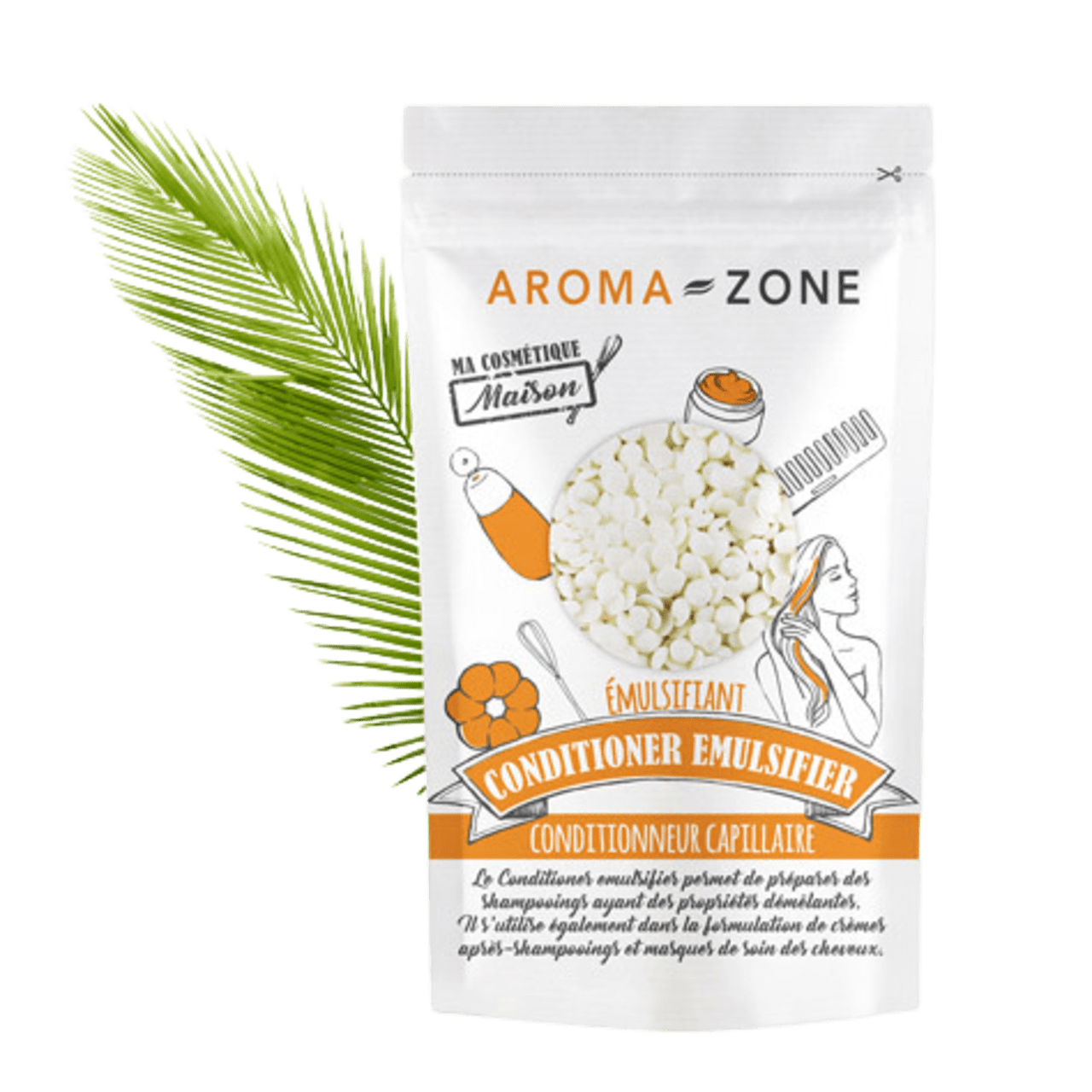
Co-emulsifier: in combination with other emulsifiers (BTMS, Emulsifying Wax No. 2), it helps to obtain stable emulsions.
Activat in acidic pH: once the pH is adjusted between 4.5 and 5.5 (we recommend using lactic acid), it acts as a conditioning agent.
When activated at an acidic pH, it delivers an antistatic effect that makes detangling easier.
It makes hair silky soft and easy to style without weighing it down.
Type of emulsions
Oil-in-water emulsions
Hair type
All hair types, especially long hair that is difficult to detangle, split ends, colored, unruly, curly, or frizzy hair.
Conditioner Emulsifier is mainly used for hair care. It can be used in several ways:
In emulsion, in combination with another emulsifier such as BTMS : to make conditioners and hair masks
In emulsion, in combination with another emulsifier such as BTMS, adding cleansing surfactants (such as sugar foam, foaming base consistency, etc.) for nourishing "cream" shampoos and conditioners
Without an oil phase, mixed with cleansing surfactants for traditional "gel" shampoos with conditioning properties for hair or shower gels that leave the skin feeling silky smooth.
Some ideas
Classic shampoos or "cream" conditioner shampoos
Detangling conditioners
Fortifying and softening hair masks
Detangling hair lotions
Discover our thematic dossier " Hair" to learn more and build your personalized hair care program...
Dosage
4 to 5% (of the total weight of your preparation to be added to the oil phase or acidified aqueous phase)
Melting point
70°C
Soluble in the oil phase
when heated
Recommended pH in formulas: 4.5-5
Acidify preparations with lactic acid.
Soluble in acidified aqueous phase
when heated
Associations
Does not produce stable emulsions when used alone.
Combine with another emulsifier (e.g., BTMS or Emulsifying Wax No. 2) to make hair creams (conditioners, masks).
Combine with cleansing surfactants (e.g., foaming base consistency) to make conditioning "gel" shampoos (without an oil phase).
Combine with another emulsifier (BTMS, for example) and cleansing surfactants (foaming base consistency, for example) to make "cream" conditioner shampoos (containing an oil phase) or conditioners.
Compatibility with preservatives
Grapefruit Seed Extract | 3/3 |
Naticide | 3/3 |
Cosgard | 3/3 |
(*** no influence on stability, ** a decrease in stability has been observed in some cases at low dosages, or temporary destabilization has been noted when the preservative is added, * risk of emulsion destabilization)
Precautions
Precautions and allergens
Precautions for use
Allergens
Allergen-free
Utensil:
Hand whisk or electric mixer for forming emulsions
Spatula or spoon to incorporate surfactants without creating foam
Conditioner Emulsifier is used in combination with a pH adjuster (we recommend lactic acid) because an acidic pH (4.5-5) is necessary to "activate" the quaternary ammonium function that gives it its properties.
If you are making a recipe, it is best to follow the recommended quantities and instructions. Otherwise, here are some guidelines to help you understand how to use Conditioner Emulsifier and experiment with your own recipes.
Shampoo or a classic shower gel (without an oily phase)
Place the Conditioner Emulsifier in water and add lactic acid (to "activate" 1 g of Conditioner Emulsifier, you will need 0.3 g of lactic acid).
Heat until the Conditioner Emulsifier dissolves.
Allow to cool, then add the previously mixed cleansing surfactants (avoid anionic surfactants unless otherwise indicated), stirring gently to avoid excessive foaming.
The addition of surfactants increases the pH (and some of the Conditioner Emulsifier may re-solidify). Check the pH using pH test strips and add lactic acid until the pH is between 4.5 and 5.5. The Conditioner Emulsifier should re-dissolve completely (you can heat the mixture slightly if necessary to help it dissolve).
Add the other active ingredients once the preparation has cooled.
Cream shampoo or emulsion with conditioning effect (conditioner, mask, etc.)
Melt the Conditioner Emulsifier at around 70°C in the oil phase with the other emulsifiers (BTMS, Emulsifying Wax No. 2, etc.).
In the aqueous phase, add lactic acid to obtain a pH between 4.5 and 5.5 (check the pH using pH test strips).
Heat the aqueous phase to approximately 70°C.
Mix the two phases at the same temperature, stirring vigorously to form the emulsion.
Once the emulsion has formed, add cleansing surfactants if desired (to make a cream shampoo or to make a conditioner easier to rinse out).
Check the pH again and adjust it between 4.5 and 5.5 using lactic acid.
Add the other active ingredients cold at the end of preparation.
Once "activated" in an acidic environment, Conditioner Emulsifier is a cationic surfactant and is therefore incompatible with strong anionic surfactants. However, according to our tests, it can be used with our mild foaming base (weak anionic surfactant). Unless otherwise indicated, avoid combining it with anionic surfactants.
Aroma-zone Tip
Conditioner Emulsifier tends to thicken preparations, especially when combined with the gentle foaming base. The use of certain active ingredients, such as provitamin B5, and certain essential oils, such as lemon litsea, will help to thin your shampoo.
To avoid having a product that is too thick, you can also avoid using the mild foaming base and opt for the consistent foaming base instead.
4% Conditioner Emulsifier | 1.2 g |
5% Conditioner Emulsifier | 1.5 g |
4% Conditioner Emulsifier | 2.0 g |
5% Conditioner Emulsifier | 2.5 g |
4% Conditioner Emulsifier | 4.0 g |
5% Conditioner Emulsifier | 5.0 g |
4% Conditioner Emulsifier | 10.0 g |
5% Conditioner Emulsifier | 12.5 g |
1 scoop 5 ml (level*) | 3.4 g |
1 scoop 2 ml (level*) | 1.5 g |
* leveled: spoon filled to the brim with the excess removed using a spatula or the back of a knife
Quality
Partially plant-based (derived from stearic acid obtained by processing palm oil) and partially synthetic (dimethylamine graft for hair conditioning effect).
Method of production
Stearamidopropyl dimethylamine: an amino derivative of stearic acid, which becomes quaternary ammonium in an acidic environment.
Function
Co-emulsifier (improves emulsion stability) and hair conditioning agent (facilitates hair detangling).
INCI designation
Stearamidopropyl Dimethylamine
Presentation
Small white pellets with a characteristic ammonia smell, packaged in zippered bags.
Type
Cationic, non-ethoxylated emulsifier
Learn more
Hair conditioners
Offering these conditioners was the subject of heated debate within the entire Aroma-Zone team, as conditioning agents are often criticized for their irritating properties. However, having soft, easy-to-detangle hair is a need expressed by many of you, and to date, no natural product allows for perfect detangling.
After deliberately avoiding synthetic silicones, which suffocate the hair and weaken it over time, we turned our attention to quaternary ammonium compounds. These compounds are often criticized for their irritating effects on the skin and their toxicity to the environment. However, we selected the most interesting of these active molecules.
PH
The pH (potential hydrogen) determines whether an aqueous mixture is acidic, neutral, or basic. The pH is measured on a scale of 1 to 14:
1 < pH <7 acidic pH
pH = 7 neutral pH
7 < pH < 14 basic (or alkaline) pH
In general, shampoo or hair care products should have a pH level that is suitable for the hair, i.e., slightly acidic, in order to tighten the hair cuticles.
Recommended pH levels:
For shampoo: 5 to 7
For shower gel: 5 to 7.5
For a detangling hair care product: 4.5 to 5
For intimate hygiene products: 4.5 to 5.5 for women of childbearing age, 6.5 to 7 for young girls and menopausal women
Surfactants
Definition: A surfactant is a compound that modifies the surface tension between two surfaces (i.e., the tension that exists at the interface between two media). Surfactant compounds are amphiphilic molecules, meaning they have two parts with different polarities: one lipophilic part that has a strong affinity for fats, and one hydrophilic part that has a strong affinity for water.
Functions of surfactants: depending on their structure, surfactants can have different functions:
Detergent (or cleaning) agent : i.e., capable of removing impurities or dirt
Foaming agent : acting on the water-air interface, this type of agent allows a large volume of gas to be dispersed in a small volume of liquid, thus forming foam
Wetting agent : this type of agent allows a liquid to spread more easily over a solid
Emulsifier : an emulsifier allows two immiscible liquids, such as water and oil, to be mixed together to form an "emulsion."
Conditioning agent : this type of surfactant combines with keratin or skin to make them smooth and silky
Types of surfactants: there are four types of surfactant compounds, which are grouped according to the nature of the hydrophilic part:
Anionic surfactants : the hydrophilic part is negatively charged (anion). These surfactants are particularly effective as detergents.
Cationic surfactants : the hydrophilic part is positively charged (cation).
Amphoteric surfactants : have two charges, one positive and one negative.
Nonionic surfactants : the molecule has no charge. These are our favorite surfactants because they allow us to manufacture skin care products that are well tolerated by the skin.
Conditioner Emulsifier
Like all surfactants, Conditioner Emulsifier is able to bind with both the oil phase and the water phase, as shown in the diagram above. In an acidic environment, it becomes positively charged and turns into a cationic surfactant. These positive charges come into contact with the hair (which is negatively charged), coating it and making it soft and easy to style.
Storage
Store at room temperature away from moisture and light. Close the bag tightly after use.
Precautions
Keep out of reach of children, do not swallow, avoid contact with eyes.
When used, the product may cause slight stinging of the eyes: in case of contact with the eyes, rinse thoroughly with clean water.
Not recommended for use in products intended for children.
Dangerous. Follow the precautions for use.
Causes serious eye damage. (risk associated with the product in its pure form). Very toxic to aquatic organisms, causes long-term adverse effects.
Environmental qualities and characteristics product sheet
Reference
04226 - conditioner Emulsifier 100 g
Main packaging material
Paper bag
Recyclability
Most packaging can be recycled

Supplier documentation
Frequently Asked Questions
Essential Oils
1 ml = approximately 35 drops (with our Aroma-Zone dropper caps)
Carrier Oils
1 pump (Aroma-Zone aluminium pump) = approx. 0.15 ml
Mass / Volume conversion (for a liquid)
Mass (g) = Density x Volume (ml) at 20°C
Further information
1 full teaspoon = between 3 and 4.5 ml
1 full tablespoon = between 7.5 and 10 ml
However, these spoon ratios depend on a number of factors (e.g. viscosity of the liquid, temperature, depth and size of the spoon, rheological behaviour of the liquid), and we strongly advise you to use precise measuring equipment, such as graduated test tubes, graduated pipettes, and precision scales.
Loading...
Fantastic
Good as a shampoo.
Okay. I plan to make a conditioner out of it for my little girl who has frizzy, very dry hair. I've tried it myself, but it leaves a film on my fine, straight hair.
Essential for the post-shampoo mask! It instantly closes the hair cuticles, leaving them soft and flowing! Amazing product!
My new favorite ❤️


