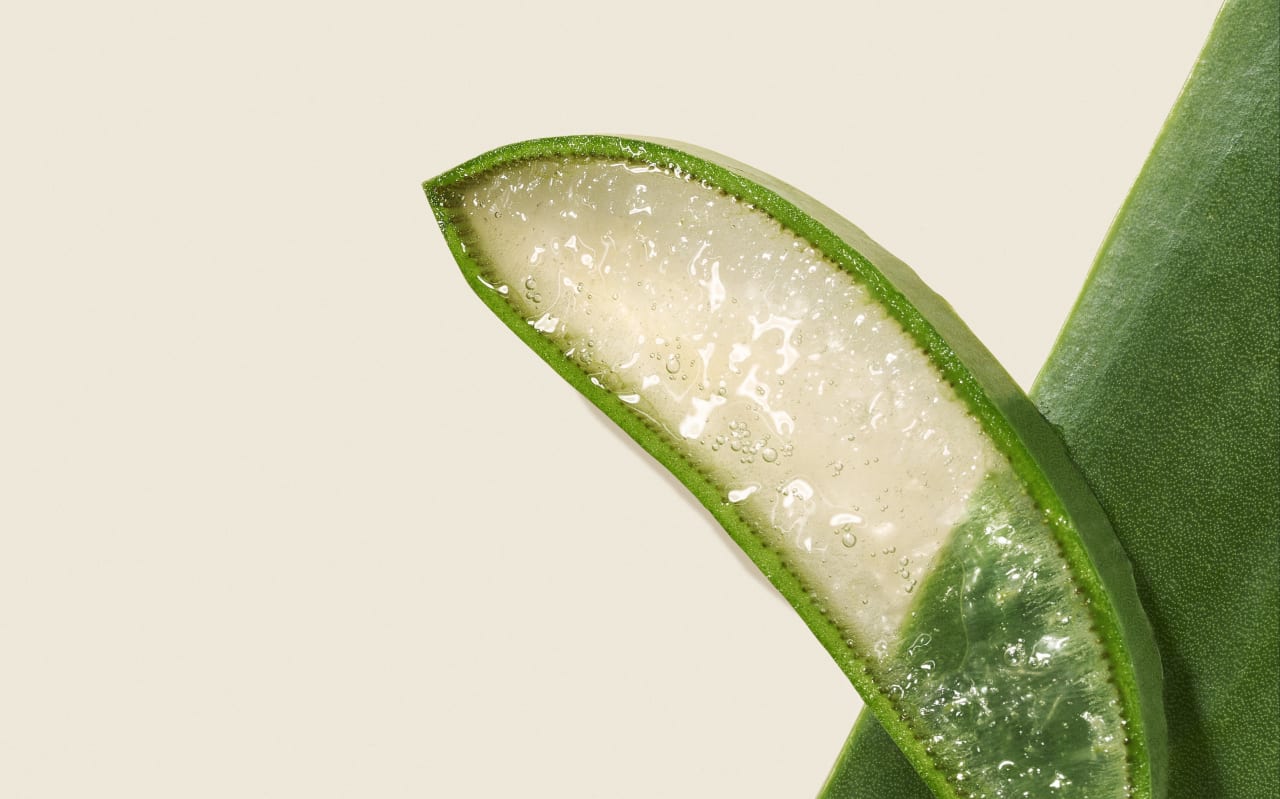
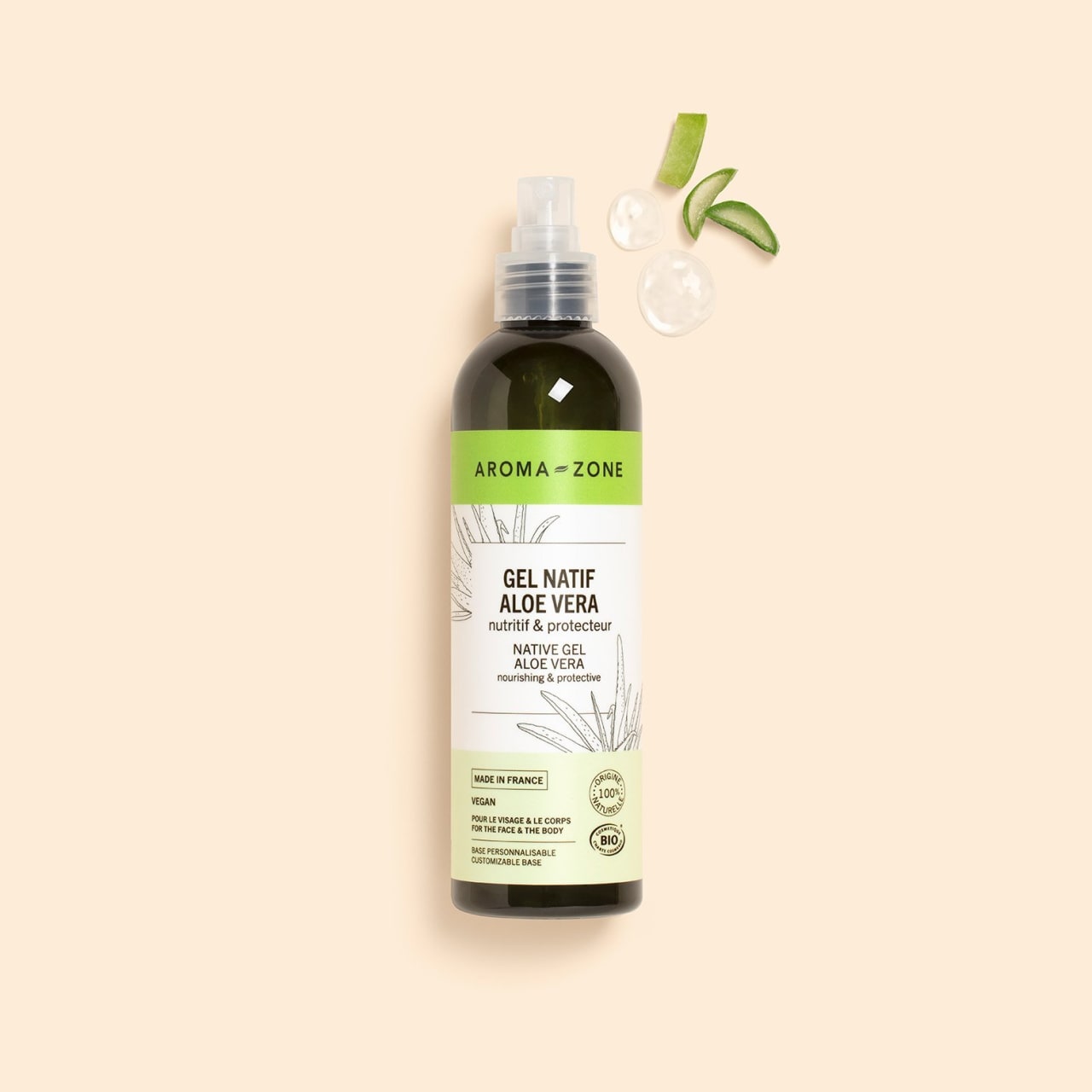
Raw aloe vera juice is the native gel/juice extracted directly from the heart of the leaf, which is very rich in water, polysaccharides, and amino acids. Aloe extracts used in cosmetics can be juice, powder, or whole-leaf extracts, whose composition varies depending on the extraction process and may include other parts of the plant.
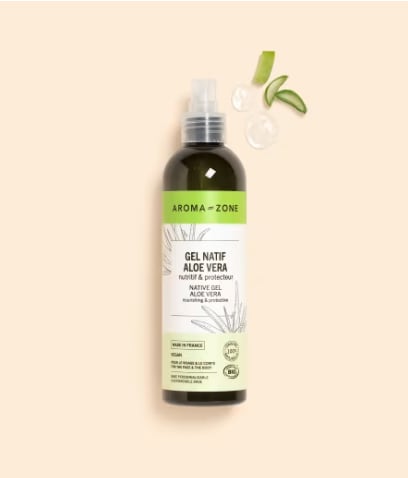
Aroma-Zone Aloe Vera gel
SOOTHING MOISTURIZING PROTECTIVE
If you could only keep one skincare product in your bathroom, this would be it. Moisturizing, soothing, nourishing, and protective, this is the versatile face, body, and hair care product for all minimalism enthusiasts. What makes it a must-have for your skin: its formula rich in polysaccharides, trace elements, amino acids... not to mention its ultra-fresh gel texture.

Aloe Vera gel Aroma-Zone profile
INCI Name : Aloe barbadensis leaf juice or leaf juice powder or leaf extract
Part of the plant used : Fresh leaf pulp
VEGAN
METHOD OF OBTAINING
Hand-harvested and processed leaves, which are peeled (to allow the latex containing aloin—an irritating and laxative compound—to drain), washed, and rinsed twice. The fresh, colorless pulp is then extracted and pressed to yield the native juice (referred to as “gel” in herbal medicine, prior to its processing for cosmetic use). Production of the cosmetic gel: Over 90% native Aloe vera juice/gel, natural preservative, xanthan gum (natural gelling agent), arginine (pH adjuster)
BIOCHEMICAL COMPOSITION OF THE NATIVE JUICE/GEL
The mucilage from the cells in the central part of the leaf constitutes the native gel/juice. Composed of a very high percentage of water, it also contains amino acids (including the 8 essential ones, except tryptophan), polysaccharides, pectin, and hemicellulose.
ITS ACTIVE MOLECULES
The polysaccharide fraction is believed to be responsible for the immunostimulatory activity of Aloe vera gel, and its main active ingredient is acemannan, a glucomannan composed primarily of mannose. Its high water content, combined with the polysaccharides, gives it moisturizing and protective properties.
This plant is also available in the form of : powder, juice
Aloe Vera gel : scientifically proven efficiency
Aloe vera gel has numerous traditional uses, some of which are recognized by the WHO, notably as a healing agent for superficial burns. Various scientific studies* have been conducted on its active ingredients, as well as on its use in skin conditions, to evaluate, among other things, its soothing and restorative properties. The results are very encouraging and warrant further investigation to scientifically confirm the full potential of this plant extract.
*See the Scientific Bibliography for more information.
Skin tolerance
A note from Adeline Nalin, our Head Pharmacist and Toxicologist at Aroma-Zone

“Aloe vera is known for its soothing and moisturizing properties. Its gel, rich in polysaccharides (particularly acemannan), vitamins, and minerals, helps maintain hydration, strengthen the skin barrier, and promote cell regeneration. It is even suitable for sensitive skin and is therefore considered a safe and gentle ingredient for daily use.”
Adeline Nalin - Head Pharmacist and Toxicologist
A plant extract safe for your health
A note from our Aroma-Zone Toxicologist
“Purified aloe vera gel is considered safe for use in cosmetics. Expert organizations confirm that it poses no health risk when properly prepared, latex-free, and in accordance with international recommendations. These properties are verified with particular care at Aroma-Zone to ensure complete safety of use.”
Adeline Nalin - Head Pharmacist and Toxicologist

A note from the Phytotherapist
“Aloe vera gel is a true bathroom staple. I don’t know of a better product to use after shaving or waxing, on sunburn, or even on hair after swimming. It hydrates, refreshes when taken straight from the fridge, and repairs. It isn’t always enough on its own, and applying a cream or oil on top is often necessary; nevertheless, it’s a base that most skin types love, and I highly recommend it as part of a minimalist and clean skincare routine.”
Caroline Gayet - Phytotherapist
Formulation focus with the Aroma-Zone R&D laboratory
In our finished products, the Aloe vera used as an ingredient comes from a freeze-dried powder that is then rehydrated using a strictly controlled process to ensure a juice with consistent and compliant properties.
But for our Native Aloe Vera Gel, the approach is different: we work directly with native juice, as it is extracted from the heart of the leaf. This juice is mostly composed of water and must therefore be gelled to achieve the fresh and stable texture of the final product, which is done using xanthan gum.
The real challenge of the formulation lies in preservation. Native juice is a raw material that is highly sensitive to microorganisms and can only be kept for a few hours without protection. It is therefore essential to add a suitable natural preservative—in this case, a preservative derived from radish fermentation—to ensure the stability of the gel and allow for safe use.
To ensure the effectiveness of this preservative, the laboratory conducts a challenge test : bacteria are intentionally introduced into the product, and their growth is measured at 7 days, 14 days, and 28 days.
If the bacteria have completely disappeared by day 28, the product meets criterion A, the most stringent standard
If the reduction is partial but adequate, the formula remains usable but requires precautions regarding packaging or use
If the bacteria persist, the formula is rejected.
At Aroma-Zone, we aim for Criterion A, ensuring optimal preservation of the gel. This is also why we recommend storing the product in the refrigerator after opening and using it quickly: despite a carefully controlled formulation, pure aloe vera gel remains a naturally fragile substance.
For which skin types ?
Aloe vera gel is suitable for mature skin, dry and dehydrated skin, damaged skin, or skin prone to redness.
What issues does this address ?
It’s suitable for sensitive, irritated, or itchy skin, minor redness, sunburn, and razor burn, as well as dry or dehydrated skin, chapped skin, or skin marked by cracks and scars.
It is also suitable for mature, dull, or devitalized skin, for anti-aging care, and can even be used in hair care.
What Aloe Vera gel does for the skin
Soothes the skin
Helps reduce redness and irritation
Protects and hydrates
Promotes repair and healing
Support skin regeneration.
Aloe Vera gel : an essential ingredient for the skin

Organic Aloe Vera gel
This Aloe Vera Gel moisturizes**, soothes irritation, and regenerates the skin. Its guaranteed concentration of aloeverose (minimum 1200 mg/L) gives it exceptional restorative properties. 100% natural, it can be used undiluted on the skin and hair or as a base for your homemade skincare products. Ideal for moisturizing, calming redness, soothing after sun exposure, or caring for dry and damaged hair.
**Laboratory test conducted using the corneometry method
Precautions
Keep out of reach of children. Do not swallow. AromaZone Aloe Vera Gel is a cosmetic product; it is not intended for consumption. To minimize the risk of contamination, avoid touching the product in the bottle with your fingers or with a non-sterile utensil. A slight darkening of the gel over time is completely normal, as it is made from fresh, native aloe vera juice.
FAQ

What is the difference between raw aloe vera juice and the aloe extracts used in cosmetics?

What is the difference between raw aloe vera juice and the aloe extracts used in cosmetics?

Does aloe vera gel actually moisturize, or does it just provide a cooling sensation?

Does aloe vera gel actually moisturize, or does it just provide a cooling sensation?
Aloe vera gel truly hydrates, thanks in particular to its high water content, which provides soothing and protective properties. Aloe vera has notable anti-aging effects, making the skin softer, improving its appearance, suppleness, and overall evenness—going far beyond a simple cooling effect.

Does aloe vera gel really penetrate the skin, or does it mainly act on the surface?

Does aloe vera gel really penetrate the skin, or does it mainly act on the surface?
The gel forms a protective moisturizing film on the surface, but it can also work deeper by supporting regeneration, particularly during the healing process. It therefore acts both on the surface and in the superficial layers of the skin.

How can you spot a high-quality aloe vera gel in an INCI list?

How can you spot a high-quality aloe vera gel in an INCI list?
The INCI list primarily helps you determine whether the gel is formulated from native juice (Aloe Barbadensis Leaf Juice) or rehydrated powder (Aloe Barbadensis Leaf Juice Powder). However, the actual quality of the gel depends on the extraction process and the freshness of the juice—factors that cannot be determined solely through the INCI.
Spotlight on our specialist editor, Delphine Duc.

Delphine DUC, a biological engineer specializing in cosmetology, has been passionate about the field of cosmetics for nearly 10 years. I started making my own homemade cosmetics using Aroma Zone products to address my skin concerns, then decided to train as a cosmetologist, and finally to create a custom-made cosmetics brand to address everyone’s unique skin concerns.
Bibliography
1
SKINCARE, Skin
An Aroma-Zone publication by La Plage
2
Chithra, P.; Sajithlal, G. B.; Chandrakasan, G. Influence of aloe vera on the healing of dermal wounds in diabetic rats. Journal of Ethnopharmacology 1998, 59(3), 195–201.
https://pubmed.ncbi.nlm.nih.gov/9507904/
3
Dal’Belo, S. E.; Gaspar, L. R.; Maia Campos, P. M. B. G. Moisturizing effect of cosmetic formulations containing Aloe vera extract in different concentrations assessed by skin bioengineering techniques. Skin Research and Technology 2006, 12(4), 241–246.
https://pubmed.ncbi.nlm.nih.gov/17026654/
4
Hamman, J. H. Composition and Applications of Aloe vera Leaf Gel. Molecules 2008, 13(8), 1599–1616.
https://www.mdpi.com/1420-3049/13/8/1599
5
Surjushe, A.; Vasani, R.; Saple, D. G. Aloe vera: a short review. Indian Journal of Dermatology 2008, 53(4), 163–166.
https://pubmed.ncbi.nlm.nih.gov/19882025/