
Natural Grenadine Red Dye
free delivery up to £25 in United Kingdom
100% secure payment CB, Visa, Mastercard, Paypal, Apple Pay, Google Pay
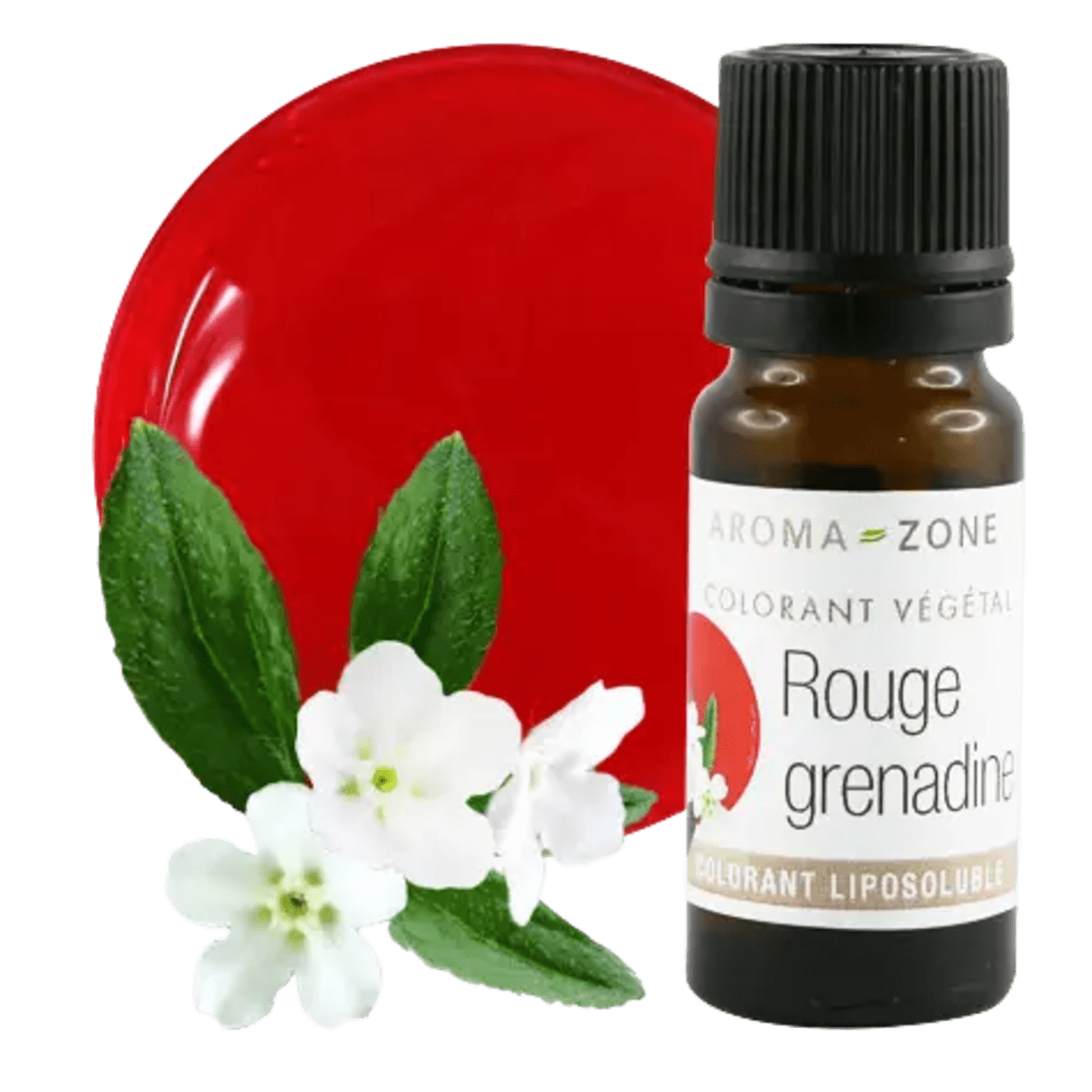

Vegan
Applications: Skin care, body care, oral care
Difficulty of use: Easy
Cosmetic recipe creation: Yes
100% plant-based dye, made from organic vegetable oils
Gives cosmetics a purple-red to pink colour
Fat-soluble dye, makes it very easy to colour oily products such as oils and glosses without losing transparency, as well as creams, balms, sticks and candles
Soluble in alcohol at low doses, it can be used to colour perfumes and alcoholic solutions without losing transparency
Good colour stability (keep your products away from light)
Colours transparently, does not provide coverage
Colouring your homemade cosmetics:
Skincare oils, massage oils
Balms, sticks
Creams, milks
Shower gels, shampoo
Massage candles Perfumes Melt & Pour soaps (gives a purplish tint)
Note: This dye does not produce good results in cold saponification, as the colour quickly turns gray and then brown.
Colouring your homemade home fragrance products:
Candles
Compositions for reed diffusers based on alcohol or alcohol + isopropyl myristate
In your homemade makeup products:
Grenadine Red Dye will not provide coverage in makeup and will only very slightly tint the skin or lips. For a dye that provides an intense pinkish-red colour, particularly in lipsticks, we recommend Rouge Baiser Dye instead . However, Grenadine Red Dye provides a slight grenadine colour, which is very popular for colouring:
Lip gloss
Lip balms
Blush in stick or balm form
Lipsticks, in combination with Rouge Baiser Dye or with mineral dyes (oxides, micas)
Quick recipes from Aroma-Zone
Cherry Coloured Anti-Ageing Oil
Organic Cherry Vegetable Oil
30 ml
Coenzyme Q10
30 drops
Grenadine Red Dye
3 drops
Exquisite Cherry Cosmetic Fragrance
10 drops
Grenadine Gloss
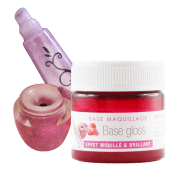
Aroma-Zone Tip
Add a spatula tip of Natural Glitter for a festive sparkling effect!
General characteristics
Dosage
0.1 to 7% (of the total weight of your preparation)
1 ml = approximately 32 drops
Soluble in oil
Density
0.92
Insoluble in water
Soluble in alcohol
Low dosage (0.1-0.2%)
Add it to a neutral AZ base.
Grenadine Red can be incorporated into the following ready-made AZ neutral bases:
Cleansing cream base at a maximum dosage of 1.0%
Youth and Refreshing cream bases at a maximum dosage of 0.5%
Vegetable Milk Base at a maximum dosage of 0.5%
Hair mask base at a maximum dosage of 1.0%
Massage Oil Base at a maximum dosage of 1.0%
Concentrated micellar base at a maximum dosage of 1.0%
Melt & Pour bases at a maximum dosage of 1.0%
Melt & Pour Stick base at a maximum dosage of 7.0%
For more information on conditions of use, please refer to the technical data sheets for these bases, available online on our website.
Make your recipe from start to finish.
This oily liquid dye can be used diluted in emulsions (creams and milks), glosses, balms and sticks, oils, candles, etc.
Oils: incorporate the Grenadine Red Dye into your oil-based preparation, stirring to homogenise.
Solid oil mixtures (lipsticks, sticks, balms, candles): incorporate the Grenadine Red Dye into the melted oil phase before pouring the product into its container or mould.
Lip gloss: add the Grenadine Red Dye to the mixture while cold.
Emulsions (creams, milks): add the Grenadine Red Dye at the end of preparation, to the cooled emulsion.
Foaming products: add the Grenadine Red Dye at the end of preparation. As it is oily, this dye can thin foaming products. To avoid this, use a low dosage (0.1 to 0.5% is generally sufficient for a beautiful colour in a shower gel), or pre-mix the colorant with a little Base Consistance surfactant (up to 10% in the recipe).
Alcoholic products (perfumes, compositions for reed diffusers): add the Grenadine Red Dye at the end of the preparation. For good solubility in alcohol, limit yourself to a low dosage (0.1-0.2%).
Notes:
In products containing water (creams, milks, soaps, foaming products), the colour varies slightly depending on the pH: it tends towards purple-pink at alkaline pH and more towards red at acidic pH.
Grenadine Red Dye is more stable than anthocyanin-type plant pigments (such as organic beet juice), but the colour tends to fade or even disappear when exposed to light for long periods of time. We recommend keeping your products away from sunlight and direct light.
Grenadine Red Dye can be used to obtain a wide range of shades:
Pale pinks, ballerina pink: use between 0.1 and 1% in a white preparation (e.g., a pH-neutral cream or lotion, a balm with white butter, or a candle made from white wax, such as soy wax).
Pale "salmon" pinks: dosed between 0.1 and 1% in a white emulsion (cream, milk) with a slightly acidic pH or a slightly yellow preparation (emulsion with fairly coloured vegetable oils, balm with vegetable butters, yellow beeswax candles).
Pink to deep pink tones: use between 1 and 7% in a white preparation (e.g., a pH-neutral cream or lotion, a balm with white butter, or a candle made from white wax, such as soy wax).
Orange tones: dosed between 1 and 7% in a yellow to orange base (for example, containing orange oils such as Buriti, Sea Buckthorn, Tomato, which in small doses can give an emulsion, oil, or candle an orange tone).
Translucent "grenadine" tones: dosed between 0.5 and 1% in foaming products or between 0.5 and 4% in colourless or lightly coloured oily preparations (or oily mixtures with emollients such as Coco silicone, Dry Touch, Dicaprylyl carbonate, Caprylis).
Translucent orange-pink to orange-red tones: dosed between 0.1 and 7% in oily preparations or yellow to orange oily mixtures.
Method of production
Extract of Lithospermum erythrorhizon roots in a base of Organic Jojoba Oil and Organic Sunflower Oil, with a guaranteed content of naphthoquinones, which are the red pigments of the plant.
Part of the plant used
Roots
Botanical name
Lithospermum erythrorhizon
Botanical family
Boraginaceae
Function
Oily liquid cosmetic dye
Quality
Cosmetics, 100% plant-based
Country of origin
Plant: China, Extraction: Switzerland
Other names
Dyer's knotweed, Zi Cao (China), Murasaki (Japan), Tokyo violet
INCI designation
Helianthus annuus hybrid oil, Simmondsia chinensis seed oil, Lithospermum erythrorhizon root extract
Presentation
Oily liquid, packaged in an amber glass bottle with a dropper.
Colour and effect
Rosy red colour, with a transparent effect (no coverage) for makeup products.
Storage
Store in the refrigerator, away from moisture and light. Close the bottle tightly after use.
Precautions
Do not swallow
Keep out of reach of children
Do not apply undiluted to the skin; avoid contact with the eyes.
Protect surfaces and wear a smock when preparing your cosmetics to avoid staining your furniture or clothing.
Environmental qualities and characteristics product sheet
Reference
03088 - grenadine red dye 2 mL
Main Packaging Material
Glass bottle
Recyclability
Most packaging can be recycled
Reference
02860 - grenadine red dye 10 mL
Main Packaging Material
Glass bottle
Recyclability
Most packaging can be recycled

Supplier documentation
Loading...
Very good for coloring my lotions and lip balms.
I don't like the smell and the color doesn't last.
Gorgeous color! But not so much the smell.
Nice, makes you want it but doesn't smell very good, so with a hint of oil that smells good then...
Pigmentation not very present


