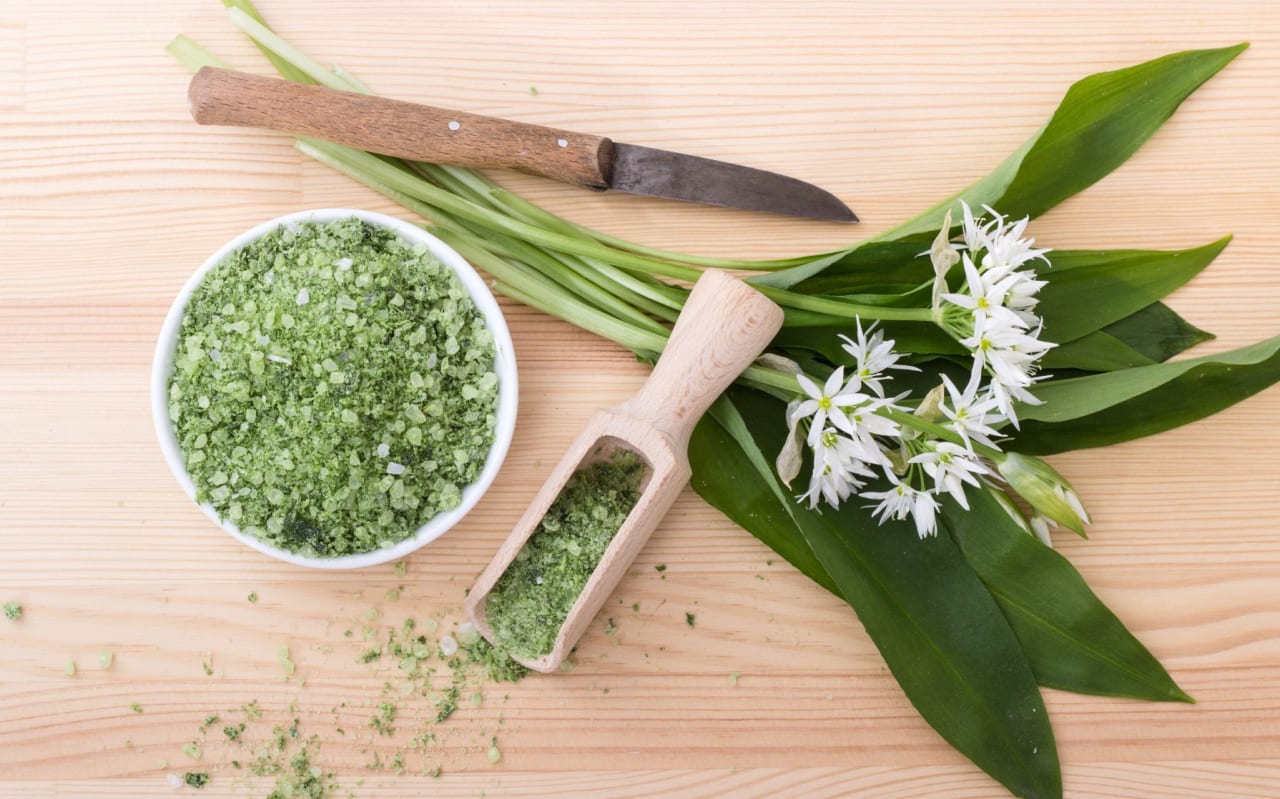

Lily of the Valley and Colchicum have different flowers, so if you’re worried about confusion, you can wait for wild garlic to bloom in April. Another simple way to avoid confusion with Lily of the Valley or Colchicum: only wild garlic has that characteristic garlic aroma
Wild Garlic: Definitions, Properties, and Benefits?
Have you heard of wild garlic? This wild garlic isn’t just for bears—folklore and legends say bears ate it at the end of hibernation to cleanse themselves. This little plant that reappears in the spring could, however, provide everything you need right now, as it’s a fantastic detox plant that also adds a touch of whimsy to your kitchen. Come explore the powers of the queen of the woods!

Wild garlic: what you need to know - Definition
Wild garlic, known by its Latin name Allium ursinum, literally garlic of the bears, belongs to the Alliaceae family, now classified under the Amaryllidaceae. We know that wild garlic was already in use during the Mesolithic period, some 9,500 years ago. This wild garlic is among the first nutritious plants to emerge at the end of winter. Given that humans’ earliest knowledge of herbal medicine came from observing animal behavior, it is not unlikely that bears actually fed on this plant.
Wild garlic is found throughout Europe and temperate Asia. It is specific to woodlands, where it grows in colonies, sometimes covering cool, damp woodlands along streams as far as the eye can see, especially in western and central France. Wild garlic is a bio-indicator of preserved alluvial valley forests.
The plant grows to a height of 10 to 50 cm. Its stem is round with long, ribbon-like leaves, often grouped in pairs, emerging directly from the ground. The leaves are glossy on top and matte underneath. The main vein, in the center of the leaf, is prominent on the underside. Its inflorescences are characteristic of the Allium genus: very rounded umbels composed of small white, star-shaped flowers with six petals and a green center. This flowering, which occurs between May and June, attracts many pollinating insects due to its abundance of pollen and nectar. Wild garlic could be mistaken for toxic plants such as colchicum, lily of the valley, Solomon’s seal, ornithogalum, or arums, but none of these plants possess the characteristic garlic odor that the plant emits. This is therefore the best way to tell whether you are harvesting wild garlic or another plant that resembles it.
When harvesting, which takes place from April to June, it is important to pick only what you need and not to remove the root. Unfortunately, we sometimes see areas ravaged by unscrupulous people. Foraging in the wild requires ethical behavior!
Another way to get wild garlic is to grow it at home. As long as it’s in moist but well-drained soil rich in organic matter, in partial shade, wild garlic can grow almost anywhere. It withstands sub-freezing temperatures (-34°C); it is therefore a hardy plant.
The leaves are the main part harvested, but the flower is also edible, though it’s best to leave it for pollinators, who love it. The bulb is also left in the ground so the plant can continue to produce, thereby preserving the colonies. Unlike cultivated garlic, where the bulb is consumed, here it is the leaves that are most valuable, combining medicinal properties with culinary delight. Wild garlic has properties similar to cultivated garlic, but its hardiness seems to multiply its benefits.

What are the properties of wild garlic?
As with cultivated garlic, it is the sulfur compounds—specifically alliin and diallyl disulfide, which is a powerful antibacterial agent. Since these are highly volatile compounds, only fresh leaves provide benefits; once dried, they lose much of their properties. Wild garlic leaves also contain vitamin C, selenium, adenosine, a powerful antimicrobial, and flavonoids, which are antioxidants. The leaves help in particular to:
Lowering cholesterol, thanks to sulfur compounds that prevent cholesterol deposits from forming in the blood, thereby preventing cardiovascular events and atherosclerosis.
Blood pressure regulators and Blood thinners by dilating blood vessels, which prevents blood platelets from clumping together, thereby preventing the formation of atherosclerotic plaques, thrombosis, and other blood clotting disorders.
Antiseptic against viral infections, particularly the flu, and respiratory infections such as emphysema and bronchitis.
Disinfectants and anthelmintics, in the intestines, Stimulants of gastric juice secretion, which helps alleviate chronic and acute diarrhea, bloating, and other stomach aches and intestinal disorders, and relieves the liver.
Purifying, diuretic (increases urine output) and detoxifying; which also helps resolve certain skin problems (just like Burdock). Like Artichoke, Wild Garlic is a plant detox ideal for spring, caring for the liver at the same time.
Our tips
Wild garlic can also be paired with dandelion, as these two plants have complementary cleansing properties for treating kidney issues.
What are the benefits of wild garlic?
Revitalizing
Detoxifying
Antiseptic
Purifying and detoxifying
Cardiovascular system protector
Improves skin health
How can you incorporate wild garlic into your daily life?
As a herbal tea or infusion: Bring water to a boil. Steep 3 to 4 fresh leaves for 5 to 10 minutes, covering the pot to retain the volatile compounds.
In cooking: eat the fresh, raw leaves in salads or as pesto
For topical use: rub into areas of rheumatic pain with wild garlic vinegar
Quick tip
To make wild garlic vinegar, macerate 30 g of fresh leaves in 25 cl of wine vinegar for about ten days.
How to use wild garlic without cooking it?
How to cook wild garlic?
Precautions for use
People taking anticoagulant medications should use wild garlic with the utmost caution. It is also contraindicated in cases of urinary or gastric irritation.
Echinococcosis is a zoonosis, an animal disease that can be transmitted to humans through contaminated fox feces. Infection is relatively rare because most people are resistant to this tapeworm.
Since wild garlic alters blood clotting parameters, it is strongly discouraged before surgery.
Expert Tip
The best way to use wild garlic for its medicinal properties, outside of its growing season, is to consume it in the form of a mother tincture made from fresh plants. Wild garlic in dried form has no medicinal value.
Learn more

How can you tell wild garlic apart from lily of the valley or colchicum?

How can you tell wild garlic apart from lily of the valley or colchicum?

When to harvest wild garlic?

When to harvest wild garlic?
Wild garlic is best harvested starting in mid-March, or in April if you’re concerned about possible confusion with lily of the valley or colchicum.

When should you plant wild garlic bulbs?

When should you plant wild garlic bulbs?
Wild garlic bulbs are planted in the fall in cool, moist, humus-rich soil, preferably in shade or partial shade. Growing them in pots is also possible.
Spotlight on our specialist editor, Catherine GILETTE

Catherine is passionate about plants and their properties; she trained in natural cosmetics at the École Lyonnaise des Plantes Médicinales in the early 2000s. Driven by curiosity, she continued to explore the richness and potential of plants. This led her to study aromatherapy at the École Française d'Aromathérapie Intégrative. She discovered an almost unexplored dimension through olfactotherapy and, at the same time, an incredible tool for getting to know herself better and practicing what she calls inner ecology.
Bibliography
1
SAPUNJIEVA T, ALEXIEVA I, MIHAYLOVA D, POPOVA A “Antimicrobial and antioxidant activity of extracts of Allium ursinum L.”
J. BioSci. Biotech. 2012, pp. 143–145 (Plovdiv, Bulgaria)
2
PARVU M, PARVU A, VLASE L, ROSCA-CASIAN O, PARVU O “Antifungal properties of Allium ursinum L. Ethanol extract” Journal of Medicinal Plants Research
2011 May, 5 (10): 2041-6 (Cluj-Napoca University, Romania)