
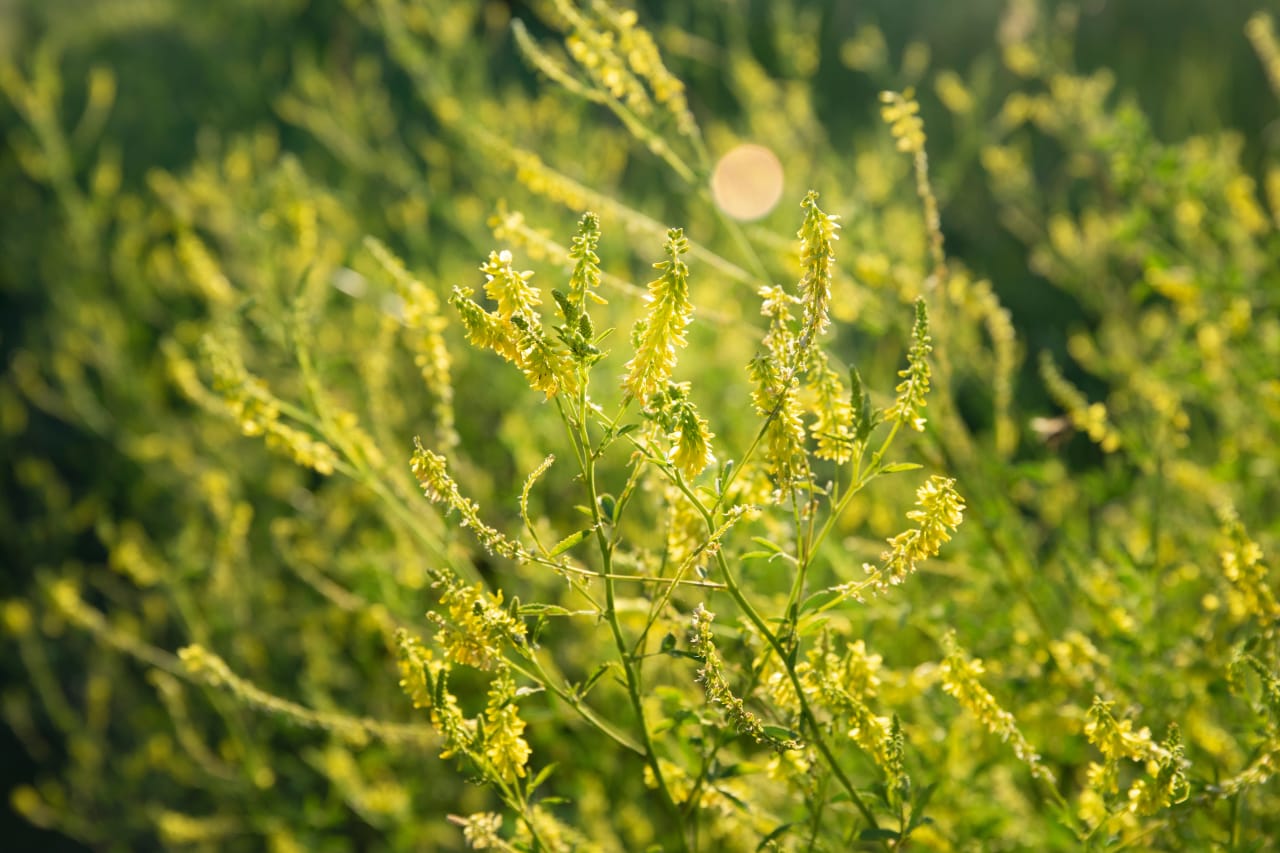
Sweet Clover: Benefits, Origins and Usage Tips

Sweet Clover: Benefits, Origins and Usage Tips


By Gipsy Dauge

Published on: Tuesday, October 31, 2023, Updated on: Wednesday, October 28, 2026

Sweet clover plants belong to the large family of legumes. Although not a household name, this plant grows all over the world. Compounds found in its two main varieties, white sweet clover (Melilotus albus) and yellow sweet clover (Melilotus officinalis), give them anti-inflammatory properties.

Contents

The history of sweet clover through the ages

Sweet clovers are herbaceous plants of the Fabaceae family (also known as the legume family) and the genus Melilotus. This genus is widespread throughout the world, comprising around 20 to 25 species. Among these, the yellow sweet clover (Melilotus officinalis), also known as medicinal sweet clover, is particularly valued for medicinal purposes. Its characteristic sweet scent, which intensifies during drying, is due to the presence of coumarin. According to several studies, the application of sweet clover extracts to the skin, as well as their oral or intravascular administration, has beneficial effects on skin ageing and the treatment of acne. It also promotes microcirculation and has anti-inflammatory properties. Sweet clover (Melilotus officinalis) was once highly prized in medicine as an emollient (a substance that softens and relaxes biological tissues) and for its properties that aid digestion. In addition to coumarin, this plant also produces other substances, including melilotin and flavonoid pigments. It possesses aromatic, emollient and carminative properties.

Sweet clover (Melilotus officinalis) can grow either upright or may spread. It can reach a height of between 30 and 250 cm. This plant is found in various regions of the world, notably in Pakistan, Kashmir, India, Tibet, Russia, China and Turkey, as well as in Southern Europe and across the Middle East. It has been introduced to the Americas and tropical Africa. The parts used for medicinal purposes are the flowering stems, or simply the flowers of the plant. Another well-known species of sweet clover is Melilotus albus, also known as white sweet clover. This is another species of sweet clover that is popularly used for medicinal purposes and as a pasture crop. The two species mentioned, white sweet clover (Melilotus albus) and yellow, common or medicinal sweet clover (Melilotus officinalis), are widely used in pastures and as herbal medicine due to the biological activity of their coumarins, which exhibit numerous biological and pharmacological effects, including anti-HIV and anti-tumour effects.

The benefits of sweet clover for the human body

Sweet clover (Melilotus officinalis), belonging to the genus Melilotus within the Fabaceae family, is used for medicinal purposes in several countries. In the United Kingdom, this plant is regarded as a remedy for oedema and renal venous circulation. In the Netherlands, Germany, Poland and Austria, it is used to combat platelet aggregation that can cause blood clots, owing to its antioxidant and hepatoprotective properties. In Japan, SETUS-M, made from sweet clover (Melilotus officinalis), is effective in treating post-operative swelling. In China, it is used to treat various conditions such as spleen disorders, dysentery, diphtheria and parasitic infections.

Modern studies have revealed that sweet clover (Melilotus officinalis) contains coumarins, flavonoids, steroids, saponins, phenolic acids, volatile compounds, fats, alcohol and uric acid, amongst other chemical compounds.

What are the benefits of sweet clover for people with diabetes?

According to studies, sweet clover may offer benefits for people with diabetic foot ulcers. Foot ulcers are common, affecting between 4 and 10 per cent of people with diabetes, with an annual incidence of 1.0 to 4.1 per cent and a lifetime incidence of up to 25 per cent. Despite efforts to treat these ulcers, a high rate of lower limb amputations persists, revealing a continued need for safe and effective treatments. New treatments being developed are primarily aimed at preventing amputations, improving quality of life, controlling infections and reducing the costs associated with hard-to-heal wounds. The properties of sweet clover (Melilotus officinalis) make it the key ingredient in a treatment called Semelil. This natural extract of sweet clover (Melilotus officinalis) has reportedly shown benefits for the healing of foot ulcers in people with diabetes.

Sweet clover for treating conjunctivitis

Conjunctivitis is the term used to describe inflammation of the conjunctiva, which can be caused by viral, bacterial or allergic infections. Viral conjunctivitis, often caused by the adenovirus, is characterised by clear discharge and lymphocytic inflammation. Bacterial conjunctivitis causes purulent discharge and is caused by bacteria such as Staphylococcus or Streptococcus. Trachoma, a bacterial infection, can lead to severe corneal damage and blindness if left untreated. Sweet clover (Melilotus officinalis) is generally used externally for conjunctivitis, where it is prescribed alongside other ophthalmic herbs (cornflower, eyebright, plantain) in equal parts (one tablespoon per glass of water; boil for one minute, then leave to infuse). However, we recommend that you always seek advice from your doctor before starting any treatment.

Sweet clover: how should it be consumed?

Sweet clover, particularly yellow sweet clover (Melilotus officinalis) and white sweet clover (Melilotus albus), can be consumed or used in various ways, including:

  1. Herbal infusion or tea: sweet clover flowers can be dried to make an herbal infusion or tea. This infusion can be consumed for its soothing digestive properties.

  2. Spice: the dried flowers can be ground into a fine powder and used as a spice to flavour dishes.

  3. Culinary use: the flowers can be added to salads or desserts for a colourful, aromatic touch.

  4. Medicinal use: Sweet clover is used in traditional medicine for its soothing, anti-inflammatory and digestive properties. It can be taken as an infusion or tincture, but this should be done with caution and under the supervision of a healthcare professional.

  5. Cosmetic use: Sweet clover extracts are sometimes used in cosmetic products for their soothing and anti-inflammatory properties on the skin.

  6. Sweet clover honey: this variety is produced by bees from the nectar of two different species: yellow sweet clover (Melilotus officinalis) and white sweet clover (Melilotus albus). Scientists believe that sweet clover honey contains coumarin compounds, characteristic secondary metabolites found in the flowers and leaves of sweet clover. Honey from Melilotus albus (white sweet clover) exhibits antioxidant and antimicrobial activity.

Sweet clover: precautions and contraindications

We recommend that pregnant women, breastfeeding women and young people under the age of 18 do not consume sweet clover, regardless of the species, without first seeking advice from their doctor. It should also be noted that you should consult a healthcare professional to determine the appropriate dosage for your needs. The plant contains coumarin, a natural substance that can become toxic when consumed in excess.

Spotlight on our writer: Gipsy Dauge

Gipsy Dauge

Gipsy graduated from ESJ Paris and spent 10 years working in general and women’s magazines before specialising in health and wellbeing. Now a certified Yin Yoga teacher, she combines her passion for writing with her love of yoga. Through her articles, she aims to share simple, practical habits that support wellbeing and encourage a more mindful approach to everyday life.

Bibliography

  1. CHEMICAL CONSTITUENTS OF MELILOTUS OFFICINALIS

    https://d1wqtxts1xzle7.cloudfront.net/31250531/Chemical_constituents_from_Melilotus_officinalis-libre.pdf?1392253345=&response-content-disposition=inline%3B+filename%3DChemical_constituents_from_Melilotus_off.pdf&Expires=1698736189&Signature=G9wBR~ZEk-uI-69disYEVbJuQX14x0PXaycNq4Bmr2C1YJH45JOAaiCaOXzhiIfNtNvxSBQVpCNyogcEK6lrDyGzme6CkoE68dXXyXq05kIcwXvEFx3-1tB2kFKyZutXR47M~CzmGCxaPnGoetOe-9oFfiP86H8BKH-zmqNUloQDI3GHT4GT-snknDUPc9KFxKXbrDZpaY8gfou7u513i71Ymq-zQsiCOMRr9NFkadN0CjoZQG20knPeMt1YcF33R9w~v1GVJSsTXOgNtFD2yehxQKgDP~IeRcIwdVnfuUlpo272-ZdsN1AgTDghOQMkHOybgCcD9UA0heZU6dkGlw__&Key-Pair-Id=APKAJLOHF5GGSLRBV4ZA

  2. Melilotus: Contribution to wound healing in the diabetic foot

    https://www.sciencedirect.com/science/article/abs/pii/S2210803313000444

  3. Coumarin Content, Morphological Variation, and Molecular Phylogenetics of Melilotus

    https://www.mdpi.com/1420-3049/23/4/810

  4. Chemical Constituents and Antioxidant, Anti-Inflammatory and Anti-Tumour Activities of Melilotus officinalis (Linn.) Pall

    https://www.mdpi.com/1420-3049/23/2/271

  5. A novel honey-based product enriched with coumarin from Melilotus flowers

    https://link.springer.com/article/10.1007/s11694-019-00092-w

  6. Infection in ophthalmology

    https://link.springer.com/chapter/10.1007/978-2-8178-0058-5_8