
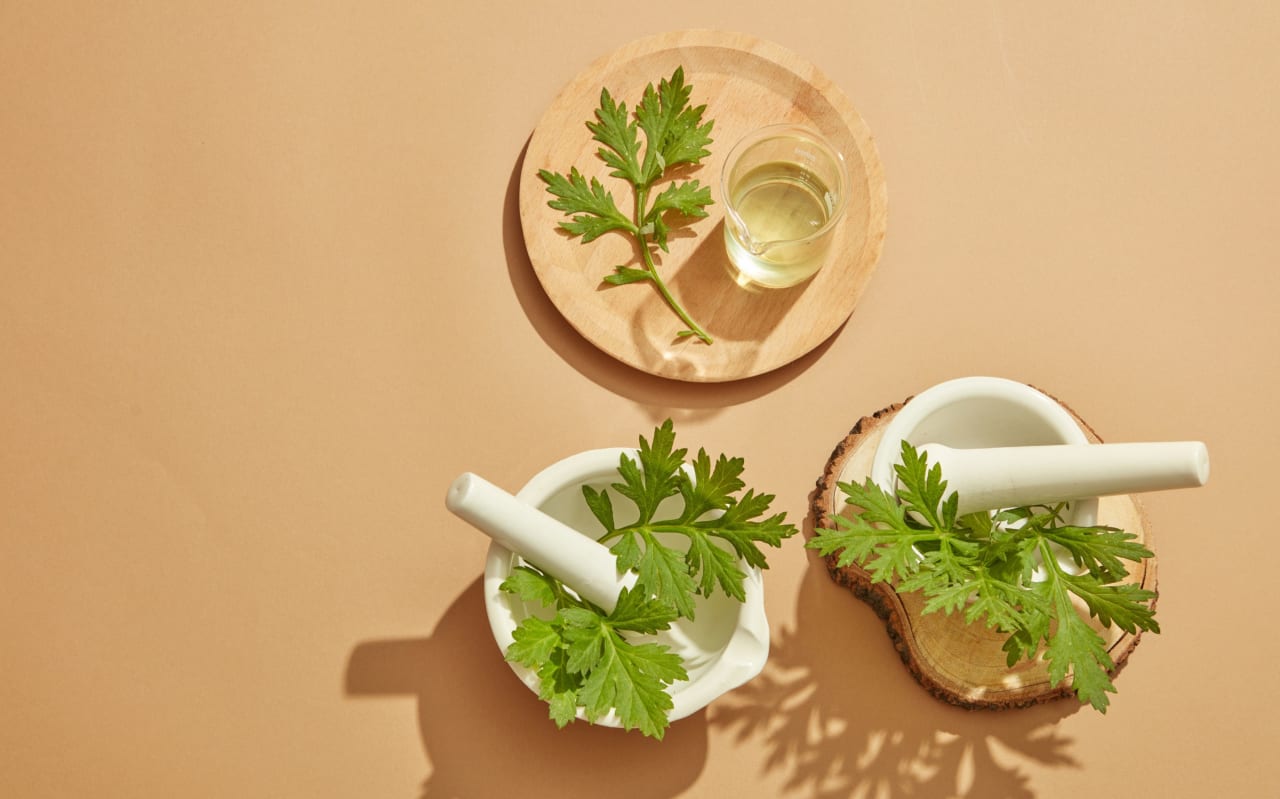
Common mugwort, Artemisia vulgaris, is a perennial, aromatic, and medicinal herb belonging to the Asteraceae family. The genus Artemisia includes several species, such as wormwood or tarragon. The name Artemisia literally means "Artemis's herb," named after the goddess of the wilderness, hunting, and childbirth. This plant is common in Europe and grows wild from North Africa to Siberia. It is important not to confuse it in the wild with mugwort-leaved ragweed, a highly allergenic species, although common mugwort pollen can also cause allergies, albeit to a lesser extent. Described as far back as antiquity, common mugwort is renowned for its virtues in the treatment of "women's ailments." In the Middle Ages, it was believed to possess magical properties, such as the ability to ward off evil spirits, lightning, and hail.The plant forms a bushy clump that can reach between 60cm and over 1m in height and about 50cm in width. It has short rhizomes and a rigid, striated, reddish stem. Its dark green foliage is silvery-white and downy on the underside. The alternate leaves are divided into broad, oblong-lanceolate segments. When crushed, they give off a camphor-like odour, often considered unpleasant. Flowering occurs from July to September, and the inflorescences, in spikes of small flower heads, range from yellow to red, with a faint spicy scent. They have no visible petals; only the stamens protrude from the white, tomentose involucre. The flowers are hermaphroditic, and the fruits, 2mm achenes, are dispersed by gravity or the wind. Common mugwort is a hardy species, tolerating temperatures down to -15°C and thriving in full sun, even intense heat. It prefers light, calcareous, or nitrogen-rich, well-drained soils and readily colonises forest edges, hedgerows, abandoned fields, and stream banks. Used for its ornamental qualities, insect-repellent properties, and therapeutic benefits, common mugwort, like wormwood, can be toxic in high doses or with prolonged use. In herbal medicine, the leaves and above-ground parts are primarily used.
Mugwort (Artemisia vulgaris): Definition, Properties, and Benefits
Published on: Thursday, September 19, 2024, Updated on: Thursday, October 29, 2026
Common mugwort, a plant with silvery leaves and a distinctive scent, has stood the test of time, traditionally valued as a plant suited to women's needs, as well as for its digestive properties. This versatile plant has found its place in many homes, whether in the garden, the kitchen, or the bathroom. Join us as we take a closer look at this plant of Artemis.
Contents
Related products
£9.00
30 ml
2 options
What is mugwort?
Note: There are many species of mugwort, such as annual mugwort (Artemisia annua), Chinese mugwort, and the Verlot brothers’ mugwort. Artemisia annua, native to Asia, is particularly used to combat malaria thanks to artemisinin, an active ingredient found in this species.
What are the main properties of common mugwort?
Common mugwort is known for its varied properties:
Tonic and antispasmodic for the digestive system: Like all bitter plants, common mugwort stimulates the secretion of gastric juices. It acts as a stomachic and hepatoprotective agent, while helping to reduce intestinal spasms.
Emmenagogue and oestrogenic: Common mugwort regulates the menstrual cycle, alleviates dysmenorrhea, and relieves symptoms of menopause, particularly thanks to its flavonoids such as eriodictyol and apigenin.
Anti-inflammatory: The flavonoids and sesquiterpene lactones present in mugwort give it notable anti-inflammatory properties.
Antifungal: The presence of camphor and 1,8-cineole in the plant is responsible for its broad-spectrum antifungal activity.
Anti-hypertensive: It can counteract the blood pressure-raising effects of norepinephrine without causing unwanted side effects.
Insect repellent and vermifuge: Common mugwort contains about fifteen insect-repellent molecules, notably monoterpenoids, which repel insects and help eliminate parasites.
All the benefits of common mugwort
As a result, common mugwort is widely recognised for its beneficial effects on:
Digestion: Its bitter compounds stimulate the production of digestive enzymes, relieve bloating and stomach cramps, while promoting appetite.
It is also effective in alleviating menstrual cramps, thanks to its antispasmodic properties. Additionally, it helps soothe anxiety, better manage stress, and improve sleep quality.
Common mugwort is also known to stimulate blood circulation and repel mosquitoes and other insects.
It may be helpful in relieving certain respiratory ailments, such as coughs, colds, or bronchitis.
How to use common mugwort in its natural form?
As an infusion: Use 1 to 1.5 g of dried plant per 250 ml of water. Drink about 30 minutes before the two main meals to aid digestion, or between meals for other desired effects. To support the menstrual cycle, drink 2 to 3 cups between meals for 8 to 10 days before your expected period.
In cooking: The young, tender, and sweet leaves of mugwort can be eaten in salads, provided they are not consumed in excess.
As a hydrosol: Common mugwort hydrosol allows you to enjoy the plant’s benefits without any toxicity; use externally for its cosmetic properties.
In cosmetics: Artemisia’s anti-inflammatory properties are ideal for soothing sensitive or irritated skin and scalps. Thanks to its antioxidant properties, common mugwort also helps protect against premature signs of ageing.
For fumigation or in closets: Fumigating with common mugwort helps repel unwanted insects such as mosquitoes. You can also place mugwort leaves in closets or wardrobes to prevent moths from appearing.
What are the side effects of mugwort?
Common mugwort may cause stomach irritation in sensitive individuals, particularly if consumed in high doses. Common mugwort contains thujones, like its cousin wormwood. However, excessive intake of thujone can cause nausea, diarrhea, and dizziness. It may also cause gastrointestinal irritation if consumed in excessively high amounts.
Precautions for use
Common mugwort is contraindicated for pregnant or breastfeeding women, as well as for people suffering from ovarian cysts, mastosis, or with a history of hormone-dependent cancers.
It is recommended not to exceed a treatment period of fifteen consecutive days.
Additionally, there is a risk of an allergic reaction, particularly in people who are sensitive to plants in the Asteraceae family.
Expert Tip
Common mugwort is also used in moxibustion, an ancient technique of Chinese medicine. This method involves burning dried mugwort near specific acupuncture points to relieve pain and improve overall well-being. The heat released by the burning of the plant stimulates these specific points, which can help rebalance the body’s energy.
Spotlight on Our Specialist Writer: Catherine Gilette

Catherine is passionate about plants and their properties. She studied natural cosmetics at the École Lyonnaise des Plantes Médicinales in the early 2000s. Driven by curiosity, she has continued to explore the richness and potential of plants. This led her to train in aromatherapy at the École Française d’Aromathérapie Intégrative. She discovered an almost unexplored world in olfactotherapy, and valuable tools for getting to know herself better and practising what she calls inner ecology.
Bibliography
Tison, J.-M., Jauzein, P., & Michaud, H. 2014. Flora of Continental Mediterranean France. Naturalia Publications, 2078 pp.
E. Oulès (UMS 2006 Natural Heritage (AFB / CNRS / MNHN)), 2016
Arif-ullah Khan and Anwarul Hassan Gilan
“Antispasmodic and bronchodilator activities of Artemisia vulgaris are mediated through dual blockade of muscarinic receptors and calcium influx,” Journal of Ethnopharmacology, vol. 126, no. 3, December 2009, pp. 480–486
John R. Rowley, A. Orville Dahl, and Joanne S. Rowley
“Substructure in exines of Artemisia vulgaris (Asteraceae),” Review of Palaeobotany and Palynology, vol. 35, no. 1, November 1981, pp. 1–38
George A. F. Hendry
“Evolutionary origins and natural functions of fructans—a climatological, biogeographic, and mechanistic appraisal,” New Phytologist, vol. 123, no. 1, April 28, 2006, pp. 3–14
Hee-Gu Lee, Hyoson Kim, Won-Keun Oh, and Kyung-Ae Yu
“Tetramethoxy Hydroxyflavone p7F Downregulates Inflammatory Mediators via the Inhibition of Nuclear Factor κB,” Annals of the New York Academy of Sciences, vol. 1030, no. 1, December 2004, pp. 555–568
G. Sujatha and B. D. Ranjitha Kumari
“Effect of phytohormones on micropropagation of Artemisia vulgaris L.,” Acta Physiologiae Plantarum, vol. 29, no. 3, May 21, 2007, pp. 189–195
Anwarul Hassan Gilani, Sheikh Yaeesh, Qamar Jamal, and Mr. Nabeel Ghayur
“Hepatoprotective activity of aqueous-methanol extract of Artemisia vulgaris,” Phytotherapy Research, vol. 19, no. 2, 2005, pp. 170–172
Diana Obistioiu, Romeo T Cristina, Ivo Schmerold, and Remigius Chizzola
“Chemical characterization by GC-MS and in vitro activity against Candida albicans of volatile fractions prepared from Artemisia dracunculus, Artemisia abrotanum, Artemisia absinthium, and Artemisia vulgaris,” Chemistry Central Journal, vol. 8, no. 1, January 29, 2014
Sang-Jun Lee, Ha-Yull Chung, Camelia G.-A. Maier, and Angela R. Wood
“Estrogenic Flavonoids from Artemisia vulgaris L.,” Journal of Agricultural and Food Chemistry, vol. 46, no. 8, Aug. 1998, pp. 3325–3329
Jitendra Pandey, Sushma Bhusal, Laxman Nepali, and Maya Khatri
“Anti-Inflammatory Activity of Artemisia vulgaris Leaves, Originating from Three Different Altitudes of Nepal,” The Scientific World Journal, vol. 2021, June 22, 2021, pp. 1–8



