
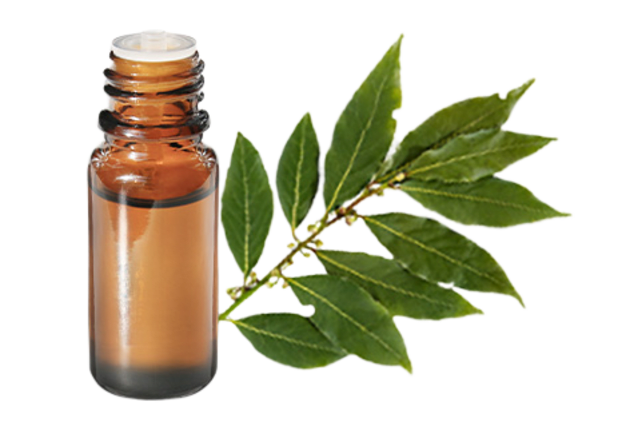
Guide to essential oils

Essential oil of Bay laurel

This purifying essential oil is used in skin and haircare. Laurel essential oil is also aromatic and can also be used in mouth care products. Known for its soothing properties, Laurel essential oil can be used in cases of joint discomfort. Bay Laurel essential oil is a powerful oil, reputed to bring strength and courage.

How to use

  • Skin application and massage

    Skin application and massage

    Suitable

  • Cosmetic active ingredient

    Cosmetic active ingredient

    Suitable

  • Aromatherapy bath

    Aromatherapy bath

    Suitable

  • Diffusion

    Diffusion

    Suitable

  • Food grade

    Food grade

    Appropriate

Features

Properties and uses

Precautions

Find out more

Features

Production process

Complete steam distillation

Part of the plant used

Leaves

Botanical name

Laurus nobilis

Warning

The properties, information and methods of use below are quotes from reference books or websites on aromatherapy, hydrolatherapy and phytotherapy. This general information is provided for informative purposes only and in no way constitutes medical guidance. Under no circumstances can this information be used as a substitute for a medical diagnosis, consultation or follow-up, nor can it incur our liability. We recommend that you consult the guide to essential oils before using them, so that you are aware of any precautions that need to be taken. If in doubt, consult a doctor before using essential oils.

Properties and uses

Health

Beauty

Wellness

Kitchen

Find out more, etc.

Properties

For health, Bay Laurel essential oil is recognised for the following properties:

  • Remarkable anti-fungal properties (scientific studies show its effectiveness, particularly on Candida albicans).

  • Anti-bacterial.

  • Antiviral.

  • Powerful mucolytic and expectorant (traditionally used to eliminate bronchial secretions).

  • Studies show its powerful analgesic and anti-inflammatory properties.

  • Acaricide, particularly against Psoroptes cuniculi.

  • Traditionally used for bruises and blows.

Uses

It is traditionally used to improve the following conditions :

  • Oral infections and inflammations:

    • Mouth ulcers

    • Gingivitis

    • Toothaches

  • Skin infections:

    • Ulcers

    • Bedsores

    • Boils

    • Paronychia

    • Abscesses

  • Viral diseases:

    • Flus

    • Viral hepatitis

    • Viral neuritis

  • Chronic respiratory conditions:

    • Bronchitis

    • Asthma

  • Arthritis, rheumatism, neuralgias (pain of a particular nerve)

  • Tropical infections and parasitic, viral and bacterial fevers.

Synergies

  • Purifying action: Palmarosa, Holy Basil essential oils, etc.

  • Dental and oral care: Lemon, Clove, tea tree essential oils, etc.

  • Preparing for winter: Rockrose, Ravintsara, Niaouli essential oils, etc.

  • Joint health: Birch, Lemon Eucalyptus, Lavandin super, Ylang-Ylang, Wintergreen, Thyme Borneol essential oils, etc.

  • Bruises: Helichrysum Italicum essential oil, etc.

In practice

Oral care: Mix into your mouthwash for a purifying action.

Precautions

  • Do not use during the first three months of pregnancy, or on children under the age of 6.

  • Rare cases of allergies to Bay laurel have been reported.

  • Always perform a patch test of your mixture in the crease of your elbow at least 48 hours before use.

  • Some natural compounds in this essential oil may present an allergy risk for sensitive individuals when the oil is incorporated into a cosmetic composition (in accordance with the 7th Amendment to the European Cosmetics Directive (2003/15/EC)): linalool and, to a lesser extent, eugenol, limonene.

Find out more

In mythology, the Laurel was dedicated to the sun. It was a symbol of peace and victory, and held a prominent place alongside victorious personalities: generals, emperors (Julius Caesar, Napoleon and others), poets, scientists, etc.

Equivalents

Essential Oils

1 ml = approximately 35 drops (with our Aroma-Zone dropper caps)

Carrier oils

1 pump (Aroma-Zone aluminium pump) = approx. 0.15 ml

Mass / Volume conversion (for a liquid)

Mass (g) = Density x Volume (ml) at 20°C

Further information

1 full teaspoon = between 3 and 4.5 ml

1 full tablespoon = between 7.5 and 10 ml


However, these spoon ratios depend on a number of factors (e.g. viscosity of the liquid, temperature, depth and size of the spoon, rheological behaviour of the liquid), and we strongly advise you to use precise measuring equipment, such as graduated test tubes, graduated pipettes, and precision scales.

Bibliography

1

Antimicrobial activities of the essential oils of various plants against tomato late blight disease agent Phytophthora infestans. Mycopathologia

Soylu EM, Soylu S, Kurt S.

2

Chemical composition, antimicrobial and antioxidative activity of laurel, sage, rosemary, oregano and coriander essential oils Journal of Essential Oil Research

Baratta MT, Dorman HJD, Deans SG, Biondi DM, Ruberto, G

3

Osman Erkmen Antimicrobial activity of the essential oils of Turkish plant spices European Food Research and Technology

Mr Özcan

4

Dessì Preservative systems containing essential oils in cosmetic products International Journal of Cosmetic Science

A. M. Maccioni, C. Anchisi, A. Sanna, C. Sardu and S.

5

The chemical composition of some Lauraceae essential oils and their antifungal activities. Phytother Res.

Simić A, Soković MD, Ristić M, Grujić-Jovanović S, Vukojević J, Marin PD.

6

Analgesic and anti-inflammatory activity of the leaf essential oil of Laurus nobilis Linn. Phytother Res.

Sayyah M, Saroukhani G, Peirovi A, Kamalinejad M.

7

Inhibition of cytokine production and arachidonic acid metabolism by eucalyptol (1.8-cineole) in human blood monocytes in vitro. Eur J Med Res.

Juergens UR, Stöber M, Vetter H.

8

Composition and acaricidal activity of Laurus novocanariensis and Laurus nobilis essential oils against Psoroptes cuniculi. The Journal of Essential Oil Research.

MACCHIONI Fabio; PERRUCCI Stefania; CIONI Pierluigi; MORELLI Ivano; CASTILHO Paula; CECCHI Francesca

9

Investigation of antioxidant activities and free radical scavenging of laurel essential oil. China Condiment.

LI Rong, JIANG Zi-tao, MA Li

10

Antioxidant properties of essential oils: autoxidation of essential oils from laurel and fennel and effects of mixing with essential oil from coriander Prikl Biokhim Mikrobiol

Misharina TA, Polshkov AN.

11

L'aromathérapie exactement

P. Franchomme

12

'Aromatherapy - Healing with essential oils'

Dominique Baudoux

13

"Votre beauté au naturel"

Chantal Clergeaud

14

'L'ABC des huiles essentielles'

Dr Thierry Telphon

15

"Les huiles végétales - Huiles de santé et de beauté"

Chantal and Lionel Clergeaud

16

"Essential oils"

Jean-Pierre Willem

17

"The Essential Guide to Natural Skin Care"

Hélène Berton

18

"L'aromathérapie énergétique ; guérir avec l'âme des plantes"

L. Bosson

19

Aromathérapie Corps et âme

André Bitsas

20

Huiles essentielles, huiles végétales, plantes aromatiques dans l’art de la cuisine

Jean-Philippe Ortega

21

'La cuisine aux huiles essentielles - Des recettes saines et créatives'

Aymeric Pataud

22

23