
The roots of argan: meeting the guardians of ancestral expertise
The roots of argan: meeting the guardians of ancestral expertise
Recognised as a leading anti-ageing treatment, argan oil is the fruit of the sun and soil of south-western Morocco. Above all, it is the result of the invaluable work of a community of over 300 women. Every bottle of this liquid gold bears the mark of their expertise, from harvesting the finest fruits to the meticulous crushing of the argan kernels.
Today, we wish to recognise the work of these women producers, these communities of women without whom none of this would be possible. These women face significant challenges: the aftermath of the 2023 earthquake, drought linked to global warming, and pressure from industrialists on this resource.
Communities of women at work
It is in the south-west of Morocco, very close to Taroudant, that the argan groves (fields of argan trees) are found. It is here that two major cooperatives operate, bringing together more than 300 women who produce our virgin argan oil, which is 100% pure and certified organic. We have been fortunate enough to work with these women’s co-operatives for over 10 years.
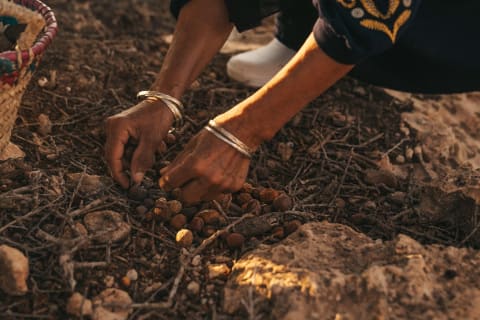
“The argan tree has always been a woman’s business”, as Hanane, Chairwoman of a women’s cooperative specialising in the production of argan oil, puts it. It is the women who oversee every stage of production. This work enables them to improve their economic and social circumstances, for example by paying their children’s school fees.
Precious skills
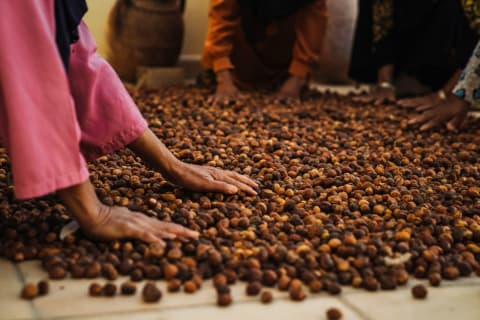
The harvest takes place from June to August. The women gather by hand the fruits that have fallen to the ground – a sign of ripeness – and then leave them to dry naturally in the sun for 1 to 2 weeks.
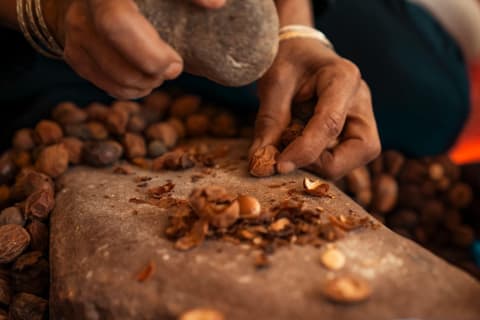
Once the fruits are dried, the women remove the pulp to extract the argan kernels. Next comes the cracking stage, a delicate process that involves breaking open the shells to extract the kernels. To obtain the highest possible quality oil, the kernels are rigorously selected through manual and visual sorting. Once the kernels have been sorted, the women move on to the extraction stage, which involves cold-pressing the kernels. It takes 36 kg of fruit to produce 1 litre of argan oil.
The final stage: three successive filtrations to obtain oil of the highest purity.
Nothing goes to waste in argan production – a true circular economy
The fruit pulp is used to feed livestock. The shells are used to stoke the heating fire or to make natural exfoliants.
The oilcake, the residue left over from argan oil extraction, is redistributed to the women, who reuse it in their own beauty routines (soap, hair care, etc.).
Significant challenges
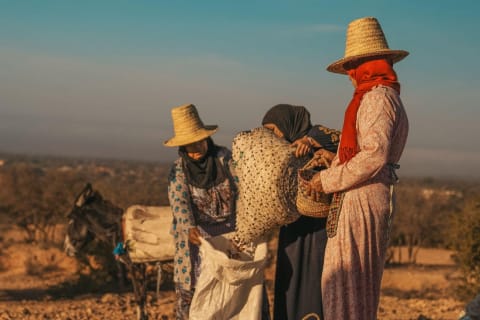
Today, these communities of women face significant challenges.
Drought, first and foremost: rainfall in Agadir has fallen by a factor of ten over the past ten years. Temperatures there exceeded 50 degrees this summer. Although the argan tree is known for its extreme resilience, it is suffering and the fruits are becoming scarcer.
Cooperatives used to account for the vast majority of oil exports, and women were in control of production and access to the raw material. However, in recent years, industrialists have taken control and are putting significant pressure on the resource.
Finally, our women producers are suffering the severe consequences of the earthquake in September 2023, which hit this region hard. A year on, they approached us, alongside the Fondation de France, to support a reconstruction project for the small cooperatives located in the villages, as well as to build a new building. This new building will serve as a community granary for the women of the cooperatives. The women will store the argan fruit there and press argan oil on the premises. This building will also have a strong social dimension, with rooms dedicated to literacy classes, sewing courses and other income-generating activities.
From the argan tree to argan oil
It all begins with the argan tree (Argania spinosa), an endemic species with a gnarled trunk and very hard wood, which grows in south-western Morocco. Present in Morocco for centuries, the argan tree can live for up to 300 years. Deeply rooted in Moroccan culture, the argan tree is often associated with the resilience and adaptability of Berber communities, symbolising their connection to the land and their ability to overcome environmental challenges.
In the arid and semi-arid regions where it grows, the argan tree plays a key role in soil conservation. By preventing erosion and improving soil fertility and water retention, it helps to combat desertification and preserve biodiversity.
Produced by cold-pressing the fruit of the argan tree, argan oil is deeply rooted in Moroccan culture. From skin and hair care to cooking and traditional medicine, it is used in a wide range of areas and has become known throughout the world as one of the beauty secrets of Moroccan women.
A remarkable blend
Virgin, organic Moroccan argan oil is one of the oils richest in unsaturated fatty acids. Ranging in colour from pale yellow to yellow, this oil has a characteristic mild scent and contains up to 50 per cent oleic acid (omega-9), which protects the hydrolipidic film and restores elasticity and suppleness to the skin. Its high linoleic acid (omega-6) content, up to 35%, helps maintain the skin’s barrier and protects the skin whilst strengthening dull and brittle hair.
Argan oil is also rich in antioxidants: vitamin E and carotenoids.
The benefits of argan oil
Recognised as a leading anti-ageing oil, particularly for promoting skin elasticity, this highly nourishing oil cares for wrinkled, dry or lacklustre skin. Rich in antioxidants, argan oil combats free radicals involved in skin ageing, strengthens the skin barrier, prevents dehydration and combats the effects of external aggressors.
Renowned as hair care, it coats and revitalises damaged hair whilst adding shine and softness to dry hair.


