
Upcycling: our initiatives for the circular economy
What is Aroma-Zone doing to contribute to the circular economy?
What is Aroma-Zone doing to contribute to the circular economy?
Faced with the climate emergency, the natural cosmetics industry must rethink its practices to ensure resources are preserved. At Aroma-Zone, this shift is based on a simple principle: the best waste is the waste we don’t produce. Upcycling – or reusing materials to create greater added value – fits naturally within this vision of a circular economy. Whether we’re transforming tomato seeds or plum stones, the aim is always to minimise our impact at every stage. Here, we’d like to share how upcycling, amongst other things, guides our CSR commitments and shapes the design of our products.
The design of our products takes major environmental and social issues into account. To reduce our greenhouse gas emissions, help conserve resources and prevent pollution – particularly pollution linked to plastic – our products are developed in accordance with an internal eco-design charter. Each month, a committee of experts analyses the environmental and social scores of our products using an internal assessment framework, before they are launched in shops and on our website.
A co-product is a material resulting from an agricultural or food production process that is not used in the main product, but which retains real potential for further use. Far from being waste, it can become a resource in its own right when it is reprocessed or repurposed.
Upcycling refers to the process of transforming a co-product – a by-product resulting from a manufacturing process – into a fully-fledged ingredient or object of greater value. Unlike recycling, which involves breaking down a material—usually from packaging—to reuse it, upcycling consists of enhancing the value of what might otherwise have been considered manufacturing waste, turning it into a valuable new resource. In the natural cosmetics sector, this means, for example, using seeds, pits or distillation waters to create oils, butters or hydrolates that are rich in active ingredients and highly effective.
More than just a trend, upcycling is a practical way to reduce the environmental impact of the cosmetics industry by:
Ensuring the preservation of natural resources: by reusing what already exists, we limit the extraction of new materials and protect ecosystems. It is therefore an effective tool for tackling resource depletion
Reducing waste: Through upcycling, by-products become raw materials in their own right. This reduces the volume of organic waste and lowers the carbon footprint associated with its disposal
Supporting local supply chains to produce better, without compromise: upcycling facilitates the creation of virtuous partnerships with food processors, farmers and cooperatives. These collaborations strengthen local economies whilst promoting traceability.
We have always been committed to minimising our environmental impact by ensuring we preserve natural resources as much as possible. In plant-based industries, food processing often leaves behind materials that are still rich in potential: seeds, stones, pomace, husks… At Aroma-Zone, we do not regard these by-products as waste but as resources in their own right that we can repurpose to create high-quality plant oils and active ingredients. We therefore prioritise local or regional supply chains, where the use of by-products helps to support our farming partners and strengthen short supply chains in line with our commitments.
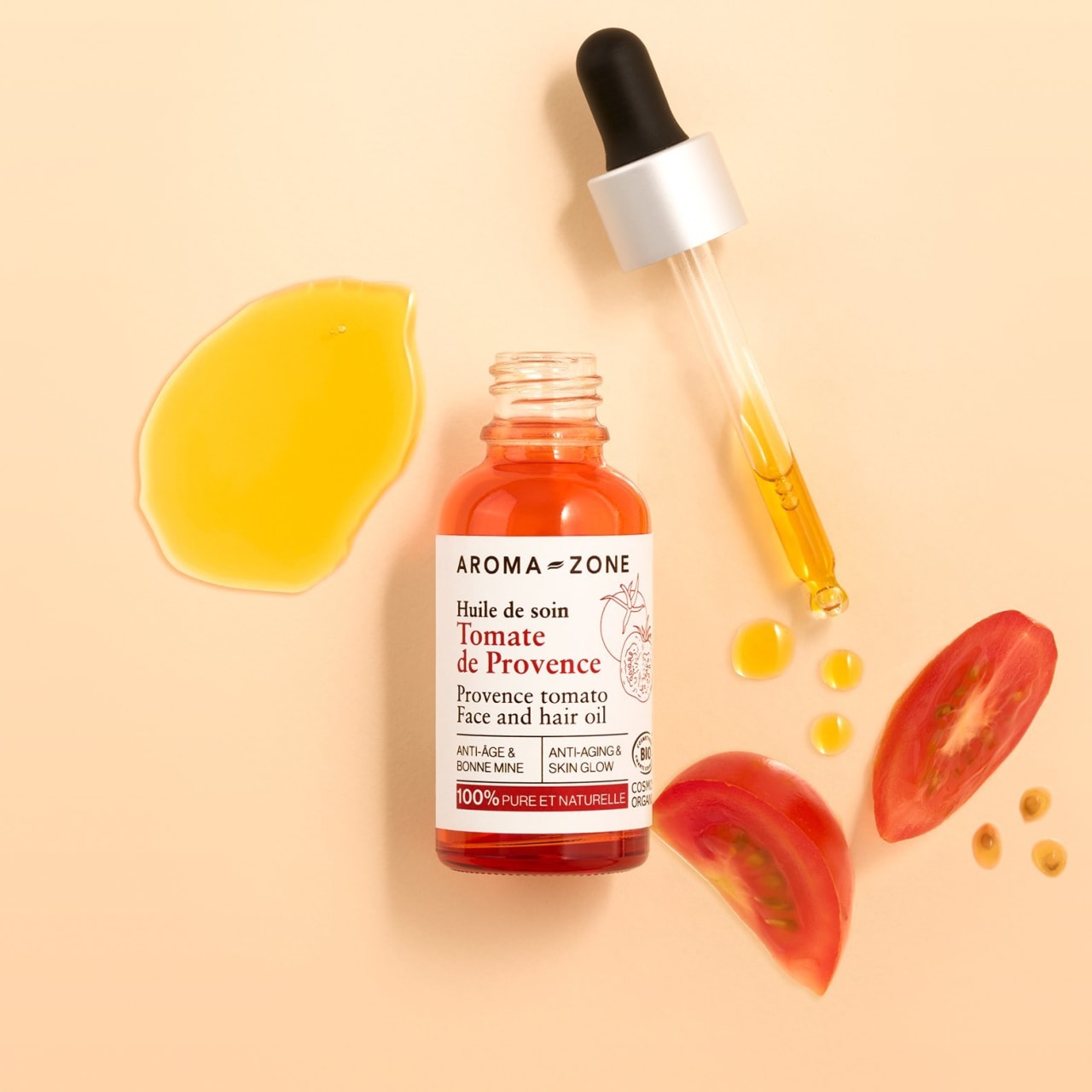
Radiant complexion
Anti-ageing
£12.50
30 ml
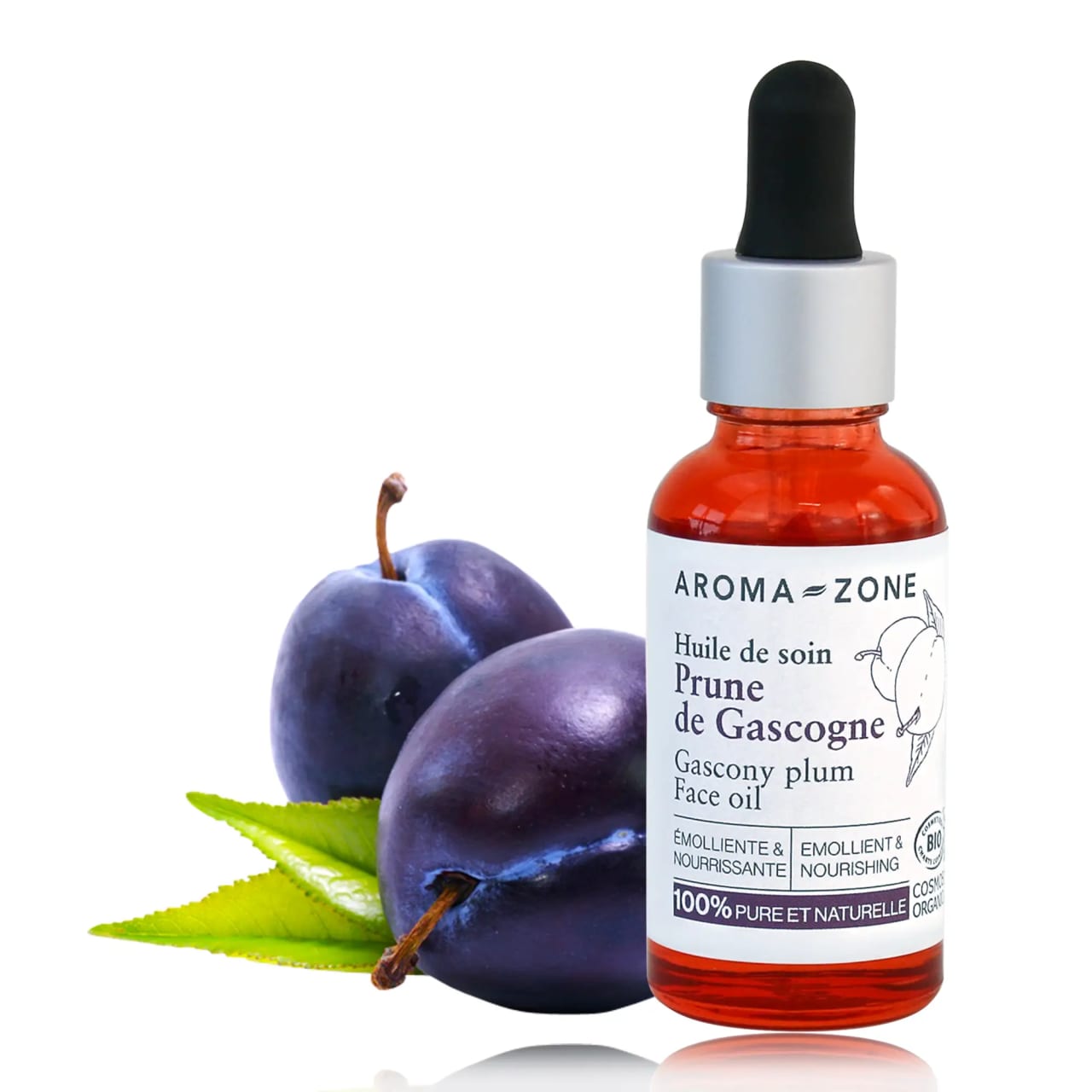
£8.50
30 ml
Made from the seeds of tomatoes grown near Aix-en-Provence, this oil is produced using supercritical CO₂ eco-extraction. The pulp is used to make purées or juices, whilst the seeds are processed into a light oil rich in antioxidants.
Produced from the kernels found inside Agen prune stones, it is pressed to yield a naturally fragrant oil, highly prized in cosmetics.
These reused materials prevent waste, create new local supply chains and support more sustainable production methods.
"The best waste is the waste we don’t produce." Aroma-Zone IMPACT CSR Report 2024–2025
True upcycling is not limited to oils: Aroma-Zone also promotes initiatives by its suppliers who develop active ingredients derived from co-products or secondary agricultural streams.
Each ingredient is selected not only for its effectiveness but also for its ability to be part of a sustainable model.
Eco-design is a key feature of Aroma-Zone’s DNA. When it comes to packaging, this involves environmentally- and socially-responsible sourcing, and circular economy.
The design of our products takes major environmental and social issues into account. With this in mind, a committee of experts analyses the environmental and social score of products each month using an internal assessment grid, before they are launched in shops and on the brand’s website.
REFUSE: eliminate the unnecessary | 96% of our products are currently free from secondary packaging. |
REDUCE: optimise to minimise the resources used | Solid cosmetics: toothpastes, shampoos, make-up removers, soaps… With these product ranges, we save 17 tonnes of plastic a year and avoid 607,000 bottles. Optimised parcels thanks to automation: by reducing their height from 10 cm to 2 cm, we have been able to transport 30% more parcels per lorry and save 58 tonnes of cardboard by 2024. |
REUSE: towards circular consumption models | Fully recyclable, single-material eco-refills: these formats deliver a 28% reduction in environmental impact from the very first refill, avoiding 956 tonnes of CO₂, and saving 4,000 MWh and 175,000 kL of water.* Bulk: for refilling bottles with vegetable oils and liquid soaps in-store. Deposit scheme: a coalition-led trial of dietary supplements in two shops in 2025. Plans to continue the trial are under consideration for 2026.
*Based on a life cycle assessment carried out for Aroma-Zone, subject to peer review. |
RECYCLING: a 2030 target already well on track | 98% of our packaging has an established recycling system. As a result, 417 tonnes of CO₂ were avoided through recycling in 2024. The aim is to offer 100% recyclable, reusable and/or compostable packaging by 2030. |
What does upcycling mean for a brand like Aroma-Zone?
For Aroma-Zone, upcycling involves transforming agricultural by-products into high-quality materials for use in natural cosmetics. Plant-based production chains generate a wide variety of secondary materials: tomato seeds, plum stones, bark, pomace, plant husks… These are still rich in valuable compounds but are often under-utilised in traditional industry. Upcycling them gives them a new lease of life by creating useful, traceable ingredients that form part of a circular economy model. This approach is not merely a technical choice: it forms part of our commitment to preserving natural resources by limiting the extraction of virgin materials. Upcycling also plays a key role in shaping our supply chains. By making the most of regional by-products, we support partners committed to sustainable agriculture or food processing. This local focus helps to encourage short supply chains, improve the traceability of raw materials and strengthen the environmental integrity of our ingredients. As such, upcycling is one of the practical measures that enable us to anchor our products within a more responsible production model.
What techniques and solutions are used to achieve this?
Upcycling in cosmetics relies on several processes that are carefully controlled and tailored to the nature of each material. For oils, processing often involves the mechanical pressing of kernels or seeds. This simple, energy-efficient process produces a pure oil whilst preserving the plant’s intrinsic qualities. Certain materials, such as tomato seeds, require more specialised techniques, such as supercritical CO₂ eco-extraction. This very gentle method extracts lipophilic compounds without the use of synthetic solvents and while preserving the quality of the original material. It is particularly well-suited to by-products from the food industry. Beyond oils, upcycling can also be applied to cosmetic active ingredients. Some partner suppliers develop extracts from pomace, bark or plant residues using aqueous or enzymatic extraction processes. At Aroma-Zone, we support these initiatives when the supply chains are sustainable, traceable and consistent with our commitments.
Aroma-Zone, “Impact” CSR Report 2024–2025 https://downloads.ctfassets.net/0xsz2r7o7t3z/1WI1HW1ZOtYNWvw6 uuiRFL/5c0ce0b2d67c25e2fb1ea6105c303477/AROMAZONE_CSR_REPORT_V6.pdf
CITEO, 2024 data on packaging recycling https://v2.citeo.com/notre-impact/
ADEME – Footprint Database V23.4 base-empreinte.ademe.fr
Circul’R – Studies on deposit schemes and packaging circularity https://www.circul-r.com/


