
Texturizing Agent Stearic Acid
free delivery up to £25 in United Kingdom
100% secure payment CB, Visa, Mastercard, Paypal, Apple Pay, Google Pay

100% Plant-Based
In beauty care, stearic acid is known for the following properties:
Thickening agent, or even hardening agent in balms and sticks
Emollient: provides softness and creaminess to formulations
Nourishing
Protective (film-forming)
Co-emulsifier: contributes to emulsification and improves emulsion stability
Adds hardness to soaps
Consistency agent in candles
Use as an ingredient in your preparations:
Sticks, balms, and butters
Creamy and thick creams
Dry skin care
Cold process soaps
Scented or massage candles
Quick recipe from Aroma-Zone
Semi-hard butter
Vegetable oil
60%
Stearic acid
30%
Cetyl alcohol
10%
Step 1
Melt the stearic acid and cetyl alcohol in the vegetable oil.
Step 2
Pour into a jar.
Step 3
Allow to cool, stirring regularly with a hand whisk throughout the cooling process.
Your butter is ready!
General characteristics
Dosage
2 to 20% depending on use In a cream: 2 to 10%; in a balm: 2 to 30%; in a candle: 10 to 20%.
Insoluble in water
Melting point
55 to 65°C
Soluble in oil
Use in homemade cosmetics
Balms, creams & lotions, sticks, soap
Melt the stearic acid with the rest of the oil phase (vegetable oils and butters, waxes, etc.) in a double boiler.
2% stearic acid | 0.2 g |
10% stearic acid | 1.0 g |
20% stearic acid | 2.0 g |
2% stearic acid | 0.6 g |
10% stearic acid | 3.0 g |
20% stearic acid | 6.0 g |
2% stearic acid | 1.0 g |
10% stearic acid | 5.0 g |
20% stearic acid | 10.0 g |
2% stearic acid | 2.0 g |
10% stearic acid | 10.0 g |
20% stearic acid | 20.0 g |
2% stearic acid | 5.0 g |
10% stearic acid | 25.0 g |
20% stearic acid | 50.0 g |
1 scoop 5 ml (level*) | 2.9 g |
1 scoop 2 ml (level*) | 1.3 g |
1 stainless steel spoon TAD (leveled*) | 0.55 g |
1 stainless steel spoon DASH (leveled*) | 0.25 g |
1 stainless steel spoon PINCH (level*) | 0.19 g |
1 plastic spoon 0.5 ml (level*) | 0.28 g |
* leveled: spoon filled to the brim with the excess removed using a spatula or the back of a knife
Quality
Cosmetics, 100% plant-based (palm oil)
Function
Texture and consistency agent: thickener and emollient
INCI designation
Stearic acid
Composition
Stearic acid
Presentation
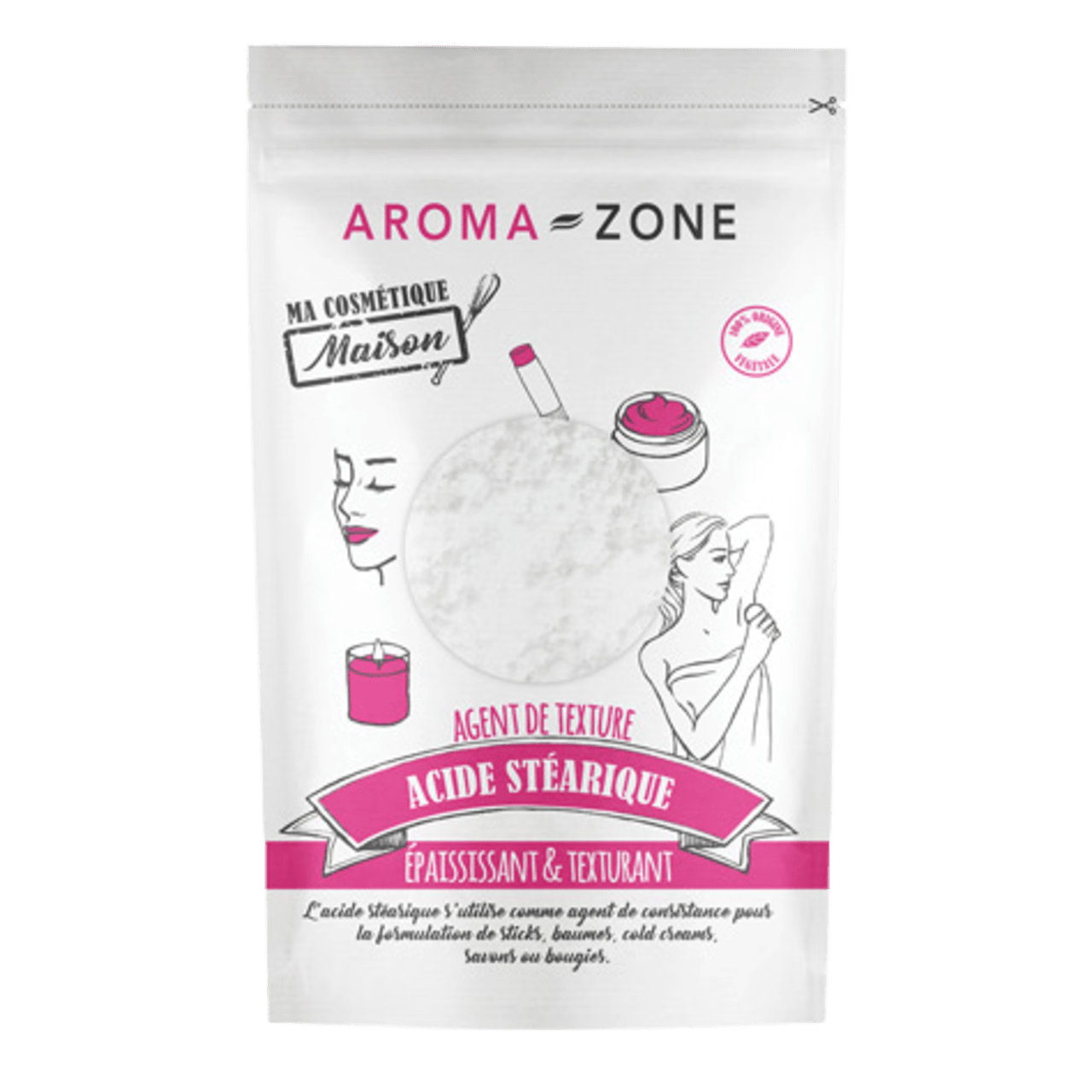
White flakes, packaged in a zip-lock bag.
Learn more
Sustainable development
With the constant increase in global demand for edible oils, the last twenty years have seen a rapid expansion in palm oil production in tropical regions. While well-managed plantations and small oil palm farms are considered models of sustainable agriculture in terms of both economic profitability and social and environmental responsibility, it is worrying to note that palm oil is not entirely produced under sustainable conditions.
The cosmetics industry consumes around 10% of global palm oil production, which is very little compared to biodiesel or food production. However, even on our own scale, it is important to prioritize sustainable production methods.
The RSPO (Roundtable on Sustainable Palm Oil) was created for this purpose. The manufacturers who are members (palm oil users) strive to engage in joint reflection and collaborate on the sustainable development of palm oil production and use (implementing good operating practices for existing production, improving land use plans for new plantation areas, promoting transparency in production, etc.).Aroma-Zone encourages this type of initiative. The stearic acid we offer is produced from palm oil that meets sustainable production standards. The laboratory that manufactures it is a member of the RSPO project.
Make your own homemade "vegetable butter"
Make your own homemade (non-hydrogenated) "vegetable butter" from vegetable oil: olive butter, apricot butter, argan butter, plum kernel butter, macadamia butter, etc. There are many "vegetable butters" that are not in their natural state, but are prepared by partial hydrogenation of vegetable oils. It is mainly the unsaturated fatty acids that give these vegetable oils their interesting properties, but partial hydrogenation modifies these fatty acids (in particular, it makes some of them "trans" and others saturated) and probably also denatures other active ingredients in the oils (vitamins, phytosterols, etc.). It is therefore understandable that it is preferable to avoid hydrogenation. It is possible to prepare vegetable "butters" with the oil of your choice, using stearic acid and cetyl alcohol.
Stearic acid mainly serves to thicken the oil, while giving it a very soft, slightly waxy feel, while cetyl alcohol gives it a creamier appearance (otherwise stearic acid tends to crystallize a little "in flakes") and a richer, oilier feel, but with less hardness. By adjusting the quantities of oil, stearic acid, and cetyl alcohol, it is therefore possible to vary the texture, consistency, and feel of the butter obtained.
Storage
Store at room temperature away from moisture. Close the bag tightly.
Precautions
Keep out of reach of children.
Do not swallow.
Environmental qualities and characteristics product sheet
Reference
00901 - stearic acid 250 g
Main packaging material
Paper bag
Recyclability
Most packaging can be recycled

EO = Essential Oil VO = Vegetable Oil or Oily Macerate
Oil phase:
16 g sweet almond oil
14 g avocado oil
4 g soy lecithin
4 g emulsifying vegetable wax
4 g beeswax
2 g stearic acid
Aqueous phase:
20 g cypress hydrosol
2 g chlorophyll
0.5 g xanthan gum
0.5 g acacia gum
0.75 g borax
Essential oils:
15 drops of cypress essential oil
10 drops of lemon essential oil
5 drops of tea tree essential oil
Method: Make an emulsion following the usual protocol. Once prepared, add the essential oils for fragrance.
Use: Massage your feet with this preparation before bedtime and cover with socks.
Aroma-Zone comments: Borax is an irritant and a rather controversial raw material. You can do without it by replacing the borax with an emulsifying wax. This cream should preferably be stored in a pump bottle to prevent contamination. Keep in a cool place and use within two weeks of preparation. You can improve its shelf life by adding about ten drops of grapefruit seed extract or Cosgard.
A highly versatile candle for the pleasure of all the senses: light it and it will delicately perfume your love nest. When desire strikes, extinguish it, take a small amount of its wax in the palm of your hand and massage your partner... sensually.
For a 125 ml glass.
20 ml vanilla macerate
10 ml of coconut vegetable oil
50 ml baobab vegetable oil
20 g stearic acid
4 g beeswax
a wick
15 drops of vanilla extract
15 drops of ylang ylang essential oil
15 drops of coconut aromatic extract
Method: Melt the stearic acid and beeswax with the vegetable oils. Remove from the heat and allow to cool slightly. Then add the drops of vanilla and ylang ylang. Add the wick and leave to rest.
9 g kokum butter
6 g apricot kernel oil
3 g beeswax
1 teaspoon vegetable glycerin
5 drops of ginger essential oil
5 drops of cinnamon essential oil
5 drops cardamom essential oil
5 drops nutmeg essential oil
Method: Melt the wax and butter in the vegetable oil in a double boiler. When the wax has melted, remove from the heat and leave to cool. Add the remaining ingredients and mix with a whisk. Pour into the jar before the mixture hardens.
Use: Apply a small amount to the inside of the wrists and neck.
Sweet almond oil: 30 g
Emulsifying wax: 8 g
Stearic acid: 2 g
Distilled water: 60 g
Xanthan gum: 1/8 teaspoon
Method: Heat the oil with the wax and stearic acid in a double boiler. In another container, weigh the water and heat it in a double boiler. When the oil phase is completely melted, remove both containers from the double boiler (they should both be at about 143°F). Add the xanthan gum to the water and stir well until a gel forms. Then, pour the gel into the oil phase little by little, mixing well until an emulsion forms. Allow to cool, stirring occasionally.
Important note from Aroma-Zone: To ensure this preparation keeps well, we recommend adding a preservative.
Avocado oil: 12 g
Olive oil: 10 g
Emulsifying wax: 8 g
Cocoa butter: 6 g
Vitamin E: 2 g
Jojoba oil: 2 g
Stearic acid: 6 g
Rose hydrosol: 40 g
Orange blossom hydrosol: 36 g
Essential oil: 10 drops
Method: Heat the oils with the cocoa butter, vitamin E, and stearic acid. In another container, heat the hydrosols. When all the oil phase has melted, remove both containers from the heat and pour the aqueous phase into the oil phase, stirring well until an emulsion forms. Allow to cool, then add the essential oils and stir well.
Important note from Aroma-Zone: To ensure the preservation of this preparation, we recommend adding a preservative.
Cocoa butter: 28 g
Olive oil: 16 g
Emulsifying wax: 8 g
Mango butter: 4 g
Shea butter: 2 g
Sweet almond oil: 2 g
Wheat germ oil: 2 g
Stearic acid: 2 g
Orange blossom hydrosol: 84 g
Xanthan gum: 1/2 teaspoon
Borax: 1/2 teaspoon
Method: Heat the oils with the butters, wax, and stearic acid. In another container, heat the hydrosol with the borax. When all the oil phase has melted, remove both containers from the heat and add the xanthan gum to the hydrosol, stirring well until you obtain a gel. Then pour the gel into the oil phase, stirring well until an emulsion forms. Leave to cool.
Aroma-Zone comment: Borax is an irritant and a rather controversial raw material. You can do without it by replacing the borax with an emulsifying wax.
Sweet almond oil: 20 g
Coconut oil: 16 g
Mango butter: 10 g
Emulsifying wax: 10 g
Stearic acid: 4 g
Ylang-ylang hydrosol: 170 g (approx. 170 ml)
Aloe vera gel: 20 g (approx. 20 ml)
Glycerin: 4 g
Bergamot essential oil: 40 drops
Sandalwood essential oil: 20 drops
Orange essential oil: 10 drops
Beeswax absolute: 6 drops
Patchouli essential oil: 2 drops
Rose essential oil: 2 drops
Method: Heat the oils with the mango butter, wax, and stearic acid. In another container, heat the hydrosol with the aloe vera gel and glycerin. When all the oil phase has melted, remove both containers from the heat and pour the aqueous phase into the oil phase, stirring well until an emulsion forms. Allow to cool, then add the essential oils and stir well.
The ultra-indulgent pleasure of caramel's slightly salty notes. Recommended container: 9 ml jar
5 g sesame oil
2 g shea butter
2 g stearic acid (natural emulsifier)
15 drops of caramel aromatic extract
A pinch of organic caramel powder
Method: Heat the sesame oil, shea butter, and stearic acid in a double boiler over very low heat until the wax has melted. Remove from the heat. Add the aromatic extract and caramel powder, then mix quickly with a small whisk and pour into the small jar.
The sweet and exotic combination of coconut and vanilla. Recommended container: small 9 ml jar
5 g vanilla macerate oil
2 g shea butter
2 g stearic acid (natural emulsifier)
20 drops of coconut aromatic extract
Method: Heat the vanilla macerate, shea butter, and stearic acid in a double boiler over very low heat until the wax has melted. Remove from the heat. Add the aromatic extract, then quickly mix with a small whisk and pour into the small jar.
A nod to the famous "After Eight" chocolate. An explosive sensation thanks to the sweetness of chocolate and the freshness of mint. Recommended container: small 9 ml jar
5 g sesame oil
2 g cocoa butter or shea butter
2 g stearic acid (natural emulsifier)
4 drops of peppermint essential oil
10 drops of organic chocolate aromatic extract
Method: Heat the sesame oil, cocoa butter, and stearic acid in a double boiler over very low heat until the wax has melted. Remove from the heat. Add the 4 drops of essential oils and the aromatic extract, then mix quickly with a small whisk and pour into the small jar.
This fondant captures all the richness of mango aromas: peach, flowers, lemon, apricot, banana... a journey for the senses... Recommended container: small 9 ml jar
5 g sesame oil
2 g mango butter
2 g stearic acid (natural emulsifier)
15 drops of organic mango aromatic extract
Method: Heat the sesame oil, shea butter, and stearic acid in a double boiler over very low heat until the wax has melted. Remove from the heat. Add the aromatic extract, then mix quickly with a small whisk and pour into the small jar.
The tangy taste of blueberry combined with the shimmer of beet juice. Recommended container: small 9 ml jar
5 g sesame oil
2 g shea butter
2 g stearic acid (natural emulsifier)
10 drops of organic blueberry aromatic extract
2 to 5 drops of beetroot juice (depending on the desired intensity)
Method: Heat the sesame oil, shea butter, and stearic acid in a double boiler over very low heat until the wax has melted. Remove from the heat. Add the aromatic extract, then quickly mix with a small whisk and pour into the small jar.
Supplier documentation
"90 DIY Organic Beauty Recipes" by Sophie Macheteau
"Making aromatherapy creams and lotions" by Donna Maria
Frequently Asked Questions
Essential Oils
1 ml = approximately 35 drops (with our Aroma-Zone dropper caps)
Carrier Oils
1 pump (Aroma-Zone aluminium pump) = approx. 0.15 ml
Mass / Volume conversion (for a liquid)
Mass (g) = Density x Volume (ml) at 20°C
Further information
1 full teaspoon = between 3 and 4.5 ml
1 full tablespoon = between 7.5 and 10 ml
However, these spoon ratios depend on a number of factors (e.g. viscosity of the liquid, temperature, depth and size of the spoon, rheological behaviour of the liquid), and we strongly advise you to use precise measuring equipment, such as graduated test tubes, graduated pipettes, and precision scales.
Loading...
Excellent quality and a great selection of ingredients. I found almost everything I needed for my shampoo bars, and I'm very happy with my purchase. The lemongrass essential oil smells beautiful, but my absolute favourite is the blue tansy essential oil, it smells amazing and feels very high quality. Highly recommend Aroma-Zone!
The best for DIY cosmetic products and Shampoo & conditioner. Wide availability of hard-to-find products, fairly fast shipping! Highly recommended. Quality products! Excellent value for money.
I find that this product was better before, it was thicker
Excellent product! Easy to use! I highly recommend it.
useful for all types of cleansing milk and for the manufacture of hair products


