
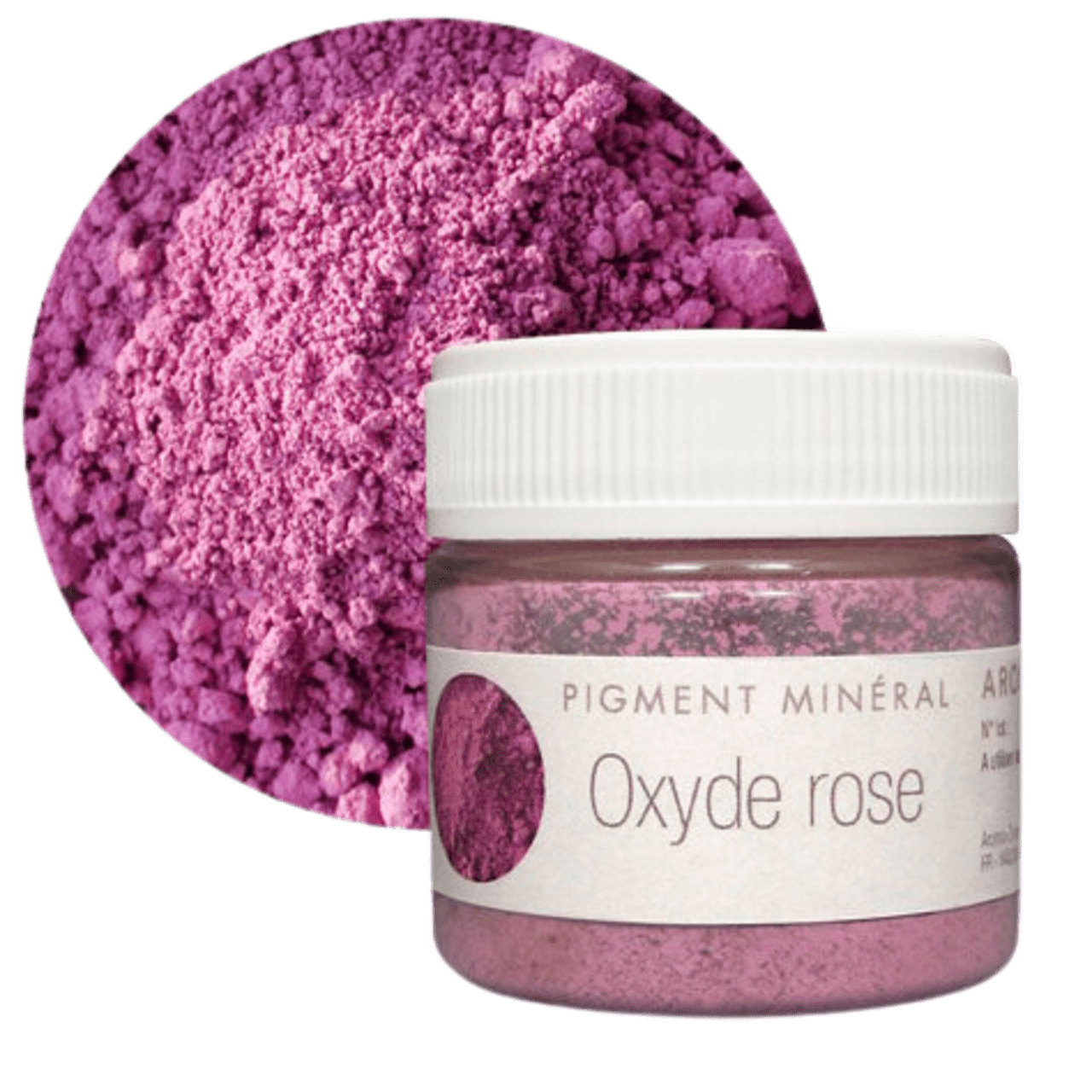
Pink Oxide Mineral Dye
free delivery up to £25 in United Kingdom
100% secure payment CB, Visa, Mastercard, Paypal, Apple Pay, Google Pay
Applications: Makeup
Difficulty of use: Easy
Cosmetic recipe creation: Yes
Pink colouring for makeup and other cosmetic products
Use as an ingredient in your homemade mineral makeup products:
Matte or pearlescent eye shadows, loose or pressed
Loose or pressed foundation powders
Loose or pressed blush
Cream foundations
Matte or pearlescent lipsticks
Matte or pearlescent lip gloss
Mascara and eyeliner
Lip pencils
Concealers and blemish concealers
Body paints
Colouring your homemade cosmetics:
Coloured gels
Skincare creams
Body lotions
Melt & Pour and cold process soaps
General characteristics
Dosage
0.1 to 30% (of the total weight of your preparation)
Oil-insoluble
Use as a dispersion
Insoluble in water
1 scoop 5 ml (level*) | 1.8 g |
1 scoop 2 ml (level*) | 0.8 g |
1 stainless steel spoon TAD (arasée*) | 0.35 g |
1 DASH stainless steel spoon (arasée*) | 0.13 g |
1 stainless steel PINCH spoon (arasée*) | 0.09 g |
1 SMIDGEN stainless steel spoon (arasée*) | 0.04 g |
1 stainless steel DROP spoon (arasée*) | 0.01 g |
* leveled: a spoon filled to the brim with the excess removed using a spatula or the back of a knife
Matte mineral pigments: red oxide, yellow oxide, green oxide, blue oxide, brown oxide, black oxide
Satin mineral pigments: silver mica, gold mica, bronze mica, copper mica, deep blue mica, ocean green mica
Shiny mineral pigments: sparkling hazelnut mica, shiny mica with intense glitter effect
Natural ochres: yellow ochre, red ochre, pink ochre, Indian black earth
Natural clays: purple clay, red clay, yellow clay, pink clay
Plant-based colourants (in emulsions or butters): caramel, chlorophyll, beet juice, grape powder, indigo powder, chestnut powder
Carriers: coated talc (powder, the coating facilitates dye dispersion), corn starch (powder), white or black paste (dispersing paste for colored emulsions), micronized rice flour
Makeup actives: "touch of softness" (powder) for an ultra-silky feel, sugar mirror or glycerin to add shine, etc.
I add it to a neutral AZ base.
Pink oxide can be incorporated into the following ready-made AZ neutral bases:
Cleansing cream base at a maximum dosage of 1.0%
Melt & Pour bases at a maximum dosage of 1.0%
Makeup powder base at a maximum dosage of 30.0%
Melt & Pour Stick Base at a maximum dosage of 30.0%
For more information on conditions of use, please refer to the technical data sheets for these bases, available online on our website.
I create my recipe from A to Z
This oxide can be used dispersed in a powder mixture or suspended in soaps, balms, and sticks.
Powder mixtures: Add the oxide to your powder mixture. Grinding with a mortar or coffee grinder is recommended to obtain uniform colours; using coated talc significantly reduces grinding time.
Oily and waxy mixtures (balms, oils, lipsticks): incorporate at the end of preparation
Pink oxide can be used to create the following shades:
A gradient of pinks
Mauve and purple tones when mixed with blue oxide
Brown, yellow, or red tones when mixed with brown, yellow, or red oxides
Quality
Cosmetics, non-irradiated product, Ecocert certified
Method of production
100% mineral origin
Pink oxide is an ultramarine obtained by mixing, grinding, heat treatment, cooling, washing, filtering, drying, and then grinding (micronisation).
Function
Cosmetic pigment
Other names
Colour Index: CI 77007 (international registry of colouring substances)
INCI designation
Ultramarine
Composition
Ultramarine (mineral complex of double sodium and aluminum silicates containing sulfur - no harmful salts)
Presentation
Ultra-fine powder (5 microns, not considered a nanoparticle product) in an intense pink colour, packaged in a small transparent jar.
Storage
Store away from moisture at room temperature.
Precautions
Wearing gloves, goggles, a dust mask, and a smock is strongly recommended.
Keep out of reach of children, do not swallow, do not inhale the powder.
Pink oxide is unstable in acidic environments. Do not use in acidic aqueous formulas (pH <7) or in effervescent bath product formulas based on citric acid (bath bombs). Never mix with strong acids or household products. Incompatible with AHA fruit acids.
The Aroma-Zone quality guarantee:
This product has been selected after extensive testing by our cosmetic formulation laboratory. With this oxide, you have access to the highest quality professional cosmetic pigment available today:
This product has been selected following extensive testing by our cosmetic formulation laboratory. With this oxide, you benefit from one of the highest quality professional cosmetic pigments currently available:
100% mineral origin
Non-irradiated product
High-purity product with a very low level of impurities, specifically intended for use in the cosmetics industry
Colour consistency with no variation from one batch to another
Micronised product with a very fine particle size of 1 to 2 microns, facilitating dispersion in the base and improving the finish and wear of the product
High colouring power, producing vibrant and true shades for make-up products in powder, emulsion or stick form
Excellent colour fastness, dispersing evenly in the product without clumping or streaking during application
Pink oxide vs pink ochre: which should you choose?
Pink ochre and pink oxide contain iron oxide and ultramarine respectively. While ochre also contains a significant proportion of kaolinite, which is white, pink oxide contains only ultramarine.
In terms of colouring power, pink oxide therefore has a clear advantage. In addition, its small particle size facilitates dispersion in powder or emulsion-based formulations, significantly improving the hold and finish of products containing it.
Pink oxide is therefore the preferred choice for achieving strong, long-lasting colours, particularly in the manufacture of makeup products, while ochre is ideal for creating very natural pastel shades, where colour dispersion is less critical, such as in soaps.
Ochre has the advantage of being extracted directly from nature, making it 100% natural, whereas ultramarine is produced from sulphur through human intervention. For those seeking strictly natural cosmetic ingredients, ochre is therefore often preferred to oxide. Ochre and oxide can also be combined in a formulation, with pink oxide enhancing an ochre-based shade.
Environmental qualities and characteristics product sheet
Reference
01320 - pink oxide 10 g
Main packaging material
RPET (recycled PET) pot
Recyclability
Most packaging can be recycled

Supplier documentation
Loading...
Very beautiful color in soaps
Beautiful but I expected it to be more pink and less purple. I love it anyway!
Good colorant for soaps
Excellent product, I use it in my DIY lipsticks and blushes.
Pretty pink shades depending on the dosage


