
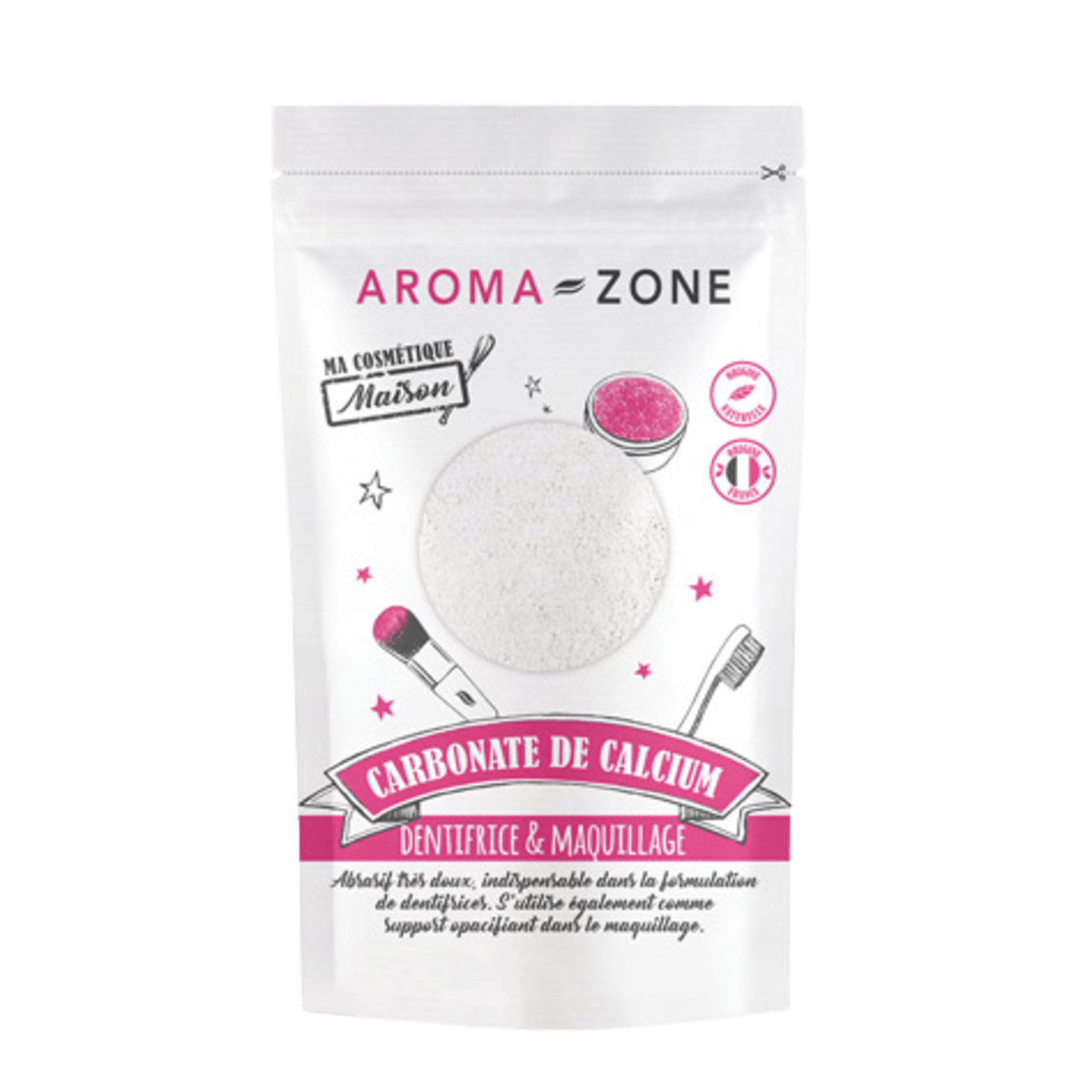
Multipurpose Agent Calcium Carbonate (Blanc de Meudon)
free delivery up to £25 in United Kingdom
100% secure payment CB, Visa, Mastercard, Paypal, Apple Pay, Google Pay

From France
In beauty products, calcium carbonate is known for the following properties:
Abrasive mild
Opacifying agent White
Thickening agent
Cosmetic uses
Use as an ingredient in your preparations:
In toothpaste as a mild abrasive and thickener
In makeup products as an opacifying and white base ingredient
Domestic uses
Traditional natural paints and coatings: oil paints, gesso, whitewash, fillers, "gelatinous white"
Cleaning and scouring products for delicate surfaces: stainless steel, silverware, ceramic hobs, marble, pewter, windows, etc.
Some ideas
Window paint (Christmas decorations): mix approximately 1 part calcium carbonate with 1/2 part water to obtain a smooth paste. This paste is spread on the windows using a brush or sponge (drawing shapes with stencils, for example). This paint can be easily removed by rubbing with a damp sponge. The same technique is often used to obscure windows during construction work, for example.
Scouring cream for sensitive surfaces: mix calcium carbonate with water until you obtain a creamy consistency.
Dosage
Adjust according to the desired effect and/or texture.
Insoluble in water
Used in dispersion
oil-insoluble
Use in homemade cosmetics
Toothpaste, powder, cream & lotion, gel
Equivalence table
1 scoop 5 ml (level*) | 4.4 g |
1 scoop 2 ml (level*) | 2.0 g |
1 stainless steel spoon TAD (leveled*) | 0.95 g |
1 stainless steel spoon DASH (leveled*) | 0.36 g |
1 stainless steel spoon PINCH (level*) | 0.23 g |
1 stainless steel spoon SMIDGEN (leveled*) | 0.10 g |
* leveled: spoon filled to the brim with the excess removed using a spatula or the back of a knife
Method of production
Made from natural calcite.
Function
Mild abrasive agent, opacifying filler and thickener
Quality
Cosmetics, nanoparticle-free
Country of origin
France (Orgon quarries)
Other names
Lime carbonate
INCI designation
Calcium carbonate
Composition
Calcium carbonate CaCO3 (99%)
Presentation
Fine white powder, packaged in a zip-lock bag.
Storage
Store at room temperature away from moisture. Close the bag tightly.
Precautions
Keep out of reach of children.
Avoid contact with eyes, do not inhale.
Also known as "Meudon white" and sometimes "Spanish white," calcium carbonate is the main component of chalk.
In addition to its applications in chalk form, calcium carbonate is traditionally known as a "white opacifying pigment" in natural paints and as a "mild abrasive agent."
In cosmetics, calcium carbonate is especially useful in toothpaste, where it acts as both a very mild abrasive and a thickener. It can also be used as a white pigment or support ingredient in makeup powders.
Environmental qualities and characteristics product sheet
Reference
0102001 - calcium carbonate 250 g
Main packaging material
Paper bag
Recyclability
Most packaging can be recycled

EO = Essential Oil VO = Vegetable Oil or Oily Macerate
Recommended container: tube or dispenser bottle for toothpaste
Ingredients for 250 ml:
White clay: 50 g
Calcium carbonate: 50 g
Licorice powder: 2 teaspoons
Bamboo powder: 1 teaspoon
Iris root powder: 1/2 teaspoon for its whitening properties
Orange blossom hydrosol: 100 ml
Calendula tincture: 20 drops
Tea tree essential oil: 3 drops
Grapefruit seed extract: 50 drops
Natural vitamin E: 17 drops
Method: Pour the white clay, calcium carbonate, bamboo powder, licorice powder, and iris root powder into the bowl. Add the orange blossom hydrosol and mix with the mini whisk until you obtain a smooth paste. Finally, add the calendula tincture, tea tree essential oil, natural vitamin E, and grapefruit seed extract, and mix everything together. Pour the toothpaste into the tube, which has been sterilized beforehand.
Recommended container: tube or dispenser bottle for toothpaste
Ingredients for 250 ml:
Green clay: 80 g
Calcium carbonate: 10 g
Lithothamnion powder: 10 g
Himalayan salt: 1/2 teaspoon
Sodium bicarbonate: 1/2 teaspoon
Blue mint hydrosol: 100 ml
Blue mint essential oil from Auvergne: 30 drops
Lemon essential oil: 10 drops
Grapefruit seed extract: 50 drops
Natural vitamin E: 17 drops
Method: Pour the green clay, calcium carbonate, lithothamnion powder, Himalayan salt, and sodium bicarbonate into the bowl. Add the blue mint hydrosol and mix the preparation with a mini whisk until you obtain a smooth paste. Finally, add the Auvergne blue mint and lemon essential oils, natural vitamin E, and grapefruit seed extract, and mix everything together. Pour the toothpaste into the pre-sterilized tube.
For a 250 ml rigid tube
80 g calcium carbonate
20 g of powdered vegetable charcoal
1 teaspoon of iris root powder
½ teaspoon of fine sea salt
100 ml of linden hydrosol
30 drops of propolis plant tincture
17 drops of natural vitamin E
Method: Mix the calcium carbonate, vegetable charcoal, salt, and iris powder. Add the hydrosol and mix until you obtain a smooth paste. Finally, add the rest of the ingredients and mix everything together. Pour the mixture into the previously boiled tube.
Supplier documentation
"90 Organic Beauty Recipes to Make Yourself"
Sophie Macheteau and Vanina Guet.
Loading...
With the heatwave we've been experiencing for several months, Meudon white is an alternative for reducing the heat inside my house.
Very good product, very fair price
As always, I am happy with this product
I use calcium to make toothpaste.
Perfect


