
pH Corrector - Citric Acid
free delivery up to £25 in United Kingdom
100% secure payment CB, Visa, Mastercard, Paypal, Apple Pay, Google Pay

100% natural origin
In cosmetic products, citric acid is known for the following properties:
Acidifying agent: lowers the pH of preparations.
Effervescent agent: enables the preparation of effervescent bath products when combined with sodium bicarbonate
Cosmetic uses
Use as an ingredient in your preparations:
As a pH adjuster: to correct excessively high pH levels in your cosmetic preparations, particularly in foaming products using the Consistance Foaming Base or Sugar Foam
Effervescent bath products: bath bombs, bath pebbles, "magic powders"
Domestic use
In domestic use, citric acid is known for the following properties:
Descaling agent
Removes rust stains from fabrics or objects
Domestic uses
To descale all types of household appliances and surfaces, for example:
Descaling coffee machines: Dissolve 1 to 2 tablespoons of citric acid in 1 liter of cold water, fill the machine with this solution. Run through one cup, leave to stand for 15 to 30 minutes. Run through the rest and rinse twice with water.
Descaling kettles: Dissolve 1 to 2 tablespoons of citric acid in 1 liter of water, fill the kettle and bring to the boil briefly, leave to act for 30 minutes. Then rinse thoroughly with water.
Descaling washing machines: Pour 6 to 8 tablespoons into the drum and run the program at 95°, without any laundry, of course!
Cleaning burnt bottoms of stainless steel pots or pans: Dissolve 2 tablespoons of citric acid in 1 cup of water, heat the solution in the burnt pot for a few minutes, then rinse thoroughly.
Descaling taps, water reducers, etc.: Dissolve 2 to 5 tablespoons of citric acid in 1 liter of hot water, scrub the affected areas or leave them to soak for a long time, then rinse.
Removing deposits from cups, tea or coffee pots, flower vases, etc.: Pour ½ to 2 tablespoons into the container, cover with boiling water and leave to work for 30 minutes. Then rinse thoroughly.
Cleaning chrome, stainless steel, ceramic, and plastic surfaces: Dissolve 2 to 5 tablespoons of citric acid in 1 liter of hot water, scrub the surfaces with this solution, and rinse thoroughly.
Removing lime, cement, or plaster deposits: Dissolve 3 to 6 tablespoons of citric acid in 1 liter of water and scrub with this solution. Rinse thoroughly.
ERemoving rust stains: Soak or cover the stains with a solution of citric acid in a little water. Leave to soak in, then rub gently and rinse. If this is not enough, try sprinkling salt on the stains after covering them with the citric acid solution. Be careful, as some surfaces (marble, stone, etc.) are damaged by citric acid. Test on an inconspicuous area first.
Dosage
Depending on use
Soluble in water
Insoluble in oil
Equivalency chart
1 scoop 5 ml (level*) | 4.3 g |
1 scoop 2 ml (level*) | 1.9 g |
1 stainless steel spoon TAD (leveled*) | 0.89 g |
1 stainless steel spoon DASH (leveled*) | 0.29 g |
1 stainless steel spoon PINCH (level*) | 0.19 g |
1 stainless steel spoon SMIDGEN (leveled*) | 0.08 g |
* leveled: spoon filled to the brim with the excess removed using a spatula or the back of a knife
To lower the pH of a cosmetic preparation that is too alkaline (cream, cleansing gel, etc.), add a small amount of citric acid and mix well before retesting the pH using a pH test strip.
Repeat until the desired pH is achieved.
Method of production
Natural origin, produced using biotechnology from plant-based raw materials (corn, tapioca, cassava, sweet potato), guaranteed GMO-free.
Function
pH adjuster (acidifier), ingredient for effervescent bath products, household descaler
Benefits and properties
Acidifier
Quality
Cosmetics
INCI designation
Citric acid
Composition
Citric acid monohydrate
Presentation
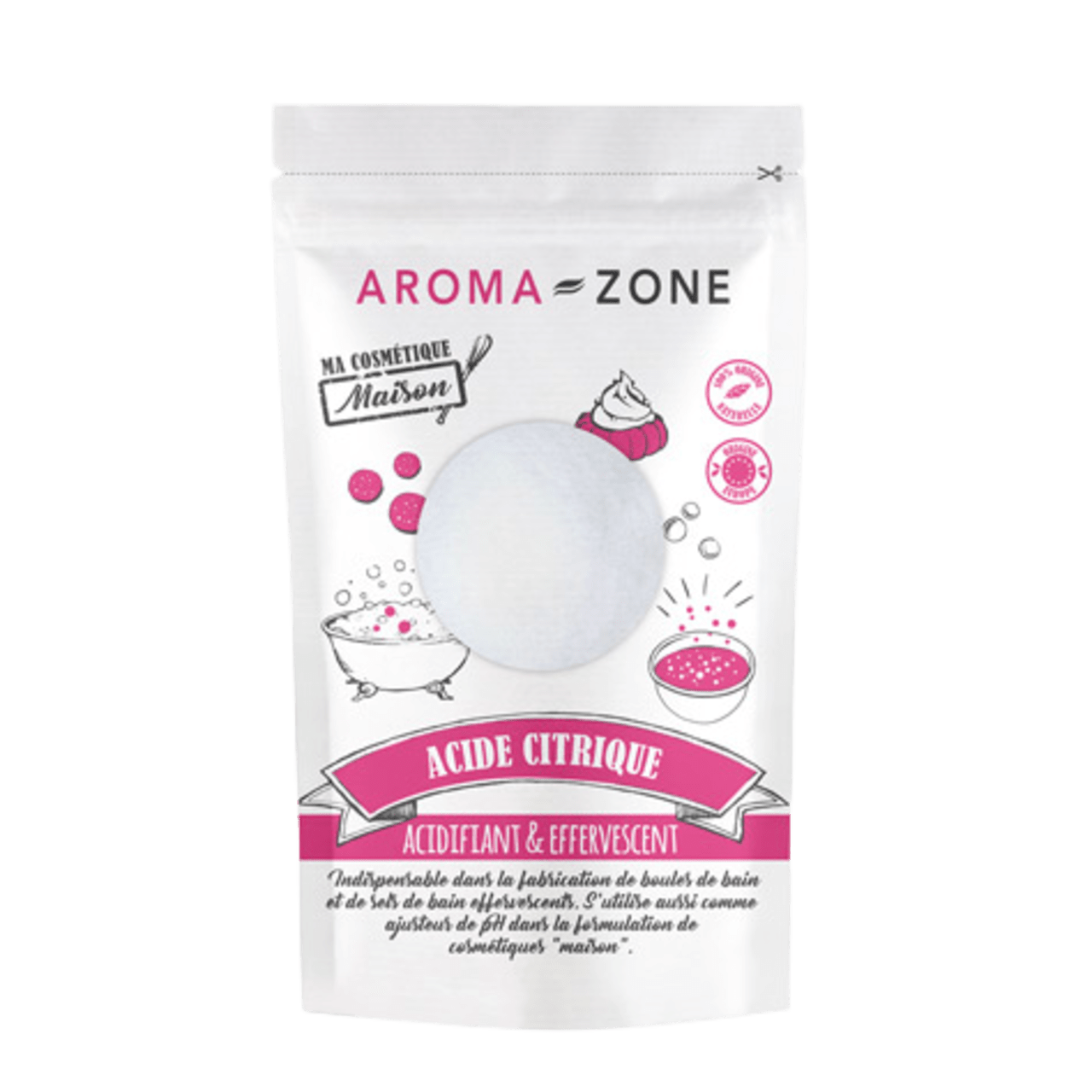
White crystalline powder, packaged in a zip-lock bag.
Storage
Store at room temperature away from moisture. Close the bag tightly.
Precautions
Keep out of reach of children.
Dangerous. Follow the precautions for use.
Causes severe eye irritation.
Do not swallow, avoid contact with eyes and skin.
Wearing gloves and protective eyewear is recommended when handling this product.
Incompatible with pink oxide and blue oxide in bath bombs or acidic aqueous formulas.

Focus on pH
pH (potential hydrogen) determines whether an aqueous mixture is acidic, neutral, or basic. pH is measured on a scale of 1 to 14:
1 < pH < 7 acidic pH
pH = 7 neutral pH
7 < pH < 14 basic (or alkaline) pH
In general, the skin has a pH between 4 and 6, which is rather acidic, but it varies depending on the area of the body (underarms, intimate mucous membranes), skin type, and age.
Recommended pH levels:
For shower gel: 5.0 to 7.5
For shampoo: 4.5 to 7.0
For detangling hair care: 4.0 to 5.0
For intimate hygiene products: 4.5 to 5.5 for women of childbearing age, 6.5 to 7.0 for young girls and menopausal women
For leave-on products (creams, milks, gels, lotions, etc.): 4.5 to 7.0
For creams containing AHA or DHA: 4.0 to 5.5
How does effervescence work?
In bath bombs, the effervescent effect is achieved by mixing citric acid with sodium bicarbonate. In its "dry" state, nothing happens, but when it comes into contact with water, an acid-base reaction occurs between the two ingredients. The reaction of an acid with baking soda produces carbon dioxide, which is a gas and therefore escapes in the form of small bubbles, creating effervescence! The other products of this reaction are water molecules and sodium citrate.
Environmental qualities and characteristics product sheet
Reference
00854 - citric acid 250 g
Main packaging material
Paper bag
Recyclability
Most packaging can be recycled

EO = Essential Oil VO = Vegetable Oil or Oily Macerate
Baking soda: 100 g
Corn flour: 50 g
Citric acid: 50 g
Sesame or jojoba oil: 10 drops
Sweet orange essential oil: 8 drops
Petitgrain essential oil: 5 drops
Grapefruit essential oil: 2 drops
Method: In 2 tablespoons of baking soda, mix in the vegetable oils and essential oils drop by drop. Pour the rest of the baking soda, flour, and citric acid into a bowl. Add the first mixture with the oils, stirring vigorously for a few minutes. Now comes the tricky part: add the hydrosol very slowly, spray by spray, stirring well and leaving half a minute between each spray to avoid a foaming reaction. It takes approximately 30 sprays for the powder to reach the desired moisture level. This amount is indicative. It is ready when the powder is barely moist. Fill the molds, pressing down firmly. Leave to dry for 24 hours before carefully removing from the molds and leaving for another 24 hours before use. Store in a very dry place to prevent the bombs from deteriorating.
Added to salt dough, citric acid works wonders! The mixture of salt and citric acid is hygroscopic, meaning it absorbs moisture from the air, allowing the salt dough to remain pliable for longer.
500 g wheat flour
150 g salt
3 tablespoons citric acid
20 to 50 g natural pigment
Method: Mix all these ingredients in a bowl. Bring ½ liter of water to a boil, mix in 5 to 8 tablespoons of cooking oil, add to the previous mixture, and knead thoroughly. That's it: you've made natural modeling clay in about 15 minutes!
Use: If stored in an airtight plastic bag (such as a freezer bag) and kept cool (in the refrigerator), the modeling clay will keep for several weeks.
Aroma-Zone tip: We recommend using plant-based pigments (caramel, grape, chlorophyll, beetroot, hibiscus, annatto, turmeric, madder, logwood, indigo) or ochres with this recipe. Please note that citric acid is not compatible with certain mineral oxides containing sulfur: pink oxide and blue oxide.
Supplier documentation
http://fr.wikipedia.org/wiki/Acide_citrique
http://www.ecodis.info/Niveau_3/acide_citrique.htm
"Natural cosmetics"
Hélène Baron and Tiphaine Chagnoux - Editions Sully
"Delicious soaps"
Mélinda Coss - Parangon Publishing
Loading...
It's perfect for making my own cleaning products.
Useful while waiting for the 500g citric acid to be restocked
I use it for cleaning the house and I'm happy with it.
Excellent value for money, thank you very much
easy, fast, efficient


