
Eco Sodium Bicarbonate – Detergent Grade
free delivery up to £25 in United Kingdom
100% secure payment CB, Visa, Mastercard, Paypal, Apple Pay, Google Pay

100% natural origin

Ecocert Ecodetergent

From France
Multi-purpose cleaner
Degreases and shines all types of washable surfaces
Purifying and deodorizing
Laundry stain remover
Water softener, increases the effectiveness of natural detergents and prevents limescale buildup
Use neat on a damp sponge to clean surfaces
Mix with water to form a paste for stubborn stains
Make your own homemade household products (multi-purpose cleaners, dishwashing products, etc.)
Make your own powder or liquid laundry detergent
Kitchen
To clean and deodorise the refrigerator: Sprinkle baking soda on a damp sponge. Clean, then rinse.
To clean the sink and hob: Sprinkle baking soda on a damp sponge. Scrub the surfaces, then rinse.
To deodorise the bin: Place 1–2 tablespoons of baking soda (+ possibly 4–6 drops of lemon essential oil) at the bottom of the bin before inserting the bag.
To clean the oven and barbecue racks: Apply a paste of baking soda and water, especially on charred residue and grease marks. Leave overnight, then clean with a damp sponge and rinse.
To scrub pots and roasting tins: To remove burnt-on residue, cover with a paste made from baking soda and water, leave overnight, scrub, then rinse.
To clean worktops, tiles, and splashbacks: Pour a little concentrated black soap onto a sponge, sprinkle with baking soda, scrub the surfaces, then rinse.
To neutralise unpleasant odors in the refrigerator: Place a small bowl filled with baking soda in your refrigerator.
Bathroom
To clean sinks, showers, bathtubs, and tiles: Sprinkle baking soda on a damp sponge. Scrub the surfaces and then rinse.
To clean hairbrushes, hair clips, makeup accessories, etc.: Soak the items in 1 litre of hot water with 2 tablespoons of baking soda added. Scrub and then rinse.
To unclog toilet pipes (minor blockages and regular preventive maintenance): Pour ½ cup of baking soda into the pipe opening, then add 1 cup of white vinegar. Leave to react for a few minutes, then run hot water for 1 to 2 minutes. Allow to sit for around ten minutes.
Laundry detergent
To increase the effectiveness of Marseille soap or soap nuts and prevent limescale build-up: Use ½ cup of baking soda in the detergent compartment or directly in the drum.
To remove stains from laundry: Before washing, apply a paste of baking soda and warm water to the stains. Leave on for 30 minutes before washing.
Pets
To neutralise unpleasant odors in cat litter: Sprinkle a thin layer of baking soda on the bottom of the litter box.
To clean bird cages and small rodent cages: Use a baking soda solution (4 tablespoons per litre of hot water). Scrub and rinse.
To clean pet toys and bowls: Soak them in a baking soda solution (4 tablespoons per litre of water) for 1 hour to clean and sanitize them. Rinse and wipe dry.
To neutralise your dog's bad breath: Brush their teeth with baking soda, then rinse.
Garage
To remove an oil stain from concrete or asphalt: Lightly wet the stain, cover with baking soda, and scrub with a stiff brush. Leave overnight, then rinse. Repeat if necessary.
To remove sap stains from car bodies or clean a windshield covered with gnats: Prepare a solution with 1 tablespoon of baking soda in 1 litre of hot water. Dip a cloth or chamois in this solution and scrub the stains.
To make chrome shine: Rub with a mixture of baking soda and water.
To clean car battery terminals: Apply a paste made from 3 parts baking soda and 1 part water to the battery terminals. Then scrub with a stiff brush. Rinse with a damp cloth and dry thoroughly.
To neutralise bad odors: Sprinkle baking soda on the seats or in the trunk of the car. Leave on for 30 minutes, then vacuum.
Garden
See ideas for use below in the formulas listed in the bibliography.
Some recipe ideas
Ingredients
Concentrated black household soap
1 cup
Baking soda
1 tablespoon
Essential oil of your choice (lemon, grapefruit, pine, etc.)
40 drops
In a 1-liter bottle, mix black liquid soap and baking soda.
Add water. Add about 40 drops of your choice of essential oil.
Ingredients
Concentrated black household soap
2 tablespoons
Baking soda
3 tablespoons
Water
2 cups
Essential oil of your choice (tea tree, lemon, eucalyptus, etc.)
1 teaspoon
Fill a spray bottle with all the ingredients. Shake well before use.
Ingredients
Concentrated black household soap
2 tablespoons
Hot water
1 L
Baking soda
2 tablespoons
Essential oils (lemon, Scots pine, lemon litsea, lavandin, etc.)
50 drops
Dissolve the soap and baking soda in a liter of hot water.
Allow to cool, then add the essential oil of your choice (optional).
Store in a bottle with a dispenser cap.
Use as a multi-purpose cleaner (enamel, stainless steel, plastic, glass, stovetops, dishes, etc.). Pour a small amount of product onto a damp sponge and scrub.
Leave to act if necessary, then rinse.
Ingredients
Concentrated black household soap
3 tablespoons
Hot water
1 L
Baking soda
1 tablespoon
Essential oils (lavender, lemon, grapefruit, lemongrass, etc.)
40 drops
Dissolve the soap and baking soda in a liter of hot water.
Allow to cool, then add the essential oil of your choice (optional).
Store in a suitable container.
Use 1/2 cup of product for a 5-6 kg load.
Ingredients
Marseille soap flakes
50 g
Hot water
1 L
Baking soda
3 tablespoons
Essential oil of your choice
30 to 40 drops
Dissolve the Marseille soap flakes in a liter of very hot water, stirring regularly until completely dissolved.
Add baking soda.
Leave to cool, then blend in a mixer.
You can also add 30 to 40 drops of your favorite essential oil. Shake before use.
Quality
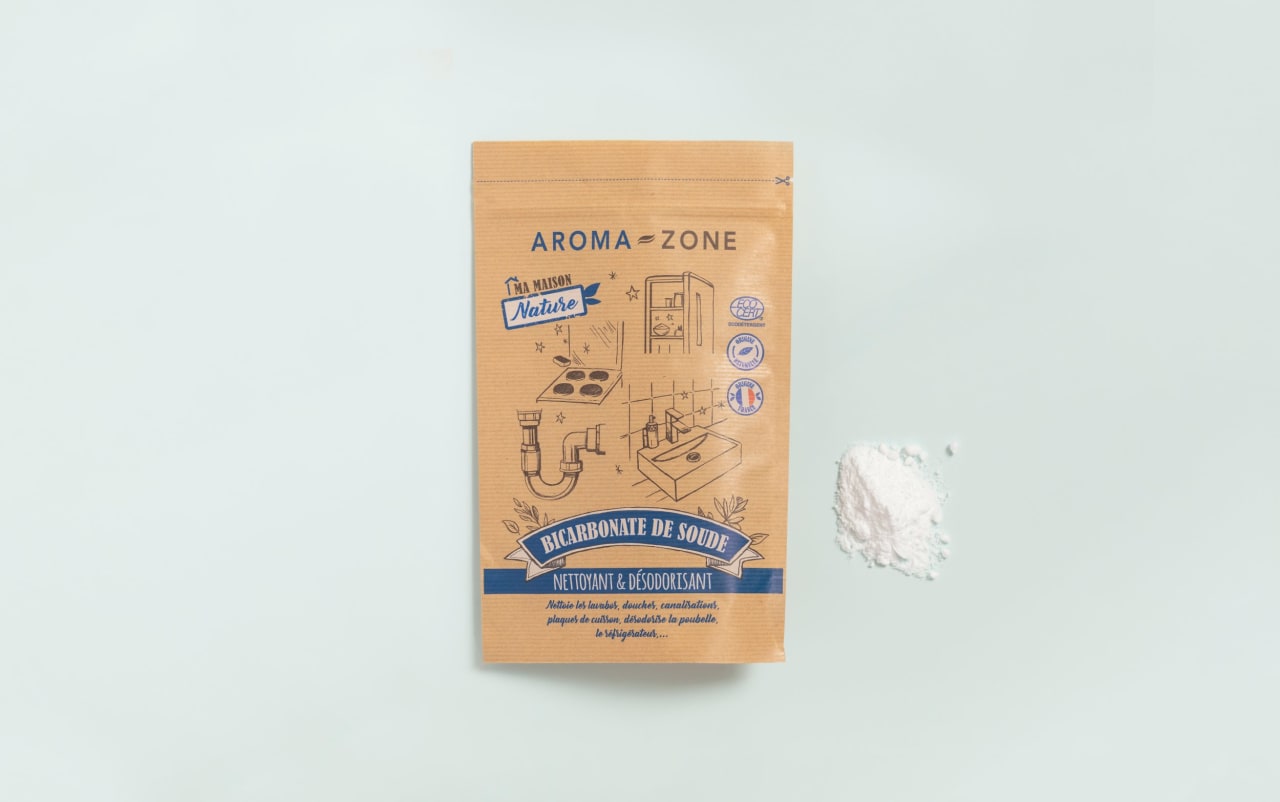
100% pure sodium bicarbonate, 100% natural origin, fine grade.
100% of the ingredients are of natural origin. Eco-detergent certified by Ecocert Greenlife according to the ECOCERT standard available at http://detergents.ecocert.com
Function
Multi-purpose household cleaner
Other names
Sodium bicarbonate, sodium hydrogen carbonate, baking soda
Particle size
Very fine, less than 160 microns
Composition
Sodium bicarbonate
Presentation
Fine white powder with a neutral odor
Country of origin
France
Storage
It keeps very well over time. Close the bag tightly after use and store away from moisture, heat, and light.
Precautions
Keep out of reach of children.
Avoid contact with eyes.
Test on an inconspicuous area before first use on fabric or surfaces.
Environmental qualities and characteristics product sheet
Reference
04122 - baking soda 500 g
Main packaging material
Paper bag
Recyclability
Most packaging can be recycled

EO = Essential Oil VO = Vegetable Oil or Oily Macerate
Black spots and brown spots on leaves are caused by microscopic fungi. You need a fungicide to get rid of them from your plants. Mix 5 teaspoons of baking soda with 4 liters of water. Add 1 liter of liquid soap and spray the mixture on the affected plants. For best results, water the plants generously 2 days before treating them with this spray.
Baking soda is an organic insecticide. To combat ants, aphids, red spiders, and other insects, spray your plants with an aqueous solution of baking soda (1 teaspoon of baking soda per 1 liter of water).
Mildew is the generic name for a series of fungal diseases affecting many plant species, including vines, tomatoes, and potatoes. [...] Spraying baking soda is quite effective against mildew. Dissolve 1 teaspoon of baking soda in 3 liters of water and add 1 tablespoon of liquid Marseille soap (or dishwashing liquid) so that the solution sticks to the leaves. Spray this solution (which is not harmful) under and on the leaves after watering, and repeat after each heavy rain.
It appears as a grayish-white, flour-like powder on the surface of leaves, stems, and sometimes flowers. Powdery mildew can cause leaf deformation, causing them to curl and blister. Spraying baking soda is quite effective against powdery mildew. Its basic pH prevents fungal spores from germinating. Dissolve 1 teaspoon of baking soda per liter of water and add 1 teaspoon of liquid Marseille soap or milk so that the solution sticks to the leaves. Spray this solution (which is not harmful) under and on the leaves and repeat after each heavy rain.
Baking soda can also be used as a weed killer. Sprinkle it between stones or paving slabs in paths or on patios to slow down the growth of unwanted weeds.
1 cup of soda crystals
1 cup of baking soda
1 cup of pure soap flakes
6 drops of sandalwood essential oil
Method: Mix all the ingredients together.
Use: Use 1/2 cup for washing, adjusting according to the dirtiness and quantity of laundry. Aroma-Zone note: For better soap dissolution, this detergent is best used with a hot cycle, starting at 60°C.
1/2 cup salt
1/2 cup borax
1/2 cup baking soda
Hot water
Method and use: Mix the powdered ingredients and add water to form a paste. Apply generously to the oven walls. Leave for one hour. Wipe with a clean cloth dipped in white vinegar, adding lemon juice if desired. Then wipe again with a damp cloth.
1/4 cup baking soda
1 cup of water
6 drops of rosemary essential oil
Method and use: Mix all the ingredients together. Dip a soft, clean cloth into the mixture and wipe down the inside of the refrigerator or freezer, then wipe with a dry cloth.
1/2 cup borax
1/2 cup baking soda
6 drops of eucalyptus essential oil
Method: Mix these two ingredients in a shaker.
Use: You can use it on all surfaces and remove black stains by brushing. Once the powder has been applied, leave it to work for an hour before rinsing.
2 tablespoons of baking soda
2 tablespoons of salt
1/4 cup white vinegar
Method and use: Sprinkle baking soda and salt into the sink and scrub, paying particular attention to the grooves and drain grate. Rinse with hot water and finish by wiping with a cloth dampened with white vinegar.
Internet and supplier documents.
Frequently Asked Questions
Essential Oils
1 ml = approximately 35 drops (with our Aroma-Zone dropper caps)
Carrier Oils
1 pump (Aroma-Zone aluminium pump) = approx. 0.15 ml
Mass / Volume conversion (for a liquid)
Mass (g) = Density x Volume (ml) at 20°C
Further information
1 full teaspoon = between 3 and 4.5 ml
1 full tablespoon = between 7.5 and 10 ml
However, these spoon ratios depend on a number of factors (e.g. viscosity of the liquid, temperature, depth and size of the spoon, rheological behaviour of the liquid), and we strongly advise you to use precise measuring equipment, such as graduated test tubes, graduated pipettes, and precision scales.
Loading...
good
Practical for household preparations
I use it for my laundry and I am very satisfied
Very good, thank you
Perfect for making your own laundry detergent.
Associated tip

Oral care tips


