Aroma-Zone supports Terre et Humanisme

Aroma-Zone supports Terre et Humanisme


By Lucie Granjon

Published on: Monday, March 18, 2024, Updated on: Thursday, October 22, 2026

It was in southern Ardèche, at the historic Terre et Humanisme site in Lablachère, that Sabrina Herlory, CEO of Aroma-Zone, and our teams met with the Terre et Humanisme association. From these discussions, a lasting partnership emerged, forged by shared values and complementary initiatives.  Both sides share the same commitment to protecting the earth, passing on knowledge to foster self-reliance, and supporting everyone towards more eco-friendly (and happier!) lifestyles. Here is the story of a meaningful partnership and an introduction to a vital organisation that has been working for 30 years to promote vibrant, regenerative agriculture that respects the soil and all living things. Inspiring!

Contents

Terre et Humanisme: 30 years of history

Founded in 1994, Terre & Humanisme raises awareness and provides training to the general public and agricultural professionals on ecological agriculture that respects all living things. In France and internationally, it supports the transition towards sustainable agricultural practices that respect biodiversity, combat climate change, and improve living conditions through self-sufficiency and food security. Terre & Humanisme shares, promotes and supports agroecology in France and in 10 countries around the Mediterranean and in West Africa.

Based at the Mas de Beaulieu in Lablachère in southern Ardèche, the association employs a team of 25 staff and 12 board members, and draws on 8 partner training centres and a strong network of 200 agroecology facilitators within its network. Recognised as a charity and a training organisation, Terre & Humanisme holds the ‘Don en confiance’ accreditation. It is audited annually by a statutory auditor and makes every effort to improve its financial transparency.

What is agroecology?

Farming that mimics nature

To put it simply, we could describe agroecology as follows: farming in harmony with living organisms and nature, without chemical fertilisers, whilst respecting biodiversity.

Agroecology is a form of agriculture that draws inspiration from the functioning of ecosystems to preserve the environment and resources. By taking nature as its model, agroecology brings together a range of agricultural techniques aimed at reducing the ecological footprint of agricultural production.  Energy efficiency, the preservation of biodiversity, the maintenance and restoration of living soils, and water conservation are just some of the pillars of agroecology. Agroecology reintroduces trees into fields (a practice known as agroforestry) to reduce the risk of erosion, provide shade for plants and enhance the soil’s ability to retain moisture, thereby limiting the need for irrigation. Agroecology also advocates the reintroduction of animals into agricultural systems to utilise crop residues and produce natural fertiliser for the farm. 

“When applied across our entire agricultural and societal model, agroecology enables greater resilience in local areas, better water resource management, improved carbon sequestration, soil regeneration, a boost to biodiversity and, by extension, environmental services that benefit all life on Earth.” Terre & Humanisme Association

Solidarity-based, sustainable and ethical agriculture

Agroecology advocates the right to food for all and supports small-scale, community-based farming . It works to promote the re-localisation of agricultural production in order to boost employment and the local economy. It ensures that farms remain viable and liveable across generations, and that prices are fair and transparent for all links in the supply chain.

“Current food production should be more than enough to feed humanity. Despite this, there are still more than 800 million people suffering from hunger today. Agroecology can feed the world, provided that all levels of our societies shift towards this virtuous model" Terre & Humanisme Association

undefined

How does Terre et Humanisme operate in France and around the world?

“In 2023, Terre & Humanisme is rolling out its awareness-raising, training and consultancy activities in France and internationally to foster the emergence of a small-scale, community-led agroecology that addresses the food and climate challenges facing local areas.”

For 30 years, Terre & Humanisme has been championing the agroecology movement. The organisation’s work is divided into three areas: Training, Expertise and Solidarity. Developing a network of agroecological farms, supporting vulnerable groups, training farmers, courses for the general public, hosting radio programmes, community gardens, lecture series, an online resource library, raising awareness amongst schoolchildren… it is difficult to summarise all of Terre & Humanisme’s activities, such is the richness and variety of the organisation’s work. 

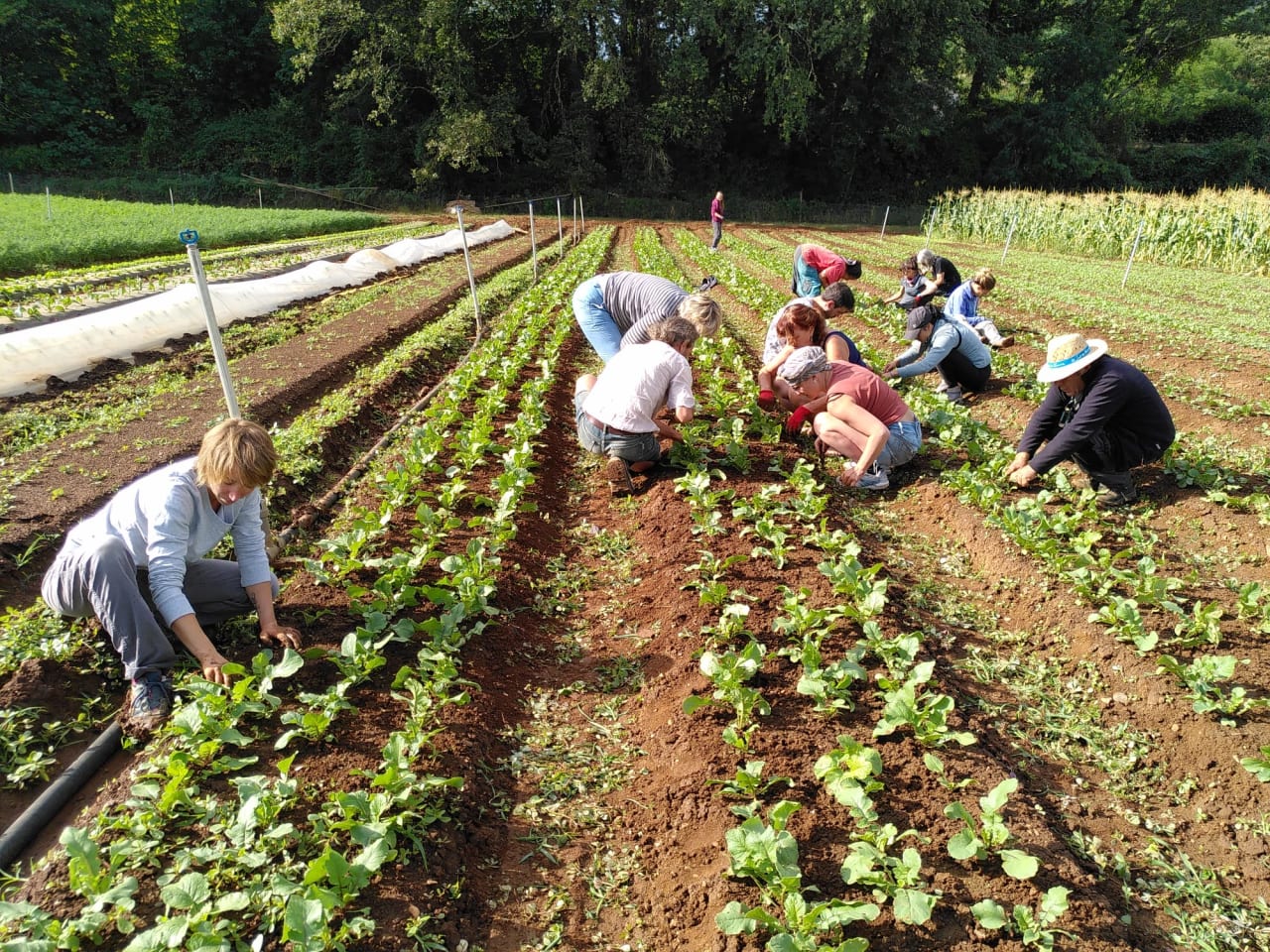
Mas Beaulieu in the Ardèche: a garden for experimentation and training

“It was here, at Mas de Beaulieu, that it all began, and it is here that life still teems. The barren land has become a lush jungle that withstands the vagaries of the climate. Here, our gardeners tend to living things, experiment, invent and innovate! And they pass on their knowledge. To those who wish to discover agroecology during a stay, whether for a week or just a few hours’ holiday.”

A veritable open-air laboratory garden, teeming with plants and life, the Terre & Humanisme garden demonstrates through example the resilience of agroecology. This garden has welcomed over 2,000 visitors a year for the past 24 years. Despite some years of catastrophic weather, such as 2022—marked by 35 days of heatwave during the summer—the gardens (covering a total area of 1.2 hectares including paths, of which 600 m² is dedicated to cultivation) recorded a record yield that year of 1,400 kg of vegetables and 176 kg of fruit. This is a good way of demonstrating the effectiveness of agroecological techniques that are resilient to climate change: water conservation, soil fertilisation, companion planting and the selection of suitable seeds. 

In 2023, Terre & Humanisme supported 110 young people on immersion programmes to help them bring their food self-sufficiency projects to fruition. This programme, which lies at the heart of the organisation’s awareness-raising mission, serves as a springboard for young people towards the socio-economic integration of future project leaders and, more broadly, the large-scale dissemination of ecological and environmental values that foster public awareness. 

Terre & Humanisme: courses and training programmes

If you’d like to learn about permaculture, find out more about aromatic and medicinal plants, or create an agroecological vegetable garden, discover all the Terre & Humanisme training courses on their website.

Community gardens

In 2023, Terre & Humanisme is continuing its ‘Solidarity Gardens’ programme ” in partnership with Habitat et Humanisme to create and run 25 therapeutic and community gardens within the network’s care and accommodation facilities (accommodation centres, community and intergenerational homes, care homes for the elderly, and reception centres for asylum seekers…), aimed at people in extremely vulnerable circumstances. This project, which restores a zest for life to more than 3,000 beneficiaries, will be further expanded in 2024 to reach as many centres as possible.

La Ferme de la Noria: training the farming community

“For the past ten years or so, we have been searching for a place to pass on and put agroecology into practice, aimed primarily at the farming community, on a larger scale than the gardens at Mas de Beaulieu, to demonstrate that agroecology is viable and to encourage as many people as possible to embark on this journey. Let me remind you that a farm disappears every quarter of an hour in France and that in 10 years’ time we are likely to have fewer than half the number of farmers we have now – that is, 200,000 people. There is therefore an urgent need to (re)learn how to feed ourselves, to care for living things and not to let our land fall victim to urban sprawl.” Françoise Vernet, chair of the Terre et Humanisme association

The Noria farm is situated in the commune of Robiac-Rochessadoule, near Bessèges in the north of the Gard department, 32 km from the Mas de Beaulieu, the association’s headquarters. The farm’s objectives are: 

  • To experiment with and demonstrate on a larger scale the economic and environmental viability of agroecological models

  • To promote agroecology amongst those developing agricultural and food production projects

  • To co-design a food and agriculture project rooted in the local area

  • To become a hub for resources and knowledge-sharing centred on agriculture and nature, and a catalyst for social cohesion.

undefined

Terre & Humanisme in the Maghreb and the Middle East

Since 2018, Terre & Humanisme has been supporting the development of agroecology in six countries in the Maghreb and the Middle East: Algeria, Egypt, Lebanon, Morocco, Palestine and Tunisia. Climate change is exacerbating drought, which is becoming a major issue. To tackle this, the Terre & Humanisme association is rolling out initiatives that promote agroecology in a holistic manner and support the farming communities in these countries.

As a result, by 2023, there will be 7 partner organisations, 20 trained and supported facilitators, 11 model agroecology farms receiving support, 310 farmers trained and supported (67 per cent of whom are women) and 4,000 people made aware of agroecology.

Terre & Humanisme in West Africa

The climate, political and security crisis affecting the Sahel complicates Terre & Humanisme’s work in collaboration with its local partners. Supporting family farming to feed local communities is the central objective. Consequently, 6 partner organisations and 2 partner networks are being supported, with 80 facilitators spreading their work across Togo, Burkina Faso and Benin, 90 farmers’ organisations have been trained and supported, 72 farms have been strengthened with small-scale agricultural equipment, livestock or access to water, and 5,000 farmers (70 per cent of whom are women) have been trained, supported and assisted in 2023.


undefined

Terre et Humanisme: some key figures

  • A farm covering 4.25 hectares of agricultural land to win over the farming community!

  • 80,000 people raised awareness in France

  • 358 agroecology facilitators trained in France and internationally

  • 83 days of support for the transition to agroecology (local authorities, businesses, individuals, etc.)

  • 169 farmers’ organisations supported internationally

  • 19 agroecological assessments carried out for professionals in France

  • 4,753 farmers reached internationally across 10 countries of operation

  • 109 ‘volonTerres’ hosted at Mas de Beaulieu , including 6 asylum seekers in partnership with the Madera association

How does Aroma-Zone support Terre et Humanisme?

Aroma-Zone has committed to supporting Terre & Humanisme by providing financial backing for the charity’s work in promoting agroecology. This long-term support takes the form of donations from Aroma-Zone to Terre & Humanisme, as well as a commitment to involving our customers and staff. We have therefore successfully trialled rounding up the total at the till in aid of Terre & Humanisme at our shop in Nice. We plan to roll out this scheme to our other shops. It’s a small gesture on your part that helps to promote agroecology on a large scale – thank you! 

“Our customers and beneficiaries give us the strength, every day, to keep taking action. Because the more of us who are aware, the more we can, through the diversity of our commitments, help to reach the tipping point. It’s not too late yet. So let’s keep up the momentum together”

Spotlight on Our Naturopathic editor, Lucie Granjon

Passionate about plants and their properties, she started her career as a perfumer before moving to the world of natural beauty and aromatherapy over 10 years ago. Lucie supports ethical and committed brands with strategy development, product formulation and expert advice for their customers. She has worked with the Aroma-Zone team on several books, including "Le grand guide de l'Aromathérapie et des cosmétiques naturels" ("The Complete Guide to Aromatherapy and Natural Cosmetics"). She also has years of training in aromatherapy, herbalism and essential oil distillation, and supports the work of French plant growers.

Associated tip