
A Taste of Solitary Joy
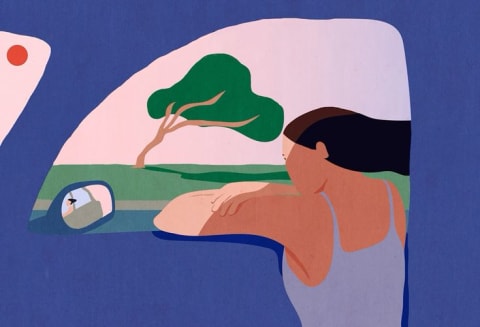
I was walking alone to the beach. It was barely ten o’clock. The ocean lapped softly against the shore and the sand had not yet been trampled by the families who would soon arrive. I’d left my phone in the car. No podcasts, no music, not even a book. Just a rolled-up towel under my arm, a damp swimsuit on, and this strange feeling that I had nothing else to do. I stepped straight into the lively, slightly chilly water in one go. I swam far from the shore until I could no longer sense the presence of the first bathers. There, floating alone in the Atlantic, I felt my body become my own again. A living, peaceful body, surrendered to the salt and the sky.
It’s a joy I rarely experience because I often forget it. It must be said that this joy isn’t exactly encouraged when you’re a woman, a mother or an entrepreneur. We’re taught to be available, visible, useful. To disappear just to breathe more easily? How indecent, how selfish. And yet, I think of Karen Blixen, who wrote with the ocean and her sorrows as her backdrop. To Marguerite Duras, who preferred the sea to everything else because the sea, at least, does not speak. I think of all those women who found in silence, slowness and the salt of the sea the means to rediscover themselves. That morning, in the cold waters of the Vendée and for a handful of stolen minutes, I was nothing to anyone. And perhaps that is why I felt so complete.
Credits: Holly Stapleton
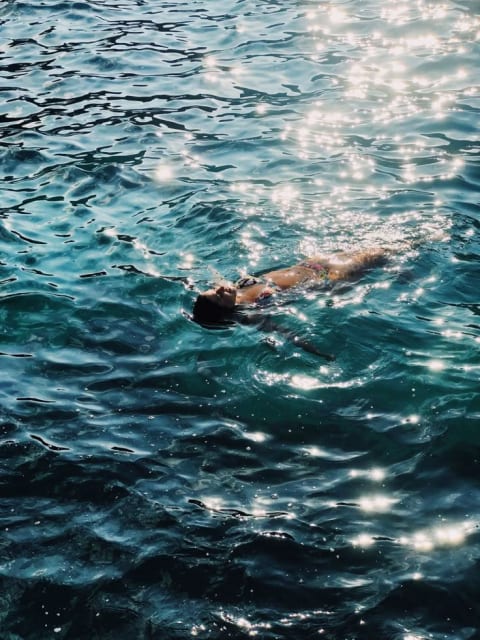
There is a silence unique to summer. It spreads through emptied towns, through the thickening countryside, and through mornings when the streets wait to be inhabited. It is a dense, cottony silence that asks for nothing. We love summer for this, because we convince ourselves that it will finally restore us to ourselves.
In this warm, gentle respite, where schedules ease off and bodies bare themselves, an exhilarating form of joy re-emerges: solitary joy. We recognise it because it is the only kind that does not seek to prove itself. It cannot be captured in a photograph. Solitude is sometimes imposed upon us, but because here it is chosen, it takes us by surprise to reawaken our dormant passions. We are alone and therefore whole, living a time free of pressure, far from the imperious duty to be available.
We live in a civilisation that confuses solitude with isolation, which fears the one and renders the other invisible. A civilisation that overvalues interaction, the collective and exhausting sociability. Hannah Arendt tells us that voluntary solitude is the condition for free thought: it alone grounds us. In this morass, solitary joy is an antidote, a sedative against the noise of the world. Without cutting us off from others, it offers an encounter with ourselves.
In ⟪A Room of One’s Own⟪, Virginia Woolf advocates for the mental space and silence necessary for women’s writing and thought. This room is a place, but also a moment of respite, a rejection of distraction. And it can sometimes take a lifetime to grant oneself this. Summer, however, offers it by way of intrusion: it makes the room possible.
Solitary joy then transforms into an invisible workshop. Neuroscience has shown that moments of chosen solitude stimulate an area of the brain that research refers to as the DMN, the ‘default mode network’, which is activated when we are not engaged in any external activity. It is this area that allows for daydreaming, memories, projections into the future, introspection, creativity and imagination.
The joy of solitude is reading without end or obligation. Walking aimlessly until you’re happily exhausted. Listening to the insects, forgetting about emails, having lunch without speaking, without looking at a screen. Sleeping for two hours in broad daylight, forgetting about your computer, watching others and watching yourself live, too. Our happiest moments are often linked to simple, unplugged and non-commercial activities. Solitary joy, in all its splendour, lies in what impresses no one.
Summer, especially when it puts demands on hold, is fertile ground for the art of joyful solitude. But one must still refrain from filling it up, from seeking to make the most of it. One must remain open, available. Allow oneself boredom just as one allows oneself a painting in the afternoon: without guilt. Reconnect with the spiritual luxury that is rest.
I love the question Mary Oliver poses in her poem The Summer Day : ‘Tell me, what do you plan to do with your wild and precious life? ’ On some days, the answer might be nothing. Nothing more than gazing at the sky, remembering who you are without anyone else’s interference.
To breathe for oneself, and for oneself alone.
Marguerite Yourcenar wrote her finest passages during her silent retreats far from Paris, at Petite Plaisance. For her, solitude was an art of depth. One might think that savouring the benefits of solitary joy means withdrawing from the world. Not quite. It means returning to it in a different way, with a fresh clarity but also a small smile that one keeps within oneself to be self-sufficient. This will allow us, in the manner of Albert Camus and when the monotony of winter sets in, to remember that an invincible summer always remains within us.
To you, the warm, solitary joys; the drifting hours when no one is looking for you. To you, this luxury: to be bound only by the gentleness of time.
Credits: Holly Stapleton

Inès Leonarduzzi is a socio-environmentalist. A few years ago, she founded an NGO that advocates for and promotes digital technology that consumes less energy and is kinder to our brains. She is the author of the essay *Réparer le futur* (Published by Observatoire, 2021) and gives talks in France and abroad on a variety of topics, ranging from the environment to culture, including our new ways of living (together). She occasionally writes poetry. Every month throughout 2025, she invites readers to come together on Aroma-Zone.com to explore the theme of joy, so that we may collectively discover the possibilities for a daily life which, despite its ups and downs, is worth living.


