Guide to essential oils

Essential oil of Pink peppercorn

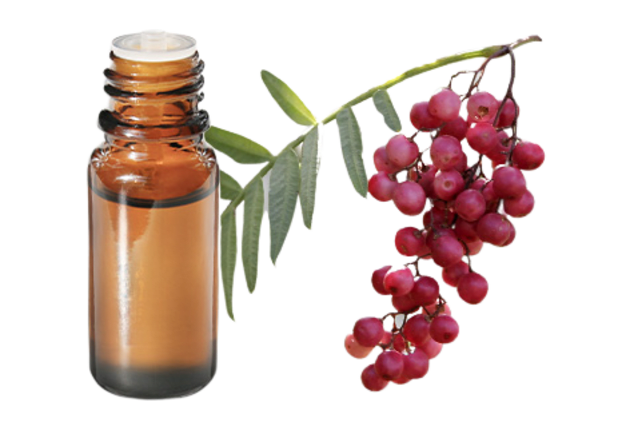
The fresh, spicy notes of pink berry or false pepper essential oil are popular in perfumery. Toning and warming, pink peppercorn essential oil is also good for sporty types: pink peppercorn essential oil helps prepare muscles for exercise and soothes aches and pains.

How to use

  • Skin application and massage

    Skin application and massage

    Appropriate

  • Cosmetic active ingredient

    Cosmetic active ingredient

    Appropriate

  • Aromatherapy bath

    Aromatherapy bath

    Possible but not recommended

  • Diffusion

    Diffusion

    Appropriate

  • Food grade

    Food grade

    Suitable

Features

Properties and uses

Precautions

Find out more

Features

Production process

Complete steam distillation

Part of the plant used

Berries

Botanical name

Schinus molle

Warning

The properties, information and methods of use below are quotes from reference books or websites on aromatherapy, hydrolatherapy and phytotherapy. This general information is provided for informative purposes only and in no way constitutes medical guidance. Under no circumstances can this information be used as a substitute for a medical diagnosis, consultation or follow-up, nor can it incur our liability. We recommend that you consult the guide to essential oils before using them, so that you are aware of any precautions that need to be taken. If in doubt, consult a doctor before using essential oils.

Properties and uses

Pink Peppercorn essential oil is traditionally used for: Arthritis, osteoarthritis, rheumatism, poor digestion, chesty coughs.

Health

Fragrance

Kitchen

Wellness

Find out more

Properties

Pink Peppercorn essential oil is renowned for the following health benefits:

  • Warming and rich in anti-inflammatory compounds, it relieves joint and muscle pain and is good for preparing muscles before sport.

  • Circulatory, it improves blood circulation and helps the kidneys to function properly.

  • Expectorant and antiseptic, it helps relieve colds and coughs.

  • Digestive tonic

  • Antibacterial, studies have shown it to be effective against S. aureus and E. Coli.

  • Blended with other essential oils, it purifies the air in your home.

Uses

It is traditionally used in the following situations:

  • Digestive disorders: bloating, colic, nausea

  • Gastric disorders, intestinal comfort

  • Muscular or joint discomfort:

    • Arthritis, osteoarthritis, rheumatism

    • Aching muscles, tendonitis

  • Preparing muscles for exercise

  • Colds and coughs

  • Air purification

Synergies

Sports preparation: essential oils of American Wintergreen, Lemon Eucalyptus, Black Pepper, Rosemary Camphor, etc.

In practice

Sports comfort: Mix with your oil blend. Apply your mixture locally, massaging lightly into the area concerned.

Precautions

  • Do not use during pregnancy or while breastfeeding, or on children under 6 years of age.

  • This essential oil has a heating effect and may be irritating. Do not use undiluted on the skin. Dilute well in your mixture. Avoid use on the face.

  • For diffusion, do not use undiluted. Dilute this essential oil with other essential oils.

  • Avoid contact with eyes.

  • Keep out of reach of children.

  • Certain natural compounds contained in this essential oil may present a risk of allergy for certain sensitive individuals when the essential oil is incorporated into a cosmetic composition (in accordance with the 7th Amendment of the European Cosmetics Directive (2003/15/EC)): limonene.

  • As a general rule, always test-apply your mixture in the crease of the elbow at least 48 hours before use.

Find out more

Schinus molle, commonly known as "false pepper" (although it is sometimes called "pink pepper", it does not belong to the same family as pepper) is a tree belonging to the Anacardiaceae family native to South America, and probably Peru, given the vernacular names "Peruvian tree" or "Peruvian pepper" attributed to it. Its name comes from the "mulli" given to it by the Incas, which the conquistadors took to mean "molle". The Incas considered it to be a veritable panacea and attributedmany properties to it.

Aromatherapy recipes from the bibliography

EO = Essential Oil VO = Carrier Oil or Macerated Oil

Filet mignon of pork with two peppers and neroli (A. Pataud)

KitchenKitchen

Serves 4:

  • 1 pork tenderloin
  • 3 tablespoons peanut oil
  • 10 cl dry white wine
  • 3 tablespoons soy sauce
  • 3 tablespoons acacia honey
  • Salt
  • 1 drop of pink peppercorn (Schinus terebenthifolius) essential oil
  • 1 drop of black pepper (piper nigrum) essential oil
  • 1 or 2 drops of neroli (citrus aurantiusm var. amara) essential oil to taste

Preparation:

Cut the tenderloin into thick slices. Brown them in a frying pan with the oil and cook the meat over a low heat for 15 minutes on each side. Add salt halfway through cooking.

Drain and keep warm on a serving dish. Deglaze the pan with the white wine, add the acacia honey and soy sauce and simmer for 5 minutes. Add the essential oils and mix well.

Coat the slices of meat with the sauce.

Chef's notes : You can also use veal tenderloin for this recipe, which is a little more expensive but extremely tender.

You can replace the neroli essential oil with a citrus essence.

Tangerine and pink peppercorn ice cream (undinerpresqueparfait.m6.fr)

KitchenKitchen

Serves 5:

  • 500 ml lotion
  • 800 ml cream
  • 8 egg yolks
  • 200 g sugar
  • 1/2 g pink peppercorn essential oil
  • 1.5 g mandarin essential oil

Howto make it:

Whisk the egg yolks with the sugar. Bring the lotion-cream mixture to the boil and pour over the blanched yolks.

Cook like a custard and strain through a fine sieve. Leave to cool. Add the drops of essential oil. Process in an ice-cream maker.

Equivalents

Essential Oils

1 ml = approximately 35 drops (with our Aroma-Zone dropper caps)

Carrier oils

1 pump (Aroma-Zone aluminium pump) = approx. 0.15 ml

Mass / Volume conversion (for a liquid)

Mass (g) = Density x Volume (ml) at 20°C

Further information

1 full teaspoon = between 3 and 4.5 ml

1 full tablespoon = between 7.5 and 10 ml


However, these spoon ratios depend on a number of factors (e.g. viscosity of the liquid, temperature, depth and size of the spoon, rheological behaviour of the liquid), and we strongly advise you to use precise measuring equipment, such as graduated test tubes, graduated pipettes, and precision scales.

Bibliography

1

'L'aromathérapie exactement'

P. Franchomme.

2

Synergistic antibacterial activity of the essential oil of aguaribay (Schinus molle L.).

Mendonça Rocha PM, Rodilla JM, Díez D, Elder H, Guala MS, Silva LA, Pombo EB.

3

Isolation of two triterpenoids and a biflavanone with anti-Inflammatory activity from Schinus molle fruits.

Yueqin Z, Recio MC, Máñez S, Giner RM, Cerdá-Nicolás M, Ríos JL.

4

Chemical composition and anticancer and antioxidant activities of Schinus molle L. and Schinus terebinthifolius Raddi berries essential oils.

Bendaoud H, Romdhane M, Souchard JP, Cazaux S, Bouajila J.

5

www.osmoz.fr

6

www.auparfum.com

7

Healthy and creative recipes. Cooking with essential oils.

Pataud A. Editions Ambre.

8

9