
Guide to essential oils

Essential oil of Myrrh

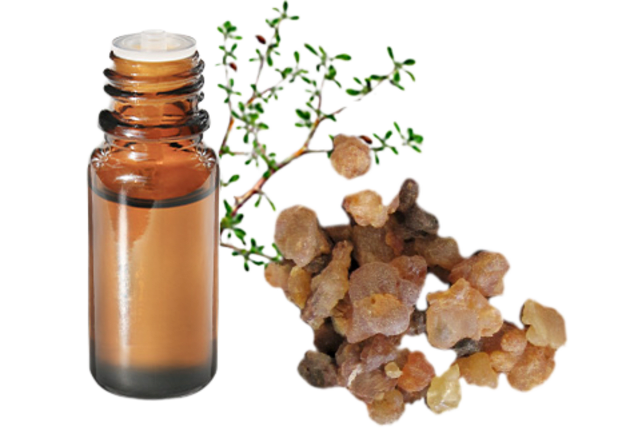
Myrrh essential oil is a mystical oil with a powerful calming and comforting effect on the soul and spirit. Myrrh essential oil has been known since ancient times for its regenerative properties, and can be used in skin care products for sensitive skin. Purifying, Myrrh essential oil is ideal for use in blends for skin problems.

How to use

  • Skin application and massage

    Skin application and massage

    Suitable

  • Aromatherapy bath

    Aromatherapy bath

    Possible but not recommended

  • Diffusion

    Diffusion

    Suitable

  • Food grade

    Food grade

    Possible but not recommended

  • Cosmetic active ingredient

    Cosmetic active ingredient

    Suitable

Features

Properties and uses

Precautions

Find out more

Features

Production process

Complete steam distillation

Part of the plant used

Dried oleoresin gum ("tears")

Botanical name

Commiphora myrrha

Warning

The properties, information and methods of use below are quotes from reference books or websites on aromatherapy, hydrolatherapy and phytotherapy. This general information is provided for informative purposes only and in no way constitutes medical guidance. Under no circumstances can this information be used as a substitute for a medical diagnosis, consultation or follow-up, nor can it incur our liability. We recommend that you consult the guide to essential oils before using them, so that you are aware of any precautions that need to be taken. If in doubt, consult a doctor before using essential oils.

Properties and uses

Myrrh essential oil is traditionally used for: chapped skin, cracks, abrasions, sores, cuts, bedsores, stretch marks and stress.

Health

Beauty

Wellness

Find out more

Properties

Myrrh essential oil is renowned for its health properties:

  • Rich in antiseptic, anti-viral and pest repellent active ingredients.

  • Rich in anti-inflammatory and analgesic active ingredients

  • Powerful healing and skin regenerating properties

  • Helps endocrine regulation (thyroid brake), anaphrodisiac

Uses

It is traditionally used to improve the following situations:

  • Skin conditions: superficial wounds, abscesses, scaly skin, eczema, bedsores, difficult healing

  • Osteoarthritis, joint pain

  • Diarrhoea, dysentery, colitis

  • Gingivitis, stomatitis, mouth ulcers

  • Hyperthyroidism (as a complement)

Synergies

  • Calming: Spike lavender essential oil, etc.

  • Purifying and sanitising: Bay laurel essential oil, etc.

  • Helps regulate endocrine activity :

    Scented Verbena, Rosemary Verbenone essential oils, etc.

In practice

Respiratory comfort: blend into your oil blend. Massage or rub your mixture into the chest and upper back.

Intestinal comfort, sanitising : Mix with your oil blend. Massage or rub your mixture into the abdomen.

Mouthwash: Mix into your mouthwash preparation. Use your mixture as a gargle.

Air purification and purification: Atmospheric diffusion.

Precautions

  • Do not use during pregnancy or while breastfeeding.

  • Keep out of reach of children.

  • Avoid contact with eyes.

  • As a general rule, always test-apply your mixture in the crease of the elbow at least 48 hours before use.

  • For use as a cosmetic ingredient, please refer to the specific precautions.

Find out more

Myrrh has long been used in the same way as frankincense. The Egyptians used it to embalm the dead and it was one of the ingredients in Kyphi, a solid perfume they burned inhonour of the god Ra.

Equivalents

Essential Oils

1 ml = approximately 35 drops (with our Aroma-Zone dropper caps)

Carrier oils

1 pump (Aroma-Zone aluminium pump) = approx. 0.15 ml

Mass / Volume conversion (for a liquid)

Mass (g) = Density x Volume (ml) at 20°C

Further information

1 full teaspoon = between 3 and 4.5 ml

1 full tablespoon = between 7.5 and 10 ml


However, these spoon ratios depend on a number of factors (e.g. viscosity of the liquid, temperature, depth and size of the spoon, rheological behaviour of the liquid), and we strongly advise you to use precise measuring equipment, such as graduated test tubes, graduated pipettes, and precision scales.

Aromatherapy recipes from the bibliography

EO = Essential Oil VO = Carrier Oil or Macerated Oil

Small wound (L. Bosson)

Health & wellbeingSkin problems

  • Cistus ladanifera Essential Oil 2 drops

  • True Lavender Essential Oil 2 drops

  • Myrrh Essential Oil 1 drop

Use: Apply 3 times a day for 4 to 5 days.

Aroma-Zone Note: Clean the wound well with soap and water before applying this mixture.

Stretch mark prevention - Pregnancy and breastfeeding excluded (D. Baudoux)

Health & wellbeingSkin problems

  • Commiphora molmol (Myrrh) essential oil: 1 ml

  • Pelargonium asperum cv Egypt (Rose Geranium): 1 ml

  • Essential oil of Cistus ladaniferus CT pinene (gum rockrose with pinene): 1 ml

  • Essential oil of Helichrysum italicum (Immortelle): 1 ml

  • Essential oil of Melaleuca cajeputii (Cajeput): 1 ml

  • Essential oil of Citrus reticulata (Mandarin): 2 ml

  • Argania spinosa oil (Argan): 5 ml

  • Rosa rubiginosa carrier oil (Chilean rose hip): 15 ml

  • Corylus avellana oil (Hazelnut): 50ml

Use: 1 application morning and evening on at-risk areas.

Aroma-Zone Note: Mandarin essential oil is photosensitising, so do not expose yourself to the sun after applying this blend.

Difficult skin healing, sluggish wounds (Aroma News - NARD)

Health & wellbeingSkin problems

  • Helichrysum italicum essential oil: 0.5 ml

  • Cistus ladaniferus CT pinene (gum rockrose) essential oil: 0.5 ml

  • Lavandula spica (spike lavender) essential oil: 0.5 ml

  • Commiphora molmol (myrrh) essential oil: 0.3 ml

  • Aniba rosaeodora (rosewood) essential oil: 0.2 ml

  • Argan carrier oil: 5 ml

  • Evening primrose carrier oil: 5 ml

  • Wheatgerm carrier oil: add up to 15 ml extra as required for product optimisation

Use: 3 topical applications per day

Pressure sores and other bed sores (under medical supervision) (Aroma News - NARD)

Health & wellbeingSkin problems

  • Helichrysum italicum essential oil: 3 ml

  • Cupressus sempervirens (cypress) essential oil: 2 ml

  • Cistus ladaniferus CT pinene (gum rockrose) essential oil: 3 ml

  • Pistacia lentiscus (mastic tree) essential oil: 3 ml

  • Laurus nobilis (bay laurel) essential oil: 3 ml

  • Commiphora molmol (myrrh) essential oil: 5 ml

  • Tanacetum annuum (blue tansy) essential oil: 2 ml

  • Lavandula spica (spike lavender) essential oil: 10 ml

  • Argan carrier oil: 50 ml

  • Evening primrose carrier oil: 50 ml

  • Thyme or chestnut honey: 100 g

  • Green clay: 570 g

  • Wheatgerm carrier oil: between 180 and 250 ml to obtain a paste of the ideal consistency

Use: 1 topical application morning and evening, cover with an occlusive dressing

Before each new application, cleanse to remove any remnants of the previous application. Keep the mixture in a cool place (fridge door)

.

Skin ulcers (on medical advice) (Aroma News - NARD)

Health & wellbeingSkin problems

  • Commiphora Molmol (Myrrh) Essential oil: 1 ml

  • Lavandula Latifolia Spica (Spike Lavender) Essential oil: 1 ml

  • Helichrysum Italicum (helichrysum) Essential oil: 1 ml

  • Lentiscus Pistacia (Mastic tree) Essential oil: 1 ml

  • Calophyllum Inophylum (Calophylla) oil: 5 ml

  • Hypericum Perforatum (St John's wort) oil: 5 ml

  • Shea butter: add to make up to 100 g

Use: Apply 3 times a day to the ulcer until healed.

Aphthosis, gingivitis, periodontal disease in children (over 6 years and on medical advice) (D. Baudoux)

Health & wellbeingChildren's medical care

  • Lavandula latifolia Spica (spike lavender) essential oil: 0.3 ml

  • Myrtus communis ct cineole (cineole myrtle) essential oil: 0.3 ml

  • Commiphora molmol (myrrh) essential oil: 0. 1 ml

  • Laurus nobilis (bay laurel) essential oil: 0.3 ml

  • Melaleuca alternifolia (tea tree) essential oil: 0.3 ml

  • HV St John's wort carrier oil: 0.5 ml

  • Argan carrier oil: 1 ml

  • 2% carbomer gel: add up to 30 ml extra as required for product optimisation (it is possible to substitute the carbomer gel with an aqueous gel containing 1.5% xanthan gum).

Use: Apply a small amount of gel locally three to four times a day until healed.

Contact eczema (D. Baudoux)

Health & wellbeingSkin problems

  • Immortelle essential oil: 0.5 ml

  • True Lavender essential oil: 0.5 ml

  • Roman chamomile essential oil: 0.3 ml

  • Myrrh essential oil: 0.2 ml

  • Tamanu carrier oil: 5 ml

  • Argan oil: 15 ml

Use: 4 local applications a day until complete improvement.

Psoriasis in adults and children (over 6 years and on medical advice) (D. Baudoux)

Health & wellbeingSkin problems

Solid form (gel)

  • Spikenard essential oil: 0.5 ml

  • Myrrh essential oil: 1 ml

  • Palmarosa essential oil: 1 ml

  • Roman chamomile essential oil: 1 ml

  • Cineole myrtle essential oil: 1 ml

  • Blue tansy: 0.5 ml

  • Rosemary verbenone: 0.5 ml

  • tamanu oil: 3 ml

  • Argan oil: 3 ml

  • 2% Carbomer gel: add up to 100 ml extra as required for product optimisation

Aroma-Zone comment: Carbomer gel can be replaced by a plant-based gel made from guar gum or tragacanth gum.

Quantity: 1 local application 3 times a day for 3 weeks or more.

Abscesses, boils and carbuncles in children (over 6 years and on medical advice) (D. Baudoux)

Health & wellbeingChildren's medical care

  • Eugenia caryophyllus essential oil (Clove): 0.5 ml

  • Commiphora Molmol essential oil (Myrrh): 0.5 ml

  • Laurus Nobilis essential oil (Bay Laurel): 1 ml

  • Melaleuca Alternifolia essential oil (tea tree): 3 ml

  • tamanu oil: additional 10 ml

Directions for use: 5 local applications of one or two drops a day for 7 days.

Diarrhoea in adults (Aroma News - NARD)

Health & wellbeingDigestive problems

  • Melaleuca Alternifolia essential oil (tea tree): 2 ml

  • Laurus Nobilis (Bay Laurel) essential oil: 2 ml

  • Artemisia Draculuncus (Tarragon) essential oil: 1 ml

  • Commiphora Molmol (Myrrh) essential oil: 1 ml

  • Mentha Piperita (Peppermint) essential oil: 1 ml

  • Hazelnut carrier oil: Top up to 15 ml

Use : 8 drops massaged into the abdomen 4 to 6 times a day for 3 to 4 days and 6 drops under the tongue 4 times a day for 5 days.

Dry eczema in children (over 6 years and on medical advice) (D. Baudoux)

Health & wellbeingChildren's medical care

Liquid form (oily)

  • Rose Egyptian geranium Essential Oil: 1.5 ml

  • Spike lavender essential oil: 1.5 ml

  • Rosewood essential oil: 0.3 ml

  • Myrrh essential oil: 0.3 ml

  • Annual Tansy essential oil: 0.3 ml

  • Wheat Germ Oil: 10 ml

  • tamanu oil: 5 ml

  • Evening primrose oil: add to make up to 50ml

Use: 1 topical application 3 times a day for 3 weeks or more.

Bibliography

1

'Huiles essentielles - 2000 ans de découvertes aromathérapeutiques pour une médecine d'avenir'

Dominique Baudoux

2

'Aromathérapie' Éditions Maloine

Dr Jean Valnet

3

'L'aromathérapie exactement'

P. Franchomme and Dr D. Pénoël

4

'La bible de l'aromathérapie'

Nerys Purchon

5

'L'ABC des huiles essentielles'

Dr Telphon

6

'Aromatherapy'

Nelly Grosjean

7

'Les huiles essentielles pour votre santé'

G. Roulier

8

"Les cahiers pratiques de l'aromathérapie française - Paediatrics" - Editions Amyris

Dominique Baudoux

9

Aroma-News newsletters

NARD Association

10

"L'aromathérapie - Se soigner par les huiles essentielles" - Editions Amyris

Dominique Baudoux