

Guide to essential oils

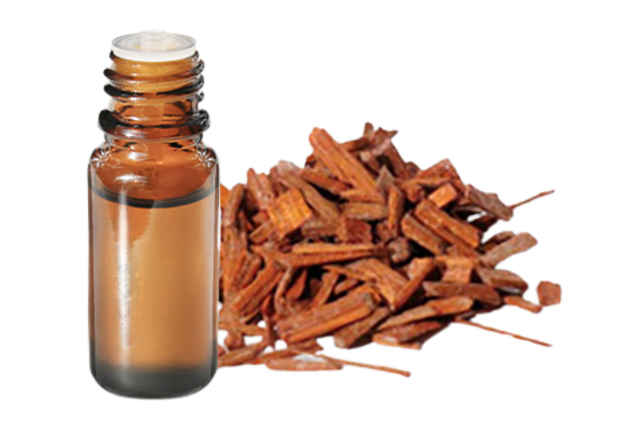
Essential oil of Indian sandalwood

White sandalwood essential oil has a sweet, woody fragrance renowned for soothing the mind. Spicy white sandalwood essential oil also has aphrodisiac properties. This premium regenerating white sandalwood essential oil is used in formulas for mature and sensitive skin. Purifying white sandalwood essential oil is ideal for skin that suffers from blemishes.

How to use

  • Skin application and massage

    Skin application and massage

    Suitable

  • Aromatherapy bath

    Aromatherapy bath

    Appropriate

  • Diffusion

    Diffusion

    Appropriate

  • Cosmetic active ingredient

    Cosmetic active ingredient

    Suitable

  • Food grade

    Food grade

    Possible but not recommended

Features

Properties and uses

Precautions

Find out more

Features

Production process

Complete distillation by low-pressure steam distillation

Part of the plant used

Wood

Botanical name

Santalum album

Warning

The properties, information and methods of use below are quotes from reference books or websites on aromatherapy, hydrolatherapy and phytotherapy. This general information is provided for informative purposes only and in no way constitutes medical guidance. Under no circumstances can this information be used as a substitute for a medical diagnosis, consultation or follow-up, nor can it incur our liability. We recommend that you consult the guide to essential oils before using them, so that you are aware of any precautions that need to be taken. If in doubt, consult a doctor before using essential oils.

Properties and uses

Indian sandalwood essential oil is traditionally used for: Quitting smoking, wrinkles, fine lines, low libido, haemorrhoids, urinary tract infections, heavy legs and varicose veins.

Health

Beauty

Wellness

Find out more

Properties

White sandalwood essential oil is recognised for its health benefits:

  • Lymphatic and venous decongestant

  • Cleansing and purifying for the lungs, genitals and urinary tract

  • Tonic

  • Expectorant

  • Helps relieve pain

  • Antispasmodic

Uses

As a complement to other treatments, it is traditionally used in the following cases:

  • Circulatory disorders: Varicose veins, haemorrhoids

  • Urinary tract infections: cystitis, prostatitis

  • Respiratory infections: bBronchitis, dry coughs

  • Pain and inflammation: Rheumatism, sciatica, lumbago

  • Physical and cardiac fatigue

In practice

Joint and venous comfort: mix into your oil blend. Gently massage the mixture into the affected areas.

Precautions

  • Not recommended during the first 3 months of pregnancy.

  • Use with caution for short periods and in small quantities.

  • Possible effect on the pituitary gland, not recommended in the case of hormone-dependent cancer, and should be considered with caution by those with any related pathology or hormone treatment.

  • Keep out of reach of children.

  • Avoid contact with eyes.

  • As a general rule, always test your product in the crease of the elbow at least 48 hours before use.

Find out more

Native to India, the white sandalwood is a small parasitic tree that feeds off the roots of its neighbours. Reputed to heighten spirituality, it is burnt to encourage meditation in Buddhist shrines. It has long been used as the wood for carved temple doors as it wards off woodworm and is mould-resistant, while giving sacred places an enchanting scent.

Aromatherapy recipes from the bibliography

EO = Essential Oil VO = Carrier Oil or Macerated Oil

Stopping smoking (A. Maillard)

Health & wellbeingNerve pain and disorders

Olfactory use: Aroma-Zone tip for how to stop smoking Make a 10 ml tinted glass bottle fitted with a dropper.

  • 1.5 ml Sandalwood essential oil, Indian sandalwood
  • 0.5 ml frankincense essential oil, Boswelia carterii
  • 0.5 ml menthol eucalyptus essential oil, Eucalyptus dives
  • 0.5 ml or 10 to 15 drops of peppermint essential oil, Mentha x piperita
  • 7 ml apricot kernel oil

Every time you experience the compulsion: 1 drop on the inside of the wrists, breathe in deeply 5 times in succession. Repeat 6 to 8 times a day throughout the withdrawal period

CONTRAINDICATIONS: People with cardiac and/or hypertensive issues, people with epilepsy, pregnant and breastfeeding women Extract from the book 'Le grand guide de l'aromathérapie et des soins beauté naturels', by Aude Maillard and Aroma-Zone, published by J'ai Lu, 2016

Cystitis (urinary tract infections) in adults (N. Purchon)

Health & wellbeingGynaecological issues

  • 6 drops bergamot essential oil
  • 3 drops Roman chamomile essential oil
  • 3 drops narrow-leaved eucalyptus essential oil
  • 4 drops sandalwood or parsley essential oil
  • 1 tbsp. grape seed oil

Uses: - For a massage, heat 1/2 teaspoon of product. Massage into the sensitive area around the bladder

Aroma-Zone note: Mandarin essential oil is photosensitising, so do not expose yourself to the sun after applying this blend. Choose furocoumarin-free bergamot essential oil, which is not phototoxic.

- For a bath, pour 2 tablespoons of product into hot water. Soak in the bath for 10 minutes.

Urinary tract infections (J-P. Willem)

Health & wellbeingUrinary issues

  • True lavender essential oil
  • White sandalwood essential oil

Use: 4 drops in honey, 3 times a day.

Equivalents

Essential Oils

1 ml = approximately 35 drops (with our Aroma-Zone dropper caps)

Carrier oils

1 pump (Aroma-Zone aluminium pump) = approx. 0.15 ml

Mass / Volume conversion (for a liquid)

Mass (g) = Density x Volume (ml) at 20°C

Further information

1 full teaspoon = between 3 and 4.5 ml

1 full tablespoon = between 7.5 and 10 ml


However, these spoon ratios depend on a number of factors (e.g. viscosity of the liquid, temperature, depth and size of the spoon, rheological behaviour of the liquid), and we strongly advise you to use precise measuring equipment, such as graduated test tubes, graduated pipettes, and precision scales.

Bibliography

1

'Huiles essentielles - 2000 ans de découvertes aromathérapeutiques pour une médecine d'avenir'

Dominique Baudoux

2

'Aromathérapie' Éditions Maloine

Dr Jean Valnet

3

'L'aromathérapie exactement'

P. Franchomme and Dr D. Pénoël

4

'La bible de l'aromathérapie'

Nerys Purchon

5

'L'ABC des huiles essentielles'

Dr Telphon

6

'Aromatherapy'

Nelly Grosjean

7

'Les huiles essentielles pour votre santé'

G. Roulier

8

'Les cahiers pratiques de l'aromathérapie française - Dermatologie' - Editions Amyris

Dominique Baudoux

9

Aroma-News newsletters from the NARD association

10

'L'aromathérapie - Se soigner par les huiles essentielles' - Editions Amyris

Dominique Baudoux

11

'L'aromathérapie énergétique ; guérir avec l'âme des plantes' - Editions Amyris

Lydia Bosson