
Guide to essential oils

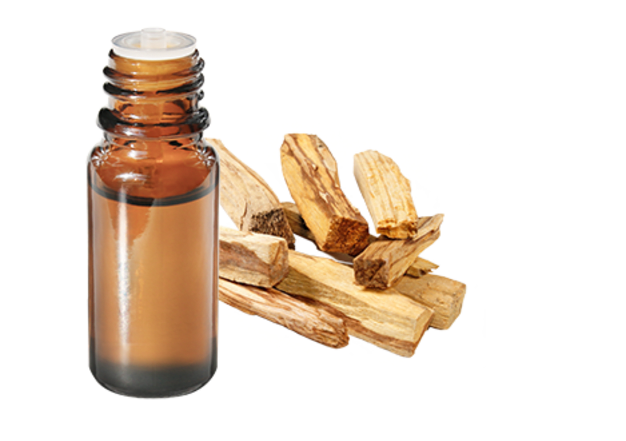
Essential oil of Palo Santo

Palo Santo essential oil is traditionally used in energising aromatherapy for its soothing, relaxing properties. On a psychological-emotional level, Palo Santo essential oil is reputed to boost self-esteem and promote a feeling of safety. Purifying, it is also sought after for cleansing the air and driving negative energies out of the home.

How to use

  • Apply to the skin and massage (always diluted in a carrier oil).

    Apply to the skin and massage (always diluted in a carrier oil).

    Suitable

  • Cosmetic active ingredient

    Cosmetic active ingredient

  • Diffusion

    Diffusion

    Suitable

  • Olfactory use

    Olfactory use

    Suitable

  • Food grade

  • Aromatherapy bath

    Aromatherapy bath

    Appropriate

Features

Properties and uses

Precautions

Find out more

Features

Production process

Complete steam distillation

Part of the plant used

Wood

Botanical name

Bursera graveolens

Warning

The properties, information and methods of use below are quotes from reference books or websites on aromatherapy, hydrolatherapy and phytotherapy. This general information is provided for informative purposes only and in no way constitutes medical guidance. Under no circumstances can this information be used as a substitute for a medical diagnosis, consultation or follow-up, nor can it incur our liability. We recommend that you consult the guide to essential oils before using them, so that you are aware of any precautions that need to be taken. If in doubt, consult a doctor before using essential oils.

Properties and uses

Palo santo essential oil is traditionally used for:

Wellness

Find out more

Properties

In wellness, Palo Santo essential oil is traditionally used to:

  • soothe nervous tension and promote relaxation

  • Help to take a step back, clarify the mind and ground oneself in the present moment

  • purify the atmosphere, ward off bad energy and disperse negative or 'heavy' energy in the home

  • Develop a sense of joy and restore self-confidence

  • to encourage creativity

Uses

  • Panic attacks, anxiety

  • Inability to concentrate, stress

  • Depression, low morale

  • Meditation, relaxation

In practice

Diffusion: A few drops combined with a few drops of another essential oil, such as Fine lavender, bergamot or Corsican clementine.

Precautions

  • Essential oils are sensitive to UV radiation and to the gradual evaporation of their constituents. It is therefore essential to store your essential oils in a sealed glass or aluminium bottle at a temperature between 5°C and 30°C.

  • Do not use during pregnancy, while breastfeeding or on children under the age of 3.

  • Irritating to the skin in its pure state, always use well diluted on the skin. Use with caution, especially on sensitive or allergic skin.

  • Keep out of reach of children Some natural compounds in this essential oil may present an allergy risk for sensitive individuals when the oil is incorporated into a cosmetic composition (in accordance with the 7th Amendment to the European Cosmetics Directive (2003/15/EC)): limonene, linalool, etc.

  • As a general rule, always perform a patch test of your mixture in the crease of your elbow at least 48 hours before use.

  • Dangerous. Observe the precautions for use.

  • Causes skin irritation (in pure form). May cause skin allergy. May be fatal if swallowed and enters the respiratory tract (if accidentally swallowed, do not induce vomiting). Very toxic to aquatic life , causes long-term adverse effects.

Find out more

The Bursera Graveolens tree, better known as the Palo Santo, is native to tropical America, and is found naturally in the region stretching from Mexico to Peru. Preferring sandy soils, this tree can grow between 3 to 15 metres tall and features clustered leaves at the ends of its branches, along with small white to pale yellow flowers.

Equivalents

Essential Oils

1 ml = approximately 35 drops (with our Aroma-Zone dropper caps)

Carrier oils

1 pump (Aroma-Zone aluminium pump) = approx. 0.15 ml

Mass / Volume conversion (for a liquid)

Mass (g) = Density x Volume (ml) at 20°C

Further information

1 full teaspoon = between 3 and 4.5 ml

1 full tablespoon = between 7.5 and 10 ml


However, these spoon ratios depend on a number of factors (e.g. viscosity of the liquid, temperature, depth and size of the spoon, rheological behaviour of the liquid), and we strongly advise you to use precise measuring equipment, such as graduated test tubes, graduated pipettes, and precision scales.

Bibliography

1

'Grandir avec les huiles essentielles'

Lydia Bosson

2

Monzote, L., Hill, G. M., Cuellar, A., Scull, R. & Setzer, W. N.

Natural Product Communications 7, 1934578X1200701 (2012).

3

Mendez, A. H. S., Cornejo, C. G. F., Antimicrobial and Antioxidant Activities From Perú.

IJPER 51, s429-s436 (2017).

4

Young, D. G., Chao, S., Casablanca, H., Bertrand, M.-C. & Minga,

Journal of Essential Oil Research 19, 525–526 (2007).

5

Pytel, K., Marcinkowska, R. & Zabiegała, B. Investigation on air quality of specific indoor environments.

Environ Sci Pollut Res 28, 59214–59232 (2021).

6

Zúñiga, B. et al. Chemical Composition and Anti-Inflammatory Activity

Planta med 71, 825-828 (2005).

7

Jaramillo-Colorado, B. E., Suarez-López, S. & Marrugo-Santander, V. Volatile chemical composition

Acta Sci. Biol. Sci. 41, e46822 (2019).

8

Tene, V. et al. An ethnobotanical survey of medicinal plants used in Loja and Zamora-Chinchipe,

Ecuador. Journal of Ethnopharmacology 111, 63–81 (2007).

9

Weintraub, B. et al.

Article on History of Chemistry.

10

Carrión-Paladines, V., Fries, A., Caballero, R. E., Pérez Daniëls, P. & García-Ruiz, R. Biodegradation of Residues from the Palo Santo

Ecuador. Fermentation 5, 76 (2019).

11

Yukawa, C., Iwabuchi, H., Komemushi, S. & Sawabe, A. Eudesmane-Type Sesquiterpenoids in the Volatile Oil from Bursera graveolens.

J. Oleo Sci. 53, 343–348 (2004).