

Guide to essential oils

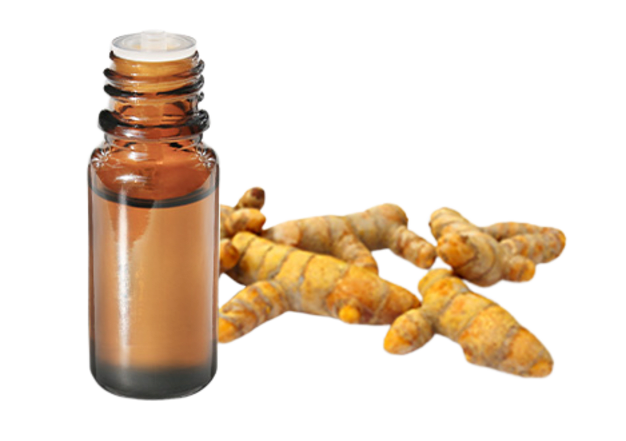
Essential oil of Turmeric

Rich in turmerones with antioxidant properties, Turmeric essential oil is useful for slowing skin ageing. With its delicately powdery scent, Turmeric essential oil is ideal for adding an anti-ageing effect to your skincare products.

How to use

  • Skin application and massage

    Skin application and massage

    Suitable

  • Cosmetic active ingredient

    Cosmetic active ingredient

    Suitable

  • Aromatherapy bath

    Aromatherapy bath

    Possible but not recommended

  • Diffusion

    Diffusion

    Possible but not recommended

  • Food grade

    Food grade

    Appropriate

Features

Properties and uses

Precautions

Find out more

Features

Production process

Complete steam distillation

Part of the plant used

Rhizomes

Botanical name

Curcuma longa

Warning

The properties, information and methods of use below are quotes from reference books or websites on aromatherapy, hydrolatherapy and phytotherapy. This general information is provided for informative purposes only and in no way constitutes medical guidance. Under no circumstances can this information be used as a substitute for a medical diagnosis, consultation or follow-up, nor can it incur our liability. We recommend that you consult the guide to essential oils before using them, so that you are aware of any precautions that need to be taken. If in doubt, consult a doctor before using essential oils.

Properties and uses

Turmeric Essential Oil is traditionally used for: Aerophagia, bloating and flatulence, wrinkles and fine lines, difficult digestion

Health

Beauty

Wellness

Kitchen

Find out more

Properties

For health, Turmeric essential oil is recognised for the following properties:

  • Aids digestion and stimulates bile secretion.

  • Helps reduce the formation of intestinal gas.

  • Anti-parasitic and anti-fungal

  • Vermifuge, active against intestinal worms (roundworms, pinworms, etc.).

  • An antibacterial agent, studies have shown its action against Staphylococcus aureus and Listeria monocytogenes.

Uses

It is traditionally used to improve the following:

  • Digestive disorders:

    • Digestive and hepatobiliary disorders

    • Aerophagia, intestinal gas

    • Colitis

    • Intestinal worms

    • Colon disorders

  • Essential oil useful in combating Methicillin-resistant Staphylococcus aureus (common in hospital-acquired infections)

  • Ringworm

  • Mycosis

  • Warts

Synergies

  • Intestinal cleansing: Thyme Thujanol and Garlic essential oils

  • Digestive action: Anise, Fennel, Tropical Basil essential oils

  • Urinary cleansing: Rosewood, Thyme Thujanol essential oils

  • Purifying: tea tree, Manuka, Palmarosa, Laurel essential oils

In practice

Digestive well-being: Mix with your oil blends. Massage or rub your mixture into the abdomen.

Precautions

  • Not for use in pregnancy or while breast-feeding, for children under 6 or people suffering from epilepsy (due to its concentration of turmerones, potentially abortifacient and neurotoxic compounds).

  • Use in small doses over limited periods.

  • May interact with anti-diabetic drugs; ask your doctor for advice on internal use.

  • May have an anti-oestrogenic effect, particularly in the case of hormone treatment.

  • Keep out of reach of children.

  • Avoid contact with eyes.

  • A natural compound contained in this essential oil may present a risk of allergy for some sensitive individuals when the essential oil is incorporated into a cosmetic composition (in accordance with the 7th Amendment to the European Cosmetics Directive (2003/15/EC)): limonene.

  • As a general rule, always carry out a test application of your mixture in the crease of the elbow at least 48 hours before using it.

Find out more

Turmeric is a plant with rhizomes in the ginger family. Initially used as a colouring agent for the golden yellow dye it produced, it later proved to be a food preservative. It is for these properties that it is found in all Indian curries.

Traditionally, turmeric has many applications in Ayurvedic medicine:

Equivalents

Essential Oils

1 ml = approximately 35 drops (with our Aroma-Zone dropper caps)

Carrier oils

1 pump (Aroma-Zone aluminium pump) = approx. 0.15 ml

Mass / Volume conversion (for a liquid)

Mass (g) = Density x Volume (ml) at 20°C

Further information

1 full teaspoon = between 3 and 4.5 ml

1 full tablespoon = between 7.5 and 10 ml


However, these spoon ratios depend on a number of factors (e.g. viscosity of the liquid, temperature, depth and size of the spoon, rheological behaviour of the liquid), and we strongly advise you to use precise measuring equipment, such as graduated test tubes, graduated pipettes, and precision scales.

Aromatherapy recipes from the bibliography

EO = Essential Oil VO = Carrier Oil or Macerated Oil

Marinade for white fish (D. Festy)

Kitchen

Make an aromatic marinade for white fish by mixing 3 spoonfuls of olive oil, 1 drop of thyme essential oil, 1 drop of lemon (or sweet orange or grapefruit) essential oil, 1 drop of ylang-ylang essential oil - ylang-ylang or turmeric**.**.

Cooking ideas with turmeric essential oil (P. De Lomas)

Kitchen

Like turmeric powder, turmeric essential oil has a peppery, musky, sweet aroma. Adding 2 or 3 drops of this essential oil to the following dishes will enhance their flavour and replace salt:

  • Seafood specialities (prawns, crab recipes, mussels, cockles, etc.)

  • Potatoes (mashed)

  • In combination with lime

  • Yellow fruit jams (mirabelle plums, apricots, etc.)

  • Pancakes and rum cakes

  • Rice pudding

  • Madeleines

Chef's tip: To enhance the flavour of your turmeric powder, add a drop of essential oil to the bottle.

Bibliography

1

Review article: Turmeric

S.Loap.

2

Review article: Turmeric

S.Loap

3

Volatile oil constituents of the fresh rhizomes of Curcuma

MUSTAFA Akhlaq; ALI Mohd; NAJM ZAHEER KHAN

4

Antimicrobial effect of Thai spices against Listeria monocytogenes and Salmonella typhimurium

Thongson C, Davidson PM, Mahakarnchanakul W, Vibulsresth P.

5

Antifungal activity of turmeric oil extracted from Curcuma longa

Apisariyakul A, Vanittanakom N, Buddhasukh D.

6

Antibacterial activity of Curcuma longa rhizome extract on pathogenic CURRENT SCIENCE

Rambir Singh†, Ramesh Chandra†, Mridula Bose# and Pratibha Mehta Luthra†,

7

Antioxidant activities of essential oil of Curcuma longa and Curcuma wenyujin. International Journal of Essential Oil Therapeutics

Kim KJ, Yu HH, Cha JD, Seo SJ, Choi NY, You YO. Antibacterial activity of Curcuma longa L. against methicillin-resistant Staphylococcus aureus. Phytother Res. 2005 Jul;19(7):599-604. Li.S.Y, Li S-P.

8

Supplier bibliography

9

Mes petites recettes magiques aux huiles essentielles, Editions Leduc

D. Festy (2011)

10

Mes petites recettes magiques au curcuma, Editions Leduc

P. De Lomas (2011)

11

12