
Guide to essential oils

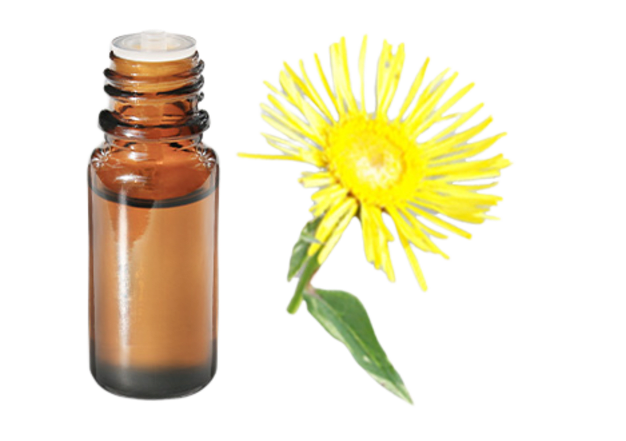
Essential oil of Sweet inula

Known for its powerful benefits for the respiratory system, Sweet Inula essential oil is traditionally used for respiratory discomfort. Calming and purifying, Sweet Inula essential oil is perfect for winter illnesses.

How to use

  • Skin application and massage

    Skin application and massage

    Suitable

  • Cosmetic active ingredient

    Cosmetic active ingredient

  • Diffusion

    Diffusion

    Possible but not recommended

  • Aromatherapy bath

    Aromatherapy bath

    Possible but not recommended

Features

Properties and uses

Precautions

Find out more

Features

Production process

Complete steam distillation

Part of the plant used

Flowering tops

Botanical name

Inula graveolens

Warning

The properties, information and methods of use below are quotes from reference books or websites on aromatherapy, hydrolatherapy and phytotherapy. This general information is provided for informative purposes only and in no way constitutes medical guidance. Under no circumstances can this information be used as a substitute for a medical diagnosis, consultation or follow-up, nor can it incur our liability. We recommend that you consult the guide to essential oils before using them, so that you are aware of any precautions that need to be taken. If in doubt, consult a doctor before using essential oils.

Properties and uses

Fragrant Inula essential oil is traditionally used for: Bronchitis, laryngitis, pharyngitis, chesty coughs

Health

Find out more

Properties

In the field of health, Sweet Inula essential oil is recognised for its properties:

  • Mucolytic and powerful anti-catarrhal

  • Antispasmodic, antitussive

  • Traditionally reputed as a cardiac regulator and tonic

  • Rich in borneol, which has antibacterial and antiseptic properties

  • Rich in borneol and bornyl acetate, which have been shown to have anti-inflammatory effects

Uses

It is traditionally used for the following conditions:

  • Chronic bronchitis, rhino-pharyngo-tonsillitis, spasmodic coughs, laryngitis, tracheitis, etc.

  • Secretory asthma

  • Helps with heart rhythm disorders (under medical supervision)

In practice

Respiratory comfort: Mix in your oil blend. Massage or rub your blend into the chest and upper back.

Precautions

  • Very powerful essential oil, use in moderation.

  • Do not use during during pregnancy and breastfeeding.

  • For external use only.

  • Allergic sensitisation possible.

  • Keep out of reach of children.

  • Certain natural compounds contained in this essential oil may present a risk of allergy in certain sensitive individuals when the essential oil is incorporated into a cosmetic composition (in accordance with the 7th Amendment of the European Cosmetics Directive (2003/15/EC)): limonene.

  • As a general rule, always carry out a test application of your mixture, in the crease of the elbow, at least 48 hours before use.

  • Hazardous. Observe safety precautions.

  • May be fatal if swallowed or if it enters the respiratory tract (if accidentally swallowed, do not induce vomiting). Harmful to aquatic organisms, causing long-term adverse effects (in the event of massive spillage of the product into a watercourse).

Find out more

There are several hundred species of inula. They belong to the Asteraceae family , formerly known as "Compositae", because of the appearance of their flowers , which are always yellow. One of them, thesweet inula, also known as the sticky inula, can grow up to 1.50 metres tall. It is a hardy perennial that will flower again every year in autumn. This aromatic plant was cultivated and harvested by monks for its medicinal properties.

Due to its composition, it is traditionally recognised for its very powerful effects on therespiratory system:

Aromatherapy recipes from the bibliography

EO = Essential Oil VO = Carrier Oil or Macerated Oil

Bronchitis (chesty cough) (D. Festy)

Health & wellbeingRespiratory problems

  • 1 drop of Red Myrtle essential oil
  • 1 drop Ravintsara essential oil
  • 1 drop of Sweet Inula essential oil
  • 3 drops of Calophylla oil

Use: Massage the chest and back with this mixture 4 times a day for 10 days.

Bronchitis (prevention - children over 6 and on medical advice) (D. Festy)

Health & wellbeingChildren's medical care

  • 1 drop Thujanol Thyme essential oil
  • 1 drop Ravintsara essential oil
  • 1 drop of Sweet Inula essential oil
  • 1 drop Rosewood essential oil
  • 4 drops Sweet Almond oil

Use: Massage the chest, back and arch of the foot with the mixture, morning and evening for one week.

Sinusitis in children (over 6 years and on medical advice) (D. Baudoux)

Health & wellbeingChildren's care

  • 1 ml Eucalyptus dives Essential Oil (menthol eucalyptus)
  • 1 ml Melaleuca alternifolia essential oil (tea tree)
  • 0.5 ml Inula graveolens essential oil (sweet inula)
  • 1 ml Aniba rosaeodora essential oil (Rosewood)
  • 1 ml Myrtus communis CT cineole essential oil (Green Myrtle)
  • Top up with 15 ml Jojoba oil as a carrier oil

Use: Apply 3 drops of the mixture to the forehead 4 to 5 times a day for 7 days, taking care not to get any in the eyes.

Chesty cough in children (over 6 years and on medical advice) (D. Baudoux)

Health & wellbeingChildren's medical care

  • 1 ml Melaleuca quinquenervia cineole essential oil (niaouli cineole)
  • 0.5 ml Inula graveolens essential oil (sweet inula)
  • 3 ml Myrtus communis cineole essential oil (Cineole Myrtle)
  • 2 ml of Cinnamomum camphora (Ravintsara) essential oil
  • 3 ml hazelnut oil
  • Supplement with 15 ml Jojoba oil

Use: Apply 5 to 6 drops of the mixture to the back in the morning and at midday and to the chest in the evening for 3 to 4 days.

Equivalents

Essential Oils

1 ml = approximately 35 drops (with our Aroma-Zone dropper caps)

Carrier oils

1 pump (Aroma-Zone aluminium pump) = approx. 0.15 ml

Mass / Volume conversion (for a liquid)

Mass (g) = Density x Volume (ml) at 20°C

Further information

1 full teaspoon = between 3 and 4.5 ml

1 full tablespoon = between 7.5 and 10 ml


However, these spoon ratios depend on a number of factors (e.g. viscosity of the liquid, temperature, depth and size of the spoon, rheological behaviour of the liquid), and we strongly advise you to use precise measuring equipment, such as graduated test tubes, graduated pipettes, and precision scales.

Bibliography

1

"Essential oils - 2,000 years of aromatherapeutic discoveries for a medicine of the future".

Dominique Baudoux

2

"Aromatherapy"

Dr Jean Valnet - Éditions Maloine

3

"L'Aromathérapie exactement"

P. Franchomme and Dr D. Pénoël

4

"The Aromatherapy Bible"

Nerys Purchon

5

"ABC des huiles essentielles"

Dr Telphon

6

"Aromatherapy"

Nelly Grosjean

7

"Essential oils for your health"

G. Roulier

8

'Les cahiers pratiques de l'aromathérapie française - Pédiatrie'

Dominique Baudoux

9

Aroma-News newsletters

NARD Association

10

'Aromatherapy - Healing with essential oils'

Dominique Baudoux