
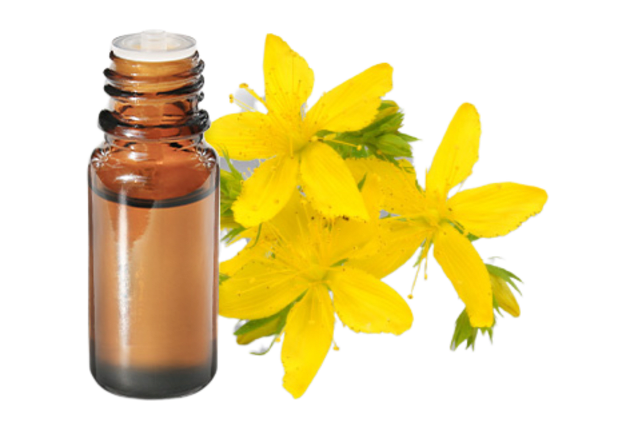
Guide to essential oils

Essential oil of St. John's Wort

Powerfully soothing, St John's wort essential oil is recommended by aromatherapists as a natural support for inflammatory or traumatic problems. As a repairing agent, St John's wort essential oil is reputed to reduce the appearance of stretch marks. St John's wort essential oil is also beneficial for sleep disorders.

How to use

  • Skin application and massage

    Skin application and massage

    Suitable

  • Cosmetic active ingredient

    Cosmetic active ingredient

    Possible but not recommended

  • Aromatherapy bath

    Aromatherapy bath

    Possible but not recommended

  • Diffusion

    Diffusion

  • Food grade

    Food grade

    Appropriate

Features

Properties and uses

Precautions

Find out more

Features

Production process

Complete steam distillation

Part of the plant used

Flowering tops

Botanical name

Hypericum perforatum

Warning

The properties, information and methods of use below are quotes from reference books or websites on aromatherapy, hydrolatherapy and phytotherapy. This general information is provided for informative purposes only and in no way constitutes medical guidance. Under no circumstances can this information be used as a substitute for a medical diagnosis, consultation or follow-up, nor can it incur our liability. We recommend that you consult the guide to essential oils before using them, so that you are aware of any precautions that need to be taken. If in doubt, consult a doctor before using essential oils.

Properties and uses

St John's wort essential oil is traditionally used for: Psoriasis, bruises, knocks and bumps and urinary tract infections.

Health

Wellness

Find out more

Properties

St John's wort essential oil is renowned for its health properties:

  • Its sesquiterpenes, powerful anti-inflammatories, make it useful, particularly for mucous membranes.

  • Thanks to its high content of germacrene-D, an anti-inflammatory compound, it is reputed to help with minor trauma, blows, bruises and shocks.

  • Healing

  • Anti-infectious (limited), antiseptic

Uses

It is traditionally used to improve the following conditions:

  • Blows, bruises, bumps

  • Emotional shock

  • Inflammation of mucous membranes

  • Urinary tract and kidney infections (in addition to appropriate antibacterial treatment)

  • Genital tract discomfort

  • Psoriasis, eczema

  • Skin healing: burns, keloid scars, stretch marks

  • Healing of mucous membranes

Synergies

  • Post-shock comfort: essential oils of Helichrysum italicum, American wintergreen, Katafray, lemon-scented eucalyptus, Italian Helichrysum, Lemon eucalyptus, St John's wort macerated oil, etc.

  • Skin prone to itching: essential oils of Geranium, Myrrh, etc.

  • Regenerating action, stretch mark treatment: essential oils of Spike lavender, Fine lavender, Geranium, St John's wort macerated oil, etc.

In practice

Soothing sensitive areas: Mix into your oil blend. Apply your blend locally, lightly massaging into the affected area.

Precautions

  • Avoid during pregnancy and breastfeeding, and in children under 6 years of age.

  • There are allergies to St John's wort; exercise caution in allergic individuals. Avoid topical use on allergic skin.

  • Avoid contact with the eyes.

  • Keep out of reach of children.

  • Some natural compounds in this essential oil may present an allergy risk for sensitive individuals when the oil is incorporated into a cosmetic composition (in accordance with the 7th Amendment to the European Cosmetics Directive (2003/15/EC)): limonene.

  • As a general rule, always perform a patch test of your mixture in the crease of your elbow at least 48 hours before use.

Find out more

St John's wort is a  botanical plant measuring 40 to 60 cm in height, found in all  temperate regions  of the world, where it typically grows  along the edges of paths. Its French name, which translates as 'one thousand holes' from the French word mille and the Old French word pertuis, comes from the  small translucent spots that dot its leaves, giving the impression of numerous perforations when viewed in the light. St John's wortflowers have been used  in traditional medicine since ancient times  for the treatment of injuries, internal infections and neurological disorders.

Equivalents

Essential Oils

1 ml = approximately 35 drops (with our Aroma-Zone dropper caps)

Carrier oils

1 pump (Aroma-Zone aluminium pump) = approx. 0.15 ml

Mass / Volume conversion (for a liquid)

Mass (g) = Density x Volume (ml) at 20°C

Further information

1 full teaspoon = between 3 and 4.5 ml

1 full tablespoon = between 7.5 and 10 ml


However, these spoon ratios depend on a number of factors (e.g. viscosity of the liquid, temperature, depth and size of the spoon, rheological behaviour of the liquid), and we strongly advise you to use precise measuring equipment, such as graduated test tubes, graduated pipettes, and precision scales.

Aromatherapy recipes from the bibliography

EO = Essential Oil VO = Carrier Oil or Macerated Oil

Psoriasis (J-P. Zahalka)

Health & wellbeingSkin problems

Skin lotion (30 ml bottle)

  • Ravintsara essential oil: 1.35 ml (or 47 drops)

  • Bergamot essential oil: 0.9 ml (or 31 drops)

  • Elemi essential oil: 25 drops

  • Atlas Cedar essential oil: 25 drops

  • St John's wort essential oil: 27 drops

  • Verbena essential oil: 25 drops

  • Vetiver essential oil: 26 drops

  • St John's wort macerated oil: 12 ml

  • apricot kernel oil: 7.5 ml

  • Calophylla oil: 6 ml

Use: apply locally to affected areas 2 to 3 times a day.

Aroma-Zone note: St John's wort macerated oil presents a risk of photosensitisation. Do not expose to the sun after applying this preparation.

Trauma (blow, bump, bruise) (J-P. Zahalka)

Health & wellbeingBlows and trauma

Skin lotion (5 ml bottle)

  • Helichrysum italicum essential oil: 2 ml

  • Lavender essential oil: 1 ml

  • Rose geranium essential oil: 1 ml

  • St John's wort essential oil: 1 ml

Use : 2 drops on the painful area 3 times a day for several days.

Bibliography

1

'L'aromathérapie exactement'

P. Franchomme, R. Jollois, and D. Pénoël

2

Dictionnaire complet d'aromathérapie

J.P. Zahalka

3

"Essential oil safety", 2nd edition

R. Tisserand and R. Young

4

The in vivo evaluation of anti-angiogenic effects of Hypericum essential oils using the chorioallantoic membrane assay

Kıyan HT1, Demirci B, Başer KH, Demirci F.

5

'Traité d'aromathérapie scientifique et médicale'

Mr Faucon