
Guide to essential oils

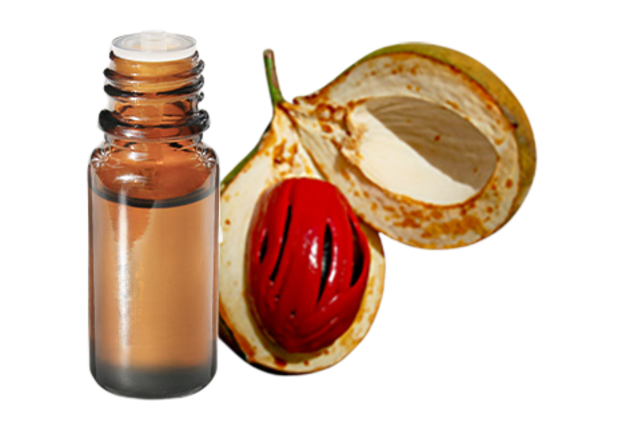
Essential oil of Nutmeg

Generally stimulating, Nutmeg essential oil awakens the body and mind. Nutmeg essential oil restores and refocuses vital energies. Nutmeg is also traditionally used to stimulate digestion. Rich in calming active ingredients, Nutmeg essential oil is traditionally found in soothing formulas to support muscle and joint health.

Features

Properties and uses

Precautions

Find out more

Features

Production process

Complete steam distillation

Part of the plant extracted

Nuts

Botanical name

Myristica fragrans

Warning

The properties, information and methods of use below are quotes from reference books or websites on aromatherapy, hydrolatherapy and phytotherapy. This general information is provided for informative purposes only and in no way constitutes medical guidance. Under no circumstances can this information be used as a substitute for a medical diagnosis, consultation or follow-up, nor can it incur our liability. We recommend that you consult the guide to essential oils before using them, so that you are aware of any precautions that need to be taken. If in doubt, consult a doctor before using essential oils.

Properties and uses

Nutmeg essential oil is traditionally used for: Fatigue, exhaustion

Health

Beauty

Find out more

Properties

In terms of health, nutmeg essential oil is renowned for the following benefits:

  • Rich in analgesic active ingredients that help to relieve pain

  • Analgesic, pain-relieving

  • Stimulates digestion; relieves gas

  • Emmenagogue: induces and regulates periods, promotes childbirth

  • Rich in antiseptic and pest repellent active ingredients

Uses

It is traditionally used to improve the following issues:

  • Digestive problems: poor digestion, intestinal infections, diarrhoea, etc.

  • Acute and chronic rheumatism, sprains, muscle aches, dental pain

  • Raynaud's disease

Synergies

Digestive health: Coriander, Cumin and Caraway essential oils.

In practice

Digestive health: Mix into your oil blend. Massage or rub the mixture into the abdomen.

Digestive comfort: Mix into your dispersible bath preparation. Pour your blend into the hot bath water. Breathe in and relax.

Precautions

  • Not for use by pregnant or breastfeeding women, children under 6, epileptics or the elderly.

  • Limited to occasional use at low doses; not for prolonged use. Stupefying at high doses.

  • Possible hormonal activity; do not use in cases of fibrocystic breast changes or hormone-dependent cancer (breast, ovarian, endometrial).

  • Dermocaustic oil; always use strongly diluted (max 20% for very localised use) on the skin.

  • For diffusion, only use diluted with milder essential oils, max. 5–10%.

  • Keep out of reach of children.

  • Avoid contact with eyes.

  • Certain natural compounds contained in this essential oil may present a risk of allergy in certain sensitive individuals when the essential oil is incorporated into a cosmetic composition (in accordance with the 7th Amendment to the EU Cosmetics Directive (2003/15/EC)): limonene and, to a lesser extent, linalool, (E)-isoeugenol, eugenol.

  • As a general rule, always carry out a test application of your mixture, in the crease of the elbow, at least 48 hours before use.

Find out more

One plant, native to the Maluku Islands in Indonesia, gives us two different spices: Mace (the aril) and Nutmeg (the kernel). The etymology of Mace can be traced to the Latin macir, meaning aromatic bark.

The Egyptians used Nutmeg toembalm mummies.

At the end of the Middle Ages, it was one of the most widely used spices after pepper, known for its digestive and stimulating properties.

It was long coveted in Europe as the most expensive spice.

Equivalents

Essential Oils

1 ml = approximately 35 drops (with our Aroma-Zone dropper caps)

Carrier oils

1 pump (Aroma-Zone aluminium pump) = approx. 0.15 ml

Mass / Volume conversion (for a liquid)

Mass (g) = Density x Volume (ml) at 20°C

Further information

1 full teaspoon = between 3 and 4.5 ml

1 full tablespoon = between 7.5 and 10 ml


However, these spoon ratios depend on a number of factors (e.g. viscosity of the liquid, temperature, depth and size of the spoon, rheological behaviour of the liquid), and we strongly advise you to use precise measuring equipment, such as graduated test tubes, graduated pipettes, and precision scales.

Aromatherapy recipes from the bibliography

EO = Essential Oil VO = Carrier Oil or Macerated Oil

Tomato omelette with essential oils (A. Pataud)

Kitchen

Serves 4 - Preparation: 20 minutes - Cooking time: 10 minutes.

  • 2 tablespoons of olive oil

  • 7 eggs

  • 3 tomatoes

  • Salt and pepper

  • 1 drop of Common sage (or Thyme or Tarragon) essential oil

  • 1 drop of Nutmeg essential oil

Directions: Beat the eggs with the salt, pepper and essential oils. Heat the olive oil in an ovenproof dish, place the sliced, peeled tomatoes on top and cover with the eggs. Place in a hot oven (220 °C - gas mark 6) for 15 minutes, keeping an eye on the colour. The omelette is cooked when almost no liquid is visible. If necessary, cover with baking paper.

Pumpkin soup with sweet orange and nutmeg (A. Pataud)

Kitchen

Serves 6 - Preparation: 15 minutes - Cooking time: 20 minutes.

  • 3 drops of Sweet Orange essential oil (Citrus sinensis)

  • 1 drop of Nutmeg (Myristica fragrans) essential oil

Directions: Add to a finely blended soup for 6 people.

Macarons with pear sorbet and nutmeg (A. Pataud)

Kitchen

Serves 4 - Preparation: 1 hour - Cooking time: 20 minutes

  • 4 egg whites

  • 35 g of caster sugar

  • 170 g of almond powder

  • 300 g of icing sugar

  • 1 L of pear sorbet

  • 1 drop of Nutmeg essential oil

  • (you can also replace the Nutmeg essential oil with Cinnamon bark essential oil)

Directions: Preheat the oven to 250 °C (gas mark 8).

Mix the icing sugar and powdered almonds to obtain a very fine powder. Whisk the egg whites until stiff, then add the caster sugar and essential oil while continuing to whisk.

Gently fold in the icing sugar and powdered almonds. If necessary, colour the batter pink with food colouring. Place a sheet of baking paper on a baking tray. Make 4 cm diameter circles of batter, spacing them well apart. Leave to rest for 1/4 hour at room temperature. Place in the oven and turn down to 180 °C (gas mark 6). Bake for about 15 minutes, leaving the door ajar. Leave the macarons to cool on the baking tray.

Arrange a macaron in the centre of a plate, top with a quenelle of pear sorbet, then place a second macaron on top.

Spicy fresh fruit salad (A. Pataud)

Kitchen

Serves 4 - Preparation: 25 minutes - Cooking time: 15 minutes - Infusion time: 2 hours

  • 3 oranges

  • 2 pink grapefruits

  • 1 mango

  • 1 Victoria pineapple

  • 1 lemon

  • 1 lime

  • 1 papaya

  • 40 g of caster sugar

  • 130 ml of orange juice

  • 30 ml of lemon juice

  • 1 tablespoon of acacia honey

  • 1 vanilla pod

  • 1 drop of Star Anise essential oil

  • 1 drop of Nutmeg essential oil

  • 1 drop of Cinnamon bark essential oil

  • (you can also replace the spice essential oils with citrus essential oils)

Directions: Peel the oranges, grapefruits and lemons. Cut into quarters. Peel the mango and papaya, and peel the pineapple. Cut into strips. Place the orange juice, caster sugar, split vanilla pod, orange juice and lemon juice in a saucepan. Bring to the boil. Remove from the heat and leave to infuse for two hours. Strain. Add the essential oils mixed with a tablespoon of acacia honey, stirring well. Mix the juice with the fruit.

Bibliography

1

'Huiles essentielles - 2000 ans de découvertes aromathérapeutiques pour une médecine d'avenir'

Dominique Baudoux

2

'The Practice Of Aromatherapy'

Dr Jean Valnet - Éditions Maloine

3

'L'Aromathérapie exactement'

P. Franchomme and Dr D. Pénoël

4

'La bible de l'aromathérapie'

Nerys Purchon

5

'L'ABC des huiles essentielles'

Dr Telphon

6

'Aromatherapy'

Nelly Grosjean

7

'Les huiles essentielles pour votre santé'

G. Roulier

8

"Les cahiers pratiques de l'aromathérapie française - Pédiatrie"

Dominique Baudoux - Editions Amyris

9

Aroma-News newsletters

the NARD association

10

'Aromatherapy - Healing with essential oils'

Dominique Baudoux - Editions Amyris

11

'Aroma-Stress'

Dr Jean-Pierre Willem

12

'La cuisine aux huiles essentielles - Des recettes saines et créatives'

Aymeric Pataud

13

"Plantes, huiles et parfums de beauté"

Marie-Françoise Delarozière and Raymonde Trierweiler