

Guide to essential oils

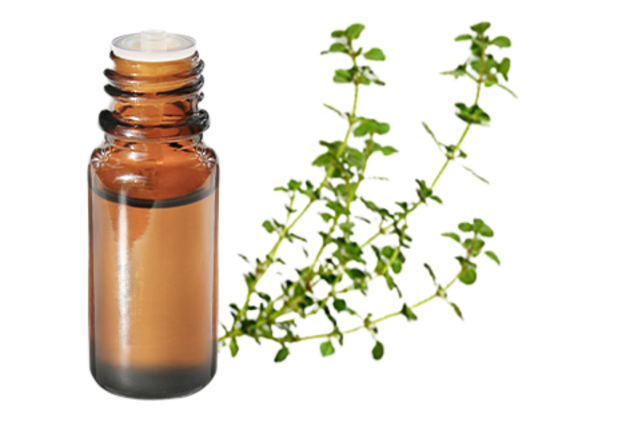
Essential oil of Organic linalool thyme

Very mild, Linalool thyme essential oil is recommended for skin problems. Purifying, Linalool thyme essential oil is renowned as a natural aid for winter infections, particularly sore throats. Supporting health, linalool thyme essential oil is useful in cases of fatigue.

How to use

  • Skin application and massage

    Skin application and massage

    Appropriate

  • Aromatherapy bath

    Aromatherapy bath

    Suitable

  • Diffusion

    Diffusion

    Suitable

  • Food grade

    Food grade

    Suitable

  • Cosmetic active ingredient

    Cosmetic active ingredient

Features

Properties and uses

Precautions

Find out more

Features

Production process

Steam distillation

Part of the plant used

Flowering tops

Botanical name

Thymus vulgaris L. linaloliferum

Warning

The properties, information and methods of use below are quotes from reference books or websites on aromatherapy, hydrolatherapy and phytotherapy. This general information is provided for informative purposes only and in no way constitutes medical guidance. Under no circumstances can this information be used as a substitute for a medical diagnosis, consultation or follow-up, nor can it incur our liability. We recommend that you consult the guide to essential oils before using them, so that you are aware of any precautions that need to be taken. If in doubt, consult a doctor before using essential oils.

Properties and uses

Linalool Thyme essential oil is traditionally used for: sore throats

Health

Beauty

Wellness

Find out more

Properties

Linalool thyme essential oil is recognised for its health benefits:

  • Powerful general anti-infectious, yet gentle on the skin

  • Antiviral and antibacterial

  • Antifungal (Candida albicans)

  • Pest repellent, vermifuge (tapeworms, roundworms, pinworms)

  • General tonic, neurotonic, uterine tonic

Uses

It is traditionally used to improve the following conditions:

  • Respiratory ailments: bronchitis, pharyngitis, coughs

  • Intestinal inflammations: gastritis, enterocolitis, colitis

  • Urinary tract and gynaecological infections

  • Nervous and cerebralfatigue , convalescence

  • Infectious skin diseases, verruca, psoriasis

Synergies

  • Respiratory comfort: essential oils of Eucalyptus radiata, Eucalyptus smithhi, Saro, Ravintsara.

  • Diffusion: essential oils of Eucalyptus, Pine, Rosemary, Cajeput, Lavender.

In practice

Air purification and cleansing : in air diffusion with other essential oils, such as Lemon, Saro, Silver fir, Scots Pine, Gully gum eucalyptus.

Respiratory comfort: blend into your oil blend. Massage or rub your mixture into the chest and upper back.

Skin purification: Mix into your oil blend. Apply your mixture locally, massaging lightly into the area concerned.

Precautions

  • Do not use during pregnancy and breastfeeding.

  • Always use diluted on the skin.

  • Keep out of reach of children.

  • Avoid contact with eyes.

  • Certain natural compounds in this essential oil may pose an allergy risk for sensitive individuals when the oil is used in cosmetic formulations (according to the 7th Amendment to the European Cosmetics Directive (2003/15/EC)): linalool and, to a lesser extent, limonene.

  • As a general rule, always carry out a patch test on the inside of the elbow at least 48 hours before use.

Find out more

The name Thymus comes from the Greek thumon , meaning "perfume", due to thepleasant smell given off by the plant naturally or when burnt.

The ancient Egyptians used thyme to embalm the dead. The Greeks burnt it as an offering to the gods in temples or public squares. At the time, the plant was thought to be a source of courage. They used it to flavour their food and in their baths for its stimulating properties. The Romans used it in cosmetics, to purify their homes and to flavour cheeses and liqueurs.

Aromatherapy recipes from the bibliography

EO = Essential Oil VO = Carrier Oil or Macerated Oil

"Tone thyme" oily skin care blend (D. Maria)

BeautyFacial skincare

Crew CO2 Blend 25 drops

  • 50 drops Lavender Essential Oil
  • 25 drops Cypress Essential Oil
  • 25 drops Rosemary verbenone Essential Oil
  • 20 drops Linalool thyme Essential Oil
  • 15 drops Sandalwood Essential Oil
  • 6 drops Lemon Essential Oil
  • 6 drops tea tree Essential Oil

Directions and use: Mix the ingredients, dilute the resulting mixture to 0.5% in a neutral base (cream, gel, etc.) and apply as a treatment for oily, acne-prone skin.

"Balancing act" skin care blend for normal to combination skin (D. Maria)

BeautyFacial skincare

Crew CO2 Blend 30 drops

  • 50 drops Lavender Essential Oil
  • 25 drops Geranium Essential Oil
  • 20 drops Myrtle Essential Oil
  • 15 drops tea tree Essential Oil
  • 15 drops Cypress Essential Oil
  • 15 drops Linalool thyme Essential Oil
  • 6 drops Sandalwood Essential Oil
  • 5 drops Ylang Essential Oil

Directions and use: Mix the ingredients, dilute the resulting mixture to 0.5% in a neutral base (cream, gel, etc.) and apply as a treatment for normal to combination skin.

Mask for oily hair (A. Brochier)

BeautyHair & nail care

  • 2 tablespoons Grape seed oil
  • 5 tablespoons Green Clay
  • A few drops of rose hydrosol to dilute the mixture
  • 2 drops Thyme Essential Oil

Directions: Mix well to obtain a creamy paste that is neither too liquid nor too thick.

Use: Apply to scalp and hair, leave on for at least 20 minutes, then rinse thoroughly and shampoo.

Equivalents

Essential Oils

1 ml = approximately 35 drops (with our Aroma-Zone dropper caps)

Carrier oils

1 pump (Aroma-Zone aluminium pump) = approx. 0.15 ml

Mass / Volume conversion (for a liquid)

Mass (g) = Density x Volume (ml) at 20°C

Further information

1 full teaspoon = between 3 and 4.5 ml

1 full tablespoon = between 7.5 and 10 ml


However, these spoon ratios depend on a number of factors (e.g. viscosity of the liquid, temperature, depth and size of the spoon, rheological behaviour of the liquid), and we strongly advise you to use precise measuring equipment, such as graduated test tubes, graduated pipettes, and precision scales.

Bibliography

1

'Huiles essentielles - 2000 ans de découvertes aromathérapeutiques pour une médecine d'avenir'

Dominique Baudoux

2

'The Practice Of Aromatherapy'

Dr Jean Valnet - Éditions Maloine

3

"Aromatherapy exactly"

P. Franchomme and Dr D. Pénoël

4

'La bible de l'aromathérapie'

Nerys Purchon

5

'L'ABC des huiles essentielles'

Dr Telphon

6

'Aromatherapy'

Nelly Grosjean

7

'Les huiles essentielles pour votre santé'

G. Roulier

8

'Les cahiers pratiques de l'aromathérapie française - Pédiatrie'

Dominique Baudoux - Editions Amyris

9

Aroma-News newsletters

NARD Association

10

'Aromatherapy - Healing with essential oils'

Dominique Baudoux - Editions Amyris