
Guide to essential oils

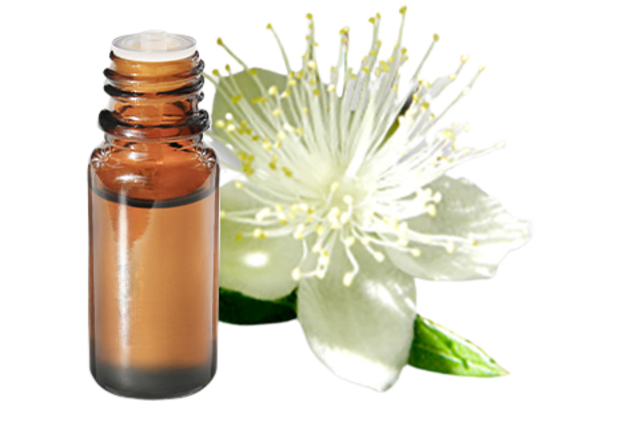
Essential oil of Red myrtle

Rich in myrtenyl acetate, Red Myrtle essential oil is traditionally renowned for its antispasmodic properties. Red Myrtle essential oil contains circulatory active ingredients known to help restore lightness to the legs. Purifying, Red Myrtle essential oil is also reputed to make breathing easier.

How to use

  • Skin application and massage

    Skin application and massage

    Suitable

  • Aromatherapy bath

    Aromatherapy bath

    Appropriate

  • Diffusion

    Diffusion

    Suitable

  • Food grade

    Food grade

    Possible but not recommended

  • Cosmetic active ingredient

    Cosmetic active ingredient

    Appropriate

Features

Properties and uses

Precautions

Find out more

Features

Production process

Complete steam distillation

Part of the plant used

Leaves and stems

Botanical name

Myrtus communis L. myrtenylacetatiferum

Warning

The properties, information and methods of use below are quotes from reference books or websites on aromatherapy, hydrolatherapy and phytotherapy. This general information is provided for informative purposes only and in no way constitutes medical guidance. Under no circumstances can this information be used as a substitute for a medical diagnosis, consultation or follow-up, nor can it incur our liability. We recommend that you consult the guide to essential oils before using them, so that you are aware of any precautions that need to be taken. If in doubt, consult a doctor before using essential oils.

Properties and uses

Red Myrtle essential oil is traditionally used for: Heavy legs, varicose veins

Health

Find out more

Properties

Red myrtle essential oil is recognised for its health benefits:

  • Venous and lymphatic decongestant

  • Antispasmodic

  • Expectorant

  • Purifying

Uses

It is traditionally used in the following situations:

  • Spasmodic stomach aches, spasmodic enterocolitis

  • Congestion of the respiratory tract: bronchitis, sinusitis, chesty coughs

  • Painful periods, cramps, aches and pains

  • Heavy legs, varicose veins

In practice

Air purification and purification: Atmospheric diffusion.

Light legs, circulatory comfort: Mix in your oil blend. Rub or apply your mixture locally to the legs.

Mix into your oil blend. Massage or rub your mixture into the solar plexus and stomach.

Precautions

  • Not recommended for pregnant women (especially during the first three months of pregnancy) or nursing mothers.

  • Not recommended for children under 6 years of age.

  • Keep out of reach of children.

  • Avoid contact with eyes.

  • Certain natural compounds contained in this essential oil may present a risk of allergy for certain sensitive individuals when the essential oil is incorporated into a cosmetic composition (in accordance with the 7th Amendment of the European Cosmetics Directive (2003/15/EC)): limonene and, to a lesser extent, linalool.

  • As a general rule, always test your product in the crease of the elbow at least 48 hours before use.

Find out more

Many legends have long associated Myrtle with love and beauty in the Mediterranean basin. In Greek and Roman mythology, it was associated with the goddess of love, Aphrodite or Venus, and newly-weds wore Myrtle wreaths on their wedding day. This custom is still found in some Mediterranean regions.

Equivalents

Essential Oils

1 ml = approximately 35 drops (with our Aroma-Zone dropper caps)

Carrier oils

1 pump (Aroma-Zone aluminium pump) = approx. 0.15 ml

Mass / Volume conversion (for a liquid)

Mass (g) = Density x Volume (ml) at 20°C

Further information

1 full teaspoon = between 3 and 4.5 ml

1 full tablespoon = between 7.5 and 10 ml


However, these spoon ratios depend on a number of factors (e.g. viscosity of the liquid, temperature, depth and size of the spoon, rheological behaviour of the liquid), and we strongly advise you to use precise measuring equipment, such as graduated test tubes, graduated pipettes, and precision scales.

Aromatherapy recipes from the bibliography

EO = Essential Oil VO = Carrier Oil or Macerated Oil

Nervous asthma (D. Festy)

Health & wellbeingRespiratory problems

  • Lavender essential oil: 1 ml

  • Hyssop essential oil: 1 ml

  • Red Myrtle essential oil: 1 ml

  • Mandarin essential oil: 1 ml

  • Calophylla oil: 30 ml Qsp

Use: Massage the back, thorax and spine with this oil 2 to 3 times a day in the case of asthma (prevention), every 1/2 hour in the case of an attack, until complete improvement.

Note from Aroma-Zone: Mandarin essential oil is photosensitising. Do not expose yourself to the sun after applying this preparation.

Allergic and nervous asthma (D. Baudoux)

Health & wellbeingRespiratory problems

  • Tarragon essential oil: 2 ml

  • Lemon Verbena essential oil: 1 ml

  • Red Myrtle essential oil: 1 ml

  • American Wintergreen essential oil: 1 ml

  • Mandarin essential oil: 2 ml

Use: 6 drops of the mixture applied locally to the chest and upper back even before the onset of an asthma attack and during the asthma attack. Repeat every 30 minutes until complete improvement.

Note from Aroma-Zone: Mandarin and Sweet Verbena essential oils are photosensitising. Do not expose yourself to the sun after applying this preparation.

Bronchitis (chesty cough) (D. Festy)

Health & wellbeingRespiratory problems

  • Red Myrtle essential oil: 1 drop

  • Ravintsara essential oil: 1 drop

  • Sweet Inula essential oil: 1 drop

  • Calophylla OIL: 3 drops

Use: Massage the chest and back with this mixture 4 times a day for 10 days.

Chesty cough (L. Bosson)

Health & wellbeingRespiratory problems

Internal use :

  • Blue Gum Eucalyptus hydrosol: 50 ml

  • Red Myrtle hydrosol: 50 ml

  • Scots Pine hydrosol: 50 ml

Procedure: Heat the mixture with 200 g of brown sugar until simmering. When the mixture is lukewarm, add the following essential oils:

  • Sweet fennel essential oil: 3 drops

  • Lemon zest essential oil: 2 drops

  • Peppermint essential oil: 2 drops

  • Red Myrtle essential oil: 5 drops

  • Rosewood essential oil: 5 drops

  • Tea tree essential oil: 5 drops

Directions for use : 1 teaspoon of the mixture 3 to 4 times a day, depending on how the condition is progressing. Store the syrup in the fridge.

Difficulty falling asleep in adults (J-P. Willem)

Health & wellbeingNerve pain and disorders

  • Ravintsara essential oil: 2 drops

  • Red Myrtle essential oil: 2 drops

  • Lemon Verbena essential oil: 2 drops

Use: Apply this mixture to the solar plexus, 1/2 hour before bedtime, for 15 days.

Note from Aroma-Zone: Scented Verbena essential oil is photosensitising. Do not expose yourself to the sun after applying this preparation.

Bibliography

1

'L'aromathérapie exactement'

P. Franchomme and Dr D. Pénoël

2

'L'aromathérapie - Se soigner par les huiles essentielles' - Editions Amyris

Dominique Baudoux

3

'Les cahiers pratiques de l'aromathérapie française - Dermatologie' - Editions Amyris

Dominique Baudoux