
Guide to essential oils

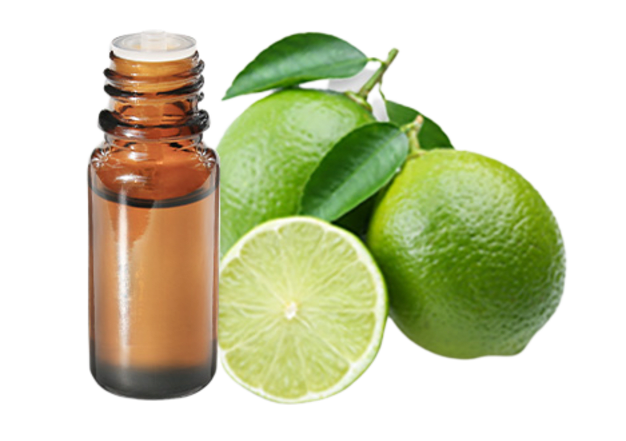
Essential oil of Organic lime

Lime essential oil replenishes, rebalances and refocuses your vital energies. Lime essential oil is reputed to combat stress and tension and is also traditionally used to boost low morale. Its tangy, fresh and invigorating scent is very popular.

How to use

  • Skin application and massage

    Skin application and massage

    Appropriate

  • Cosmetic active ingredient

    Cosmetic active ingredient

    Appropriate

  • Diffusion

    Diffusion

    Suitable

  • Food grade

    Food grade

    Suitable

  • Aromatherapy bath

    Aromatherapy bath

    Possible but not recommended

Features

Properties and uses

Precautions

Find out more

Features

Production process

Cold pressed

Part of the plant used

Zest (fruit pericarp)

Botanical name

Citrus aurantifolia

Chemotype

limonene, gamma-terpinene

Odour

Fresh, lemony, tangy, with slightly sweet and bitter notes

Warning

The properties, information and methods of use below are quotes from reference books or websites on aromatherapy, hydrolatherapy and phytotherapy. This general information is provided for informative purposes only and in no way constitutes medical guidance. Under no circumstances can this information be used as a substitute for a medical diagnosis, consultation or follow-up, nor can it incur our liability. We recommend that you consult the guide to essential oils before using them, so that you are aware of any precautions that need to be taken. If in doubt, consult a doctor before using essential oils.

Properties and uses

Lime essential oil is traditionally used for: Insomnia and stress

Health

Beauty

Wellness

Kitchen

Find out more

Properties

Lime essential oil is recognised for its health benefits:

  • Anti-inflammatory

  • Anti-spasmodic

  • Anti-coagulant

Uses

It is traditionally used to improve the following conditions:

  • Inflammatory and spasmodic enterocolitis

  • Risk of cardiovascular issues

  • Aphonia

In practice

Air purification: atmospheric diffusion.

Precautions

  • Photosensitising oil, do not expose to sunlight or UV rays for at least 8 hours after application.

  • Irritant in its pure state, use well diluted for all skin applications.

  • Not recommended during the first three months of pregnancy.

  • Keep out of reach of children.

  • Avoid contact with the eyes.

  • Certain natural compounds contained in this essential oil may present a risk of allergy in certain sensitive individuals when the essential oil is incorporated into a cosmetic composition (according to the 7th Amendment of the European Cosmetics Directive (2003/15/EC)): limonene and, to a lesser extent, citral (geranial and neral), benzyl benzoate, linalool.

  • As a general rule, always test your product in the crease of the elbow at least 48 hours before use.

  • For use as a cosmetic ingredient, please refer to the specific precautions.

Find out more

Originally from India or Malaysia, limes then began to spread around the Mediterranean and to America. Although not as rich in vitamin C as lemon, the British used it on their ships as a remedy against scurvy, earning them the nickname "Limeys".

Aromatherapy recipes from the bibliography

EO = Essential Oil VO = Carrier Oil or Macerated Oil

Aphonia (T. Telphon)

Health & wellbeingVarious

  • Green Helichrysum (Helichrysum italicum) essential oil
  • Lime essential oil (Citrus aurantifolium)
  • Lemon verbena (Lippia citriodora) essential oil

Directions and use: Mix 1 drop of each essential oil in half a glass of warm water (37°) and gargle for 1 to 2 minutes. Repeat this treatment 2 or 3 times a day

.

Equivalents

Essential Oils

1 ml = approximately 35 drops (with our Aroma-Zone dropper caps)

Carrier oils

1 pump (Aroma-Zone aluminium pump) = approx. 0.15 ml

Mass / Volume conversion (for a liquid)

Mass (g) = Density x Volume (ml) at 20°C

Further information

1 full teaspoon = between 3 and 4.5 ml

1 full tablespoon = between 7.5 and 10 ml


However, these spoon ratios depend on a number of factors (e.g. viscosity of the liquid, temperature, depth and size of the spoon, rheological behaviour of the liquid), and we strongly advise you to use precise measuring equipment, such as graduated test tubes, graduated pipettes, and precision scales.

Bibliography

1

'L'aromathérapie exactement'

P. Franchomme and Dr D. Pénoël

2

'La cuisine aux huiles essentielles - Des recettes saines et créatives'

Aymeric Pataud

3

'L'ABC des huiles essentielles'

Dr Telphon

4

'La cuisine aux huiles essentielles - Des recettes saines et créatives'

Pataud A. (2004), Editions Ambre.

5

6

7

A. Erligmann (2013), 'Créer ses cosmétiques et parfums bio: 30 recettes faciles et gourmandes à base d'huiles essentielles',

Eugen Ulmer Editions