
Guide to essential oils

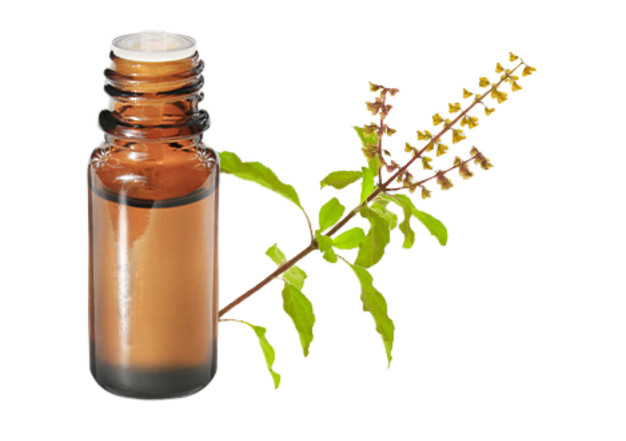
Essential oil of Holy Basil

Holy Basil essential oil is traditionally recommended for combating skin problems. Useful for mature skin, Holy Basil essential oil is also known as a powerful anti-ageing active ingredient. Highly energising, Holy Basil essential oil is renowned for its stimulating effects on the body and mind.

How to use

  • Skin application and massage

    Skin application and massage

    Suitable

  • Cosmetic active ingredient

    Cosmetic active ingredient

    Suitable

  • Aromatherapy bath

    Aromatherapy bath

    Appropriate

  • Diffusion

    Diffusion

    Suitable

  • Food grade

    Food grade

    Possible but not recommended

Features

Properties and uses

Precautions

Find out more

Features

Production process

Complete steam distillation

Part of the plant used

Leaves

Botanical name

Ocimum sanctum or Ocimum tenuiflorum

Warning

The properties, information and methods of use below are quotes from reference books or websites on aromatherapy, hydrolatherapy and phytotherapy. This general information is provided for informative purposes only and in no way constitutes medical guidance. Under no circumstances can this information be used as a substitute for a medical diagnosis, consultation or follow-up, nor can it incur our liability. We recommend that you consult the guide to essential oils before using them, so that you are aware of any precautions that need to be taken. If in doubt, consult a doctor before using essential oils.

Properties and uses

Holy Basil Essential Oil is traditionally used for: Acne, spots, fatigue, exhaustion, immunity (stimulating), intestinal worms

Health

Beauty

Wellness

Find out more

Properties

Holy basil essential oil is recognised for its health properties:

  • Helps strengthen the immune system.

  • Studies show that it can help regulate blood triglyceride , sugar and cholesterol levels .

  • Antioxidant

  • Anti-infective : antibacterial, antiviral, antiparasitic and antifungal.

  • Analgesic and antispasmodic

Uses

It is traditionally used to improve the following conditions:

  • Cholesterol, diabetes, excess triglycerides

  • Infections of the respiratory tract

  • Muscle or joint pain:

Cramp

Muscle strain

Arthritis, osteoarthritis

Rheumatism

  • Intestinal parasites, fungal infections

  • Purification of rooms

  • Skin abscesses, acne

Synergies

  • Action on the immune system: essential oils of Black Spruce, Ravintsara, Cistus, Fragonia

  • Helps regulate blood parameters (sugar, lipids): Garlic, carrot essential oils

  • Purifying for the skin: Palmarosa and Laurel essential oils

  • Intestinal cleansing: Clove, Chinese or Ceylon cinnamon essential oils

  • Skin with blemishes :

Purifying action: tea tree essential oil

Sebo-regulating action: Rosemary cineole and True lavender essential oils.

Precautions

  • Caution for sensitive skin: this essential oil contains eugenol. Use in low doses in skin care products (max 1% in cosmetic preparations).

  • Do not use during pregnancy or breastfeeding, or on children under 6 years of age.

  • For internal use only in limited doses and for limited periods. Do not use for prolonged periods without medical advice.

  • Internal use may have blood-thinning effects. Do not use orally if you have a coagulation disorder, are taking anticoagulant medication or before surgery.

  • There may be interactions with certain drugs, such as pethidine, or certain antidepressants (in particular monoamide oxidase inhibitors and selective serotonin reuptake inhibitors). For all internal use, ask your doctor for advice.

  • Keep out of reach of children.

  • Avoid contact with eyes.

  • Certain natural compounds contained in this essential oil may present a risk of allergy in certain sensitive individuals when the essential oil is incorporated into a cosmetic composition (according to the 7th Amendment of the European Directive on cosmetic products (2003/15/EC)): eugenol and, to a lesser extent, geraniol, citronnellol, linalool, citral (neral and geranial), limonene.

  • As a general rule, always test-apply your mixture in the crease of the elbow at least 48 hours before use.

Find out more

Tulsi Basil is a variety of Basil sacred in India and honoured in Ayurvedic medicine.

Dedicated to Vishnu and Krischna, Tulsi Basil strengthens faith, the capacity for enthusiasm, compassion and spiritual clarity. It owes its name 'Tulsi', in French 'incomparable', to Krishna's lover, who was transformed into a plant.

A symbol of protection and strength, it is customary in India, in the event of death, to give it to the deceased.

Equivalents

Essential Oils

1 ml = approximately 35 drops (with our Aroma-Zone dropper caps)

Carrier oils

1 pump (Aroma-Zone aluminium pump) = approx. 0.15 ml

Mass / Volume conversion (for a liquid)

Mass (g) = Density x Volume (ml) at 20°C

Further information

1 full teaspoon = between 3 and 4.5 ml

1 full tablespoon = between 7.5 and 10 ml


However, these spoon ratios depend on a number of factors (e.g. viscosity of the liquid, temperature, depth and size of the spoon, rheological behaviour of the liquid), and we strongly advise you to use precise measuring equipment, such as graduated test tubes, graduated pipettes, and precision scales.

Bibliography

1

Comparative Study of Volatile Compounds from Genus Ocimum

S. Raseetha Vani, S.F. Cheng and C.H. Chuah

2

Antioxidant Activity and Lipid-Lowering Effect of Essential Oils Extracted from Ocimum sanctum L. Leaves in Rats Fed with a High Cholesterol Diet

Thamolwan Suanarunsawat, Watcharaporn Devakul Na Ayutthaya, Thanapat Songsak, Suwan Thirawarapan, and Somlak Poungshompoo

3

Characterization of the volatile pattern and antioxidant capacity of essential oils from different species of the genus Ocimum.

Trevisan MT, Vasconcelos Silva MG, Pfundstein B, Spiegelhalder B, Owen RW.

4

Anti-hyperglycemic and anti-hyperlipidemic effect of dietary supplement of white Ocimum sanctum Linn.

Suanarunsawat T., Songsak T.

5

Antifungal activities of Ocimum sanctum essential oil and its lead molecules

Khan A, Ahmad A, Manzoor N, Khan LA.

6

Chemical composition, antifungal and antiaflatoxigenic activities of Ocimum sanctum L. essential oil and its safety assessment as plant based antimicrobial. Food and Chemical Toxicology

Ashok Kumar, Ravindra Shukla, Priyanka Singh and Nawal Kishore Dubey

7

Anticandidal effect of Ocimum sanctum essential oil and its synergy with fluconazole and ketoconazole Phytomedecine

K. Amber, A. Aijaz, X. Immaculata, K.A. Luqman and M. Nikhat

8

ANTIMICROBIAL ACTIVITIES OF ESSENTIAL OILS OBTAINED FROM FRESH AND DRIED LEAVES OF OCIMUM SANCTUM (L.) AGAINST ENTERIC BACTERIA AND YEAST ISHS

S. Mondal, S.C. Mahapatra, B.R. Mirdha, S.N. Naik

9

Anthelmintic activity of essential oil of Ocimum sanctum and eugenol.

Asha MK, Prashanth D, Murali B, Padmaja R, Amit A.

10

Evaluation of in vitro antimicrobial activity of Thai basil oils and their micro-emulsion formulas against Propionibacterium acnes International journal of cosmetic science

VIYOCH J.; PISUTTHANAN N.; FAIKREUA A.; NUPANGTA K.; WANGTORPOL K.; NGOKKUEN J

11

Acetylcholinesterase Inhibitory Activity and Chemical Composition of Commercial Essential Oils Journal of agricultural and food chemistry

DOHI Satomi; TERASAKI Masanori; MAKINO Masakazu

12

'L'aromathérapie énergétique; guérir avec l'âme des plantes' - Editions Amyris

L. Bosson