
Guide to essential oils

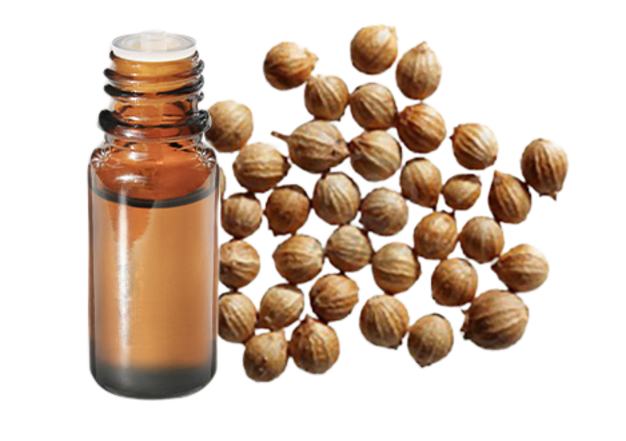
Essential oil of Coriander

Coriander essential oil is traditionally reputed to aid digestion. Tonic and purifying, Coriander essential oil is used as a memory stimulant and to combat physical and mental fatigue. Powerful, Coriander essential oil brings an unrivalled fragrance to your dishes.

How to use

  • Skin application and massage

    Skin application and massage

    Appropriate

  • Food grade

    Food grade

    Suitable

Features

Properties and uses

Precautions

Find out more

Features

Production process

Steam distillation

Part of the plant used

Seeds

Botanical name

Coriandrum sativum

Warning

The properties, information and methods of use below are quotes from reference books or websites on aromatherapy, hydrolatherapy and phytotherapy. This general information is provided for informative purposes only and in no way constitutes medical guidance. Under no circumstances can this information be used as a substitute for a medical diagnosis, consultation or follow-up, nor can it incur our liability. We recommend that you consult the guide to essential oils before using them, so that you are aware of any precautions that need to be taken. If in doubt, consult a doctor before using essential oils.

Properties and uses

Coriander Essential Oil is traditionally used for : Aerophagia, bloating and flatulence, heartburn , constipation and poor digestion.

Health

Wellness

Kitchen

Find out more, etc.

Properties

Coriander essential oil is renowned for the following health benefits:

  • Digestive tonic

  • Antibacterial

  • Antiviral

  • Antifungal

  • Pain relief

Uses

In addition to treatments, it is traditionally recommended in the following cases:

  • Digestive problems: bloating, aerophagia, gas, indigestion, slow digestion, etc.

  • Rheumatic and jointpain , osteoarthritis

  • Viral and bacterial infections of the respiratory and digestive tracts, urinary tract infections

In practice

To soothe joints: Mix into your oil blend. Lightly massage the mixture into the affected area.

Digestive comfort: Mix with your oil blend. Massage or rub the mixture into the abdomen.

Precautions

  • Keep out of reach of children.

  • Do not use during the first 3 months of pregnancy

  • Not for regular or long-term internal use unless prescribed by a therapist.

  • Possible "progesterone-like" effect, to be taken into account, particularly in the case of hormonal treatment.

  • Certain natural compounds contained in this essential oil may present a risk of allergy for certain sensitive individuals when the essential oil is incorporated into a cosmetic composition (in accordance with the 7th Amendment of the European Directive on cosmetic products (2003/15/EC)): limonene, linalool, geraniol.

  • As a general rule, always test-apply your mixture in the crease of the elbow at least 48 hours before use.

Find out more

The origin of Coriander is uncertain. It grows wild in the Near East and southern Europe, hence the comment: " It is difficult to define exactly where this plant is wild and where it has only recently become established".

A few dried mericarps have been found in the Nahal Hemar cave in Israel, which may be the oldest archaeological evidence of Coriander (around 6,000 BC).

Equivalents

Essential Oils

1 ml = approximately 35 drops (with our Aroma-Zone dropper caps)

Carrier oils

1 pump (Aroma-Zone aluminium pump) = approx. 0.15 ml

Mass / Volume conversion (for a liquid)

Mass (g) = Density x Volume (ml) at 20°C

Further information

1 full teaspoon = between 3 and 4.5 ml

1 full tablespoon = between 7.5 and 10 ml


However, these spoon ratios depend on a number of factors (e.g. viscosity of the liquid, temperature, depth and size of the spoon, rheological behaviour of the liquid), and we strongly advise you to use precise measuring equipment, such as graduated test tubes, graduated pipettes, and precision scales.

Aromatherapy recipes from the bibliography

EO = Essential Oil VO = Carrier Oil or Macerated Oil

Colitis, enterocolitis, enteritis in adults (on medical advice) (D. Baudoux)

Health & wellbeingBacterial, viral and parasitic infections

Applied to the skin as a complement to oral treatment

  • Foeniculum vulgare var.dulce essential oil (Sweet fennel): 3 ml

  • Cumimum cymimum essential oil (Cumin): 2 ml

  • Melaleuca alternifolia essential oil (tea tree): 5 ml

  • Artemesia dracunculus essential oil(Tarragon): 5 ml

  • Coriandrum sativum essential oil (Coriander): 3 ml

  • Hazelnut oil (or transcutol): 30 ml to make up the balance

Use : 10 drops 4 times a day on the stomach and lower back for 5 to 7 days.

Aroma-Zone comment: Transcutol is a little-used pharmaceutical preparation which allows fats such as essential oils to penetrate the skin easily. It can easily be replaced by a dry carrier oil such as Hazelnut, Kukui or Macadamia oil.

Stomach cramps (T. Telphon)

Health & wellbeingDigestive problems

  • Common Juniper essential oil

  • Sweet Coriander carrieroil

  • Sweet Fennel essential oil

Use : Take 1 drop of each essential oil with your meal, either in a dessert spoon of olive oil or lavender honey, or simply in a piece of breadcrumbs. Repeat this treatment 1 or 2 times a day.

Digestive disorders (N. Grosjean)

Health & wellbeingDigestive problems

  • Caraway essential oil: 9 ml

  • Nutmeg essential oil: 6 ml

  • Coriander essential oil: 4 ml

  • Cumin essential oil: 1 ml

Use : Dilute the mixture in a little carrier oil and rub 5 drops into the stomach and abdomen after a meal.

Poor digestion - Hepatobiliary disorders (T. Telphon)

Health & wellbeingDigestive problems

Local treatment:

  • Juniper essential oil: 2 ml

  • Mandarin essential oil: 2 ml

  • Coriander essential oil: 2 ml

  • St John's wort: 30 ml

  • Olive oil: 30 ml

Use: Gently massage into the plexus and the liver and pancreas area. Repeat 1 to 2 times during the day if necessary.

Aroma-Zone Note: St John's wort macerated oil presents a risk of photosensitisation. Do not expose yourself to the sun after applying this mixture.

Oral treatment:

  • Juniper essential oil: 1 drop

  • Sweet Fennel essential oil: 1 drop

  • Coriander essential oil: 1 drop

Use: Take one drop of each essential oil in a dessert spoon of olive oil or honey or in a few breadcrumbs. Repeat this treatment 1 to 2 times a day.

Gastritis (T. Telphon)

Health & wellbeingDigestive problems

Local treatment:

  • Juniper essential oil: 2 ml

  • Sweet Fennel essential oil: 2 ml

  • Coriander essential oil: 2 ml

  • St John's wort oil: 30 ml

  • Olive oil: 30 ml

Use: Gently massage the plexus and surrounding area in a clockwise direction. Repeat 1 or 2 times during the day if necessary.

Aroma-Zone Note: St John's wort macerated oil presents a risk of photosensitisation. Do not expose your skin to the sun after applying this mixture.

Infectious colitis (on medical advice) (D. Festy)

Health & wellbeingDigestive problems

  • Tarragon essential oil: 2 ml

  • Coriander essential oil: 1 ml

  • Lavandin super essential oil: 1 ml

  • Peppermint essential oil: 1 ml

  • Marjoram essential oil: 2 ml

  • St John's wort oil: 3 ml

Use: Apply 6 to 10 drops of this mixture in circular massages on the stomach and lower back, 4 times a day for 5 to 7 days.

Aroma-Zone Note: St John's wort macerated oil presents a risk of photosensitisation. Do not expose yourself to the sun after applying this mixture.

Constipation (D. Baudoux)

Health & wellbeingDigestive problems

  • Tarragon essential oil: 2 drops

  • Maritime Pine essential oil (Turpentine): 1 drop

  • Mandarin essential oil: 2 drops

  • Coriander essential oil: 1 drop

Use: 2 drops 3 times a day before meals on 1/4 lump of cane sugar or in a teaspoon of olive oil for 5 to 7 days. Repeat as required.

Bibliography

1

'Huiles essentielles - 2000 ans de découvertes aromathérapeutiques pour une médecine d'avenir'

Dominique Baudoux

2

'The Practice Of Aromatherapy'

Dr Jean Valnet - Éditions Maloine

3

'L'Aromathérapie exactement'

P. Franchomme, R. Jollois and D. Pénoël

4

'La bible de l'aromathérapie'

Nerys Purchon

5

'L'ABC des huiles essentielles'

Dr Telphon

6

'Aromatherapy'

Nelly Grosjean

7

'Les huiles essentielles pour votre santé'

G. Roulier

8

"Les cahiers pratiques de l'aromathérapie française - Pédiatrie"

Dominique Baudoux - Editions Amyris

9

Aroma-News newsletters from the NARD association

10

"L'aromathérapie - Se soigner par les huiles essentielles"

Dominique Baudoux - Editions Amyris

11

'La cuisine aux huiles essentielles - Des recettes saines et créatives'

Aymeric Pataud

12

Cuisinons avec les huiles essentielles. Des trésors de saveurs et de vitalité. Editions Anagramme

Davy O. and Fayolle M. (2007)

13

Culinary Essential Oils. Plants, Natural Flavours, Recipes. Edisud.

Erligmann A. (2009)

14

Essential oils, Vegetable oils, Aromatic plants in the art of cooking. Editions Amyris.

Ortega J.P. (2006)

15

16

17