
Guide to essential oils

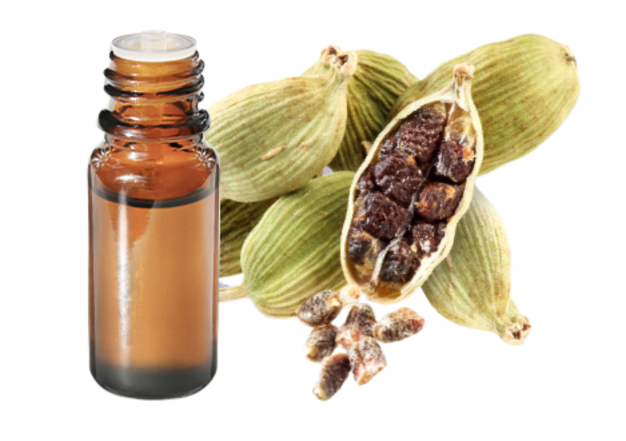
Essential oil of Cardamom

A staple of Ayurvedic tradition, Cardamom essential oil was used to relieve digestive discomfort and stimulate the appetite. Cardamom essential oil is known to combat bad breath. Spicy and balsamic, Cardamom essential oil is also reputed to clear the respiratory tract.

How to use

  • Skin application and massage

    Skin application and massage

    Suitable

  • Food grade

    Food grade

    Suitable

  • Diffusion

    Diffusion

    Possible but not recommended

  • Aromatherapy bath

    Aromatherapy bath

    Possible but not recommended

  • Cosmetic active ingredient

    Cosmetic active ingredient

    Possible but not recommended

Features

Properties and uses

Precautions

Find out more

Features

Production process

Complete steam distillation

Part of the plant used

Seeds

Botanical name

Elletaria cardamomum

Warning

The properties, information and methods of use below are quotes from reference books or websites on aromatherapy, hydrolatherapy and phytotherapy. This general information is provided for informative purposes only and in no way constitutes medical guidance. Under no circumstances can this information be used as a substitute for a medical diagnosis, consultation or follow-up, nor can it incur our liability. We recommend that you consult the guide to essential oils before using them, so that you are aware of any precautions that need to be taken. If in doubt, consult a doctor before using essential oils.

Properties and uses

Cardamom essential oil is traditionally used for: Chesty coughs

Health

Kitchen

Find out more, etc.

Properties

Cardamom essential oil is renowned for the following health benefits:

  • Digestive, effective carminative

  • Helpseliminate gas

  • Anticatarrhal, powerful expectorant

  • Rich in anti-infectious active ingredients

  • Antispamodic

Uses

It is traditionally used to improve the following situations:

  • Digestive system: poor digestion, dyspepsia, bloating, aerophagia, flatulence, spasmodic colitis, intestinal cramps, verminosis, etc.

  • Bad breath

  • Respiratory: catarrhal bronchitis, chesty coughs

Synergies

  • Respiratory health: Eucalyptus radiata, Ravintsara, Pine and Fir essential oils

  • Diffusion: Lemon, Pine essential oils

In practice

Respiratory comfort: blend into your oil blend. Massage or rub your blend into the chest and upper back.

Digestive health: mix into your oil blend. Massage or rub your mixture into the abdomen.

Air purification, respiratory health: for use in air diffusers.

Precautions

  • Not to be used during the first 3 months of pregnancy or by children under the age of 3.

  • For internal use only for a short period and on therapeutic advice.

  • Keep out of reach of children.

  • Avoid contact with eyes.

  • Certain natural compounds contained in this essential oil may present a risk of allergy for some sensitive individuals when the essential oil is incorporated into a cosmetic composition (in accordance with the 7th Amendment to the European Cosmetics Directive (2003/15/EC)): linalool, limonene and, to a lesser extent, citral (neral and geranial).

  • As a general rule, always test-apply your mixture in the crease of the elbow at least 48 hours before use.

Find out more

Throughout the ages and in different religions, the'Angel Seed' is said to have been commonly used to purify certain dishes offered as offerings to the deities. In India and Pakistan, cardamom seeds are still offered to the gods during religious festivals.

Equivalents

Essential Oils

1 ml = approximately 35 drops (with our Aroma-Zone dropper caps)

Carrier oils

1 pump (Aroma-Zone aluminium pump) = approx. 0.15 ml

Mass / Volume conversion (for a liquid)

Mass (g) = Density x Volume (ml) at 20°C

Further information

1 full teaspoon = between 3 and 4.5 ml

1 full tablespoon = between 7.5 and 10 ml


However, these spoon ratios depend on a number of factors (e.g. viscosity of the liquid, temperature, depth and size of the spoon, rheological behaviour of the liquid), and we strongly advise you to use precise measuring equipment, such as graduated test tubes, graduated pipettes, and precision scales.

Aromatherapy recipes from the bibliography

EO = Essential Oil VO = Carrier Oil or Macerated Oil

Intestinal bloating (T. Telphon)

Health & wellbeingDigestive problems

Local treatment:

  • 2 ml Cumin essential oil

  • 2 ml Peppermint essential oil

  • 2 ml Cardamom essential oil

  • 30 ml St John's wort oil

  • 30 ml Olive oil

Use: Massage into the stomach in a clockwise direction. Repeat 1 or 2 times a day if necessary.

Note from Aroma-Zone: St John's wort macerated oil presents a risk of photosensitisation. Do not expose your skin to the sun after applying this preparation.

Mycoses of the digestive tract (T. Telphon)

Health & wellbeingDigestive problems

  • 1 drop Cumin essential oil

  • 1 drop of Peppermint essential oil

  • 1 drop of Cardamom essential oil

Local treatment: Use: Pour 1 drop of each essential oil into half a glass of hot water (37°), mix well and then rinse your mouth for about 1 to 2 minutes. Repeat 2 or 3 times a day.

Oral treatment: Use: 1 drop of each essential oil at mealtime in a teaspoonful of olive oil or honey or in a little breadcrumbs. Repeat this treatment 2 or 3 times a day.

Bibliography

1

'Huiles essentielles - 2000 ans de découvertes aromathérapeutiques pour une médecine d'avenir'

Dominique Baudoux

2

'The Practice Of Aromatherapy'

Dr Jean Valnet Éditions Maloine

3

'L'aromathérapie exactement'

P. Franchomme and Dr D. Pénoël

4

'La bible de l'aromathérapie'

Nerys Purchon

5

'L'ABC des huiles essentielles'

Dr Telphon

6

"Aromatherapy"

Nelly Grosjean

7

"Les huiles essentielles pour votre santé"

G. Roulier

8

"Les cahiers pratiques de l'aromathérapie française - Pédiatrie"

Dominique Baudoux - Editions Amyris

9

Aroma-News newsletters from the NARD association

10

'Aromatherapy - Healing with essential oils'

Dominique Baudoux

11

"Essential oils"

Dr Jean-Pierre Willem

12

'Plantes, Huiles et Parfums de Beauté - Secrets et Recettes'

Marie-Françoise Delarozière and Raymonde Treirweiler

13

'Aroma Family'

Dr Jean-Pierre Willem

14

"Aroma Stress"

Dr Jean-Pierre Willem

15

"Aroma Slimming"

Dr Jean-Pierre Willem

16

"Essential oils and skin care"

Marie-Claire Laparé

17

La cuisine aux huiles essentielles - Des recettes saines et créatives

Aymeric Pataud

18

'Cuisiner avec les huiles essentielles et les eaux florales'

Emmanuel and Valérie Cupillard

19

"Guide to natural beauty "

Josephine Fairley

20

"Treatise on phytotherapy and aromatherapy - Volume 2 infectious diseases".

Paul Belaiche

21

"Les cahiers pratiques de l'aromathérapie selon l'école française - Dermatologie"

Dominique Baudoux and Dr Abdesselam Zhiri - Editions Amyris

22

"Huiles essentielles chémotypées et leurs synergies"

Dominique Baudoux and Dr Abdesselam Zhiri

23

"Phytothérapie & Aromathérapie - Comment soigner les maladies infectieuses par les plantes"

Dr J. Valnet, Dr C. Duraffourd and Dr J.C. Lapraz

24

"Saveurs et bien-être - la cuisine aux huiles essentielles"

Nathalie Le Foll and Beatriz Da Costa

25

"Le formulaire d'aromathérapie pratique pour le prescripteur et le conseil pharmaceutique"

Dominique Baudoux

26

"Les huiles végétales - Huiles de santé et de beauté"

Chantal and Lionel Clergeaud - Editions Amyris

27

28

29

30